
WPG Americas and the Holding Company That Competes With Itself
WPG Americas ranks No. 3 in electronics per MDM's 2026 Top Distributors list, 18 years after founding, backed by a parent built to out-compete itself.
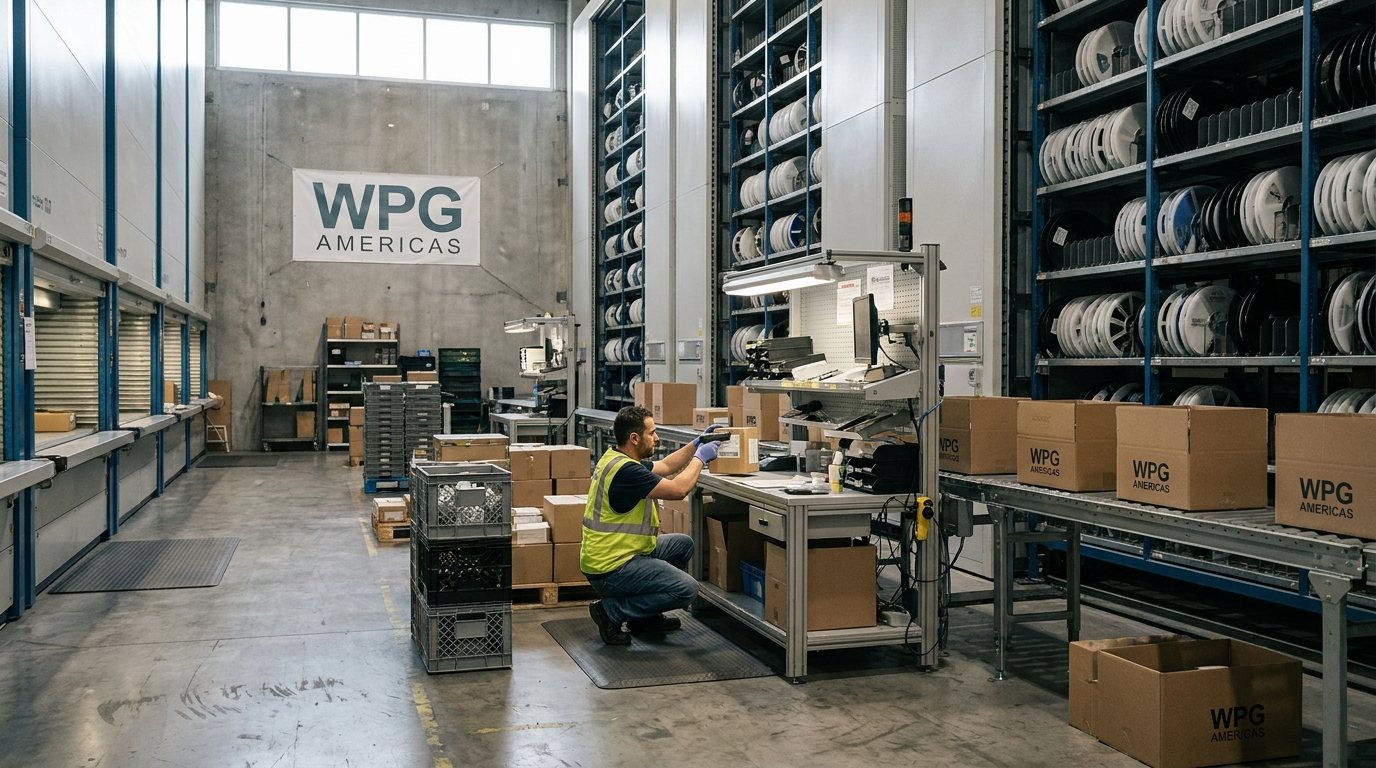
Part of Distributor Playbooks — strategy teardowns of every company on the MDM Top Distributors lists.
WPG Americas placed third in electronics on Modern Distribution Management's 2026 Top Distributors list, the annual accounting of North America's largest distributors across 20 verticals. That is a strong finish for a company that did not exist until November 2007, entering a component-distribution market that American mega-distributors had owned for generations. The explanation is not a scrappy-startup story. It is that WPG Americas is the US-facing tip of a Taiwanese holding company built on a structural idea almost nobody else in electronics distribution uses.
A young brand, an old fight
Founded in San Jose in 2007, WPG Americas Inc. (WPGA) is a member of WPG Holdings, a Taipei-listed distributor (TSE:3702) that calls itself the largest electronics distributor in the Asia-Pacific region. WPG Holdings put its 2024 revenue at $27.4 billion in the press materials WPGA distributes to media, up from the $21.55 billion the parent reported for 2023 — roughly 5,000 staff across 75 sales offices worldwide, franchising close to 250 supplier lines. WPGA is that global machine's chosen vehicle for cracking a US semiconductor-distribution market long dominated by a small number of entrenched American names. Eighteen years is not long to go from zero to a top-three electronics ranking on MDM's list. It only makes sense once you look at how the parent is built.
The insight: a holding company designed to compete with itself
WPG Holdings does not run one distribution brand. Its own literature describes operating through four separate, competing component-distribution groups — WPIg, SACg, AITg and YOSUNg — each signing its own supplier franchises and running its own sales force. That is unusual. Arrow and Avnet each sell under one name. WPG Holdings deliberately keeps multiple brands under one roof, letting them chase competing chip lines and even competing customers, while sharing the parent's balance sheet, logistics network and capital behind the scenes.
The commercial logic is straightforward once you say it out loud: semiconductor suppliers often refuse to grant the same distributor two competing product lines, or two suppliers refuse to sit inside the same sales channel. A single mega-brand runs into that ceiling constantly. A holding company with four legally distinct distributor brands does not — it can hold franchises that would otherwise conflict, simply by housing them in different subsidiaries. WPG Holdings calls this coexistence "co-opetition" in its own materials, and it has let the group represent far more of the supplier universe than one brand could alone. WPG Americas is that model's newest limb: rather than clone all four Asian brands in the US, the parent built one dedicated North American entity and pointed its balance sheet at it.
Winning narrow, not broad
WPGA has not tried to out-scale Arrow or Avnet on breadth. It organizes itself around four solution areas — AIoT, embedded computing, lighting and power, and memory and storage — and backs them with an in-house Innovation Technical Center staffed by applications engineers who work design-in problems across those categories before a socket is even won. That is a bet on depth over catalog size: fewer categories, more engineering hours per design, and a supplier-relationship style built for co-development rather than pure box-moving. It's the same playbook value-added distributors have chased for decades, but WPGA is running it with a $27-billion parent's balance sheet and Asian supply-chain relationships behind it, which is a different cost structure than a scrappy regional player trying the same trick.
The 2025 line-card sprint
That technical focus shows up in what WPGA signed in 2025 alone. It added Credo for high-speed optical and copper connectivity aimed at data-center buildouts, indie Semiconductor for automotive semiconductors, MemryX for an AI-powered industrial compute box built on Advantech's UNO platform, and closed the year with XMOS for intelligent IoT system-on-chip designs. Four supplier wins in twelve months, all clustered around data-center interconnect, automotive silicon, and edge AI compute — the exact categories where design-in support matters more than shelf inventory. That is not a broad-line distributor restocking its catalog. It's a technical specialist stacking bets on where semiconductor demand is actually growing.
The trade-off worth naming
The same structure that gives WPGA its edge also caps its independence. Its capital, its strategic direction, and its supplier-negotiation leverage all run back through Taipei. A holding company built to hold multiple competing brands can move fast when a category gets hot, as the 2025 signings show, but a US subsidiary inside that architecture will always be executing someone else's global portfolio strategy rather than setting its own. For a distributor whose whole pitch to suppliers is technical depth and design partnership, that's a real tension: the deeper WPGA gets into any one customer relationship, the more that relationship's fate depends on decisions made an ocean away.
Distribution rankings like MDM's measure revenue and rank, but the real story sits underneath: the catalogs, the branch networks, the supplier line cards and the unglamorous plumbing that decides which components actually reach the engineers who need them.