All comparisons
Works with apollonPIM platforms

Anglera + apollon

The bottom line

Keep apollon OMN as the PIM, DAM and workflow hub that approves product content and publishes it to shops, marketplaces and print. Add Anglera to fill the attribute values first, read from supplier documents with a citation on each, and written back through OMN's REST API into your existing approval workflow.

apollon and Anglera solve different halves of the problem — this page is about the seam between them.
The frame for this comparison

Product data is a practice, not a project.

apollon OMN decides who touches a product record and in what order; Anglera is the standing practice that fills each value from the supplier's own documents and hands it to that workflow with the source attached.

01

Ground it

Mine every spec from every source.

Every value traced to a document you can open. The catalog is only as honest as what it was built from.

02

Align it

Aim the catalog at the buyer who actually buys.

Grounded data still loses if it answers questions nobody asked. Alignment is what turns specs into conversion.

03

Keep it alive

Product data is a practice, not a project.

Markets move, suppliers reissue, buyers change what they ask for. A catalog that is right in March is wrong by August unless something is watching.

Capability by capability

Where apollon stops.

Scored against public documentation. Grouped by the three acts — so you can see which ones apollon leaves on your desk.

01

Ground it

Mine every spec from every source.
Source mining
Where does it get specs from?
apollonLimited

Supplier onboarder, ERP imports, image text; PDF extraction not documented

AngleraYes

PDFs, spec tables, drawings, manuals, images, sites

Schema discovery
Does it find attributes that aren't in your schema yet?
apollonYour team

Team defines attributes and classifications; no proposals documented

AngleraYes

Proposes fields your schema never had

Governed vocabulary
Does it turn messy free-text into a governed pick list?
apollonLimited

BMEcat, ETIM and ECLASS value mapping; team maintains it

AngleraYes

Normalizes and governs allowed values, versioned

Taxonomy & classification
Can it classify every SKU into your hierarchy?
apollonLimited

Classifications plus marketplace connector; Accelerator automates classification

AngleraYes

Auto-classifies; channel and marketplace mapping

Citations & provenance
Can you see where any given value came from?
apollonLimited

Workflow processes documented; per-value source citation not documented

AngleraYes

Every value cites its source doc and page

02

Align it

Aim the catalog at the buyer who actually buys.
Buyer personas
Is the content written for your buyer, or generically?
apollonLimited

AI Text drafts per channel; persona model not documented

AngleraYes

B2B specifier and B2C shopper enriched differently

Review, search & social signals
Does it learn what buyers ask from the live market?
apollonYour team

Review and search signal intake not documented; team-led

AngleraYes

Reviews, search, competitor rails, social — fed back

Copy & SEO
Does it write original, channel-ready copy?
apollonYes

AI Text drafts channel copy from attributes; AI Translate

AngleraYes

Original copy per persona and channel

Product imagery
Can it produce usable images for SKUs that lack them?
apollonLimited

AI retouching and crops; Companion creates variants and scenes

AngleraYes

Generates studio-grade imagery for photoless SKUs

03

Keep it alive

Product data is a practice, not a project.
Continuous re-enrichment
What happens when the market moves after go-live?
apollonYour team

Workflows generate task lists; team does the re-enrichment

AngleraYes

Re-enriches on its own after go-live

Quality scoring
Does it score its own output and track catalog health?
apollonYes

Quality analyses and maturity check for channel readiness

AngleraYes

Scored against your standards; nothing publishes below bar

Write-back
Does enriched data land back in your system of record?
apollonYes

Publishes to shops, marketplaces, print; ERP interfaces

AngleraYes

Writes back to PIM, ERP, warehouse, commerce

API, MCP & webhooks
Can your own tools and agents drive it headlessly?
apollonYes

Documented REST API, n8n and Zapier, MCP server in OMN 7

AngleraYes

API, webhooks, and MCP servers

Who does the work
Does it do the work, or help your team do it?
apollonYour team

Software platform; your team defines approvals and does the work

AngleraYes

Anglera owns the work; review is a guardrail

KeyYesships itLimitedlimited or gatedYour teamyour team still does itNodoesn't do itAnglera differentiator
What “buyer signals” actually means

Six signals sitting in your market right now.

“Buyer signals” is the emptiest phrase in this category, so here is the literal thing. Each of these is an observation from a live market, the gap it exposes, and the field that gets created as a result.

Review signal·Product reviews on a building-supplies retailer's webshop

"Used the 10 mm nylon plugs for a wall cabinet in an aerated concrete wall. Two pulled out within a week. Pack just says 'universal'."

The record carries diameter, length and screw size, but not which base materials the fixing is assessed for. That information sits in the manufacturer's European Technical Assessment, so buyers learn it after the cabinet comes down.

Field createdapproved_base_materials (per fixing, with the matching load class where the assessment gives one)Normal concrete (cracked / non-cracked) | Solid brick | Perforated brick | Aerated concrete | Solid sand-lime | Plasterboard — taken from the ETA or manufacturer's technical data sheet, not the pack front.
Search signal·Internal site search on an electrical wholesaler's B2B storefront

Installers search "led panel 600x600 ugr19 4000k" and "panel ugr<19 ra90" and get every 600 mm panel in the range, because glare rating and colour rendering only appear in the photometric PDF.

Office lighting specs are written against glare and colour rendering limits, but neither value is a structured field, so there is nothing to filter on and nothing for a tender spreadsheet to match.

Field createdunified_glare_rating plus colour_rendering_indexUGR as the declared upper bound (<16, <19, <22, <25) per the manufacturer's photometric data; CRI as integer Ra (80, 90, 95). Source is the luminaire datasheet or LDT/IES file, not the catalogue headline.
Marketplace signal·DIY marketplace feed (insulation category required fields)

A range of EPS and PIR insulation boards is rejected on a required reaction-to-fire field. The record says "flame retardant"; the manufacturer's declaration of performance states the Euroclass.

Fire behaviour exists as a marketing adjective rather than a classified value, so the channel field has nothing to receive and the listings wait while someone opens each declaration by hand.

Field createdreaction_to_fire_class (EN 13501-1), with the declaration of performance reference stored alongsideEuroclass A1, A2, B, C, D, E, F with smoke (s1–s3) and droplet (d0–d2) subclasses where declared; source is the declaration of performance, cited by document number and page.
Why catalogs rot

Approved is not the same as traceable

apollon's own Digital Product Passport guidance says a passport needs structured, traceable information, and that teams should identify sources, assign responsibilities and define how changes are reviewed. OMN covers the last two well: workflows assign tasks by role, processes are documented, and the maturity check confirms content is ready for its channels. A workflow log is built to record who approved a value and when, not which page of which supplier document it came from. When a manufacturer reissues a declaration of performance with a different fire class, or a datasheet changes a rated load, the approved value stays approved while the source underneath it has moved. Traceability has to live on the value itself, and keeping it current is weekly work: watch for reissued documents, update the affected values with their citations, and send them back through the same OMN approval step.

Messy in, governed out.

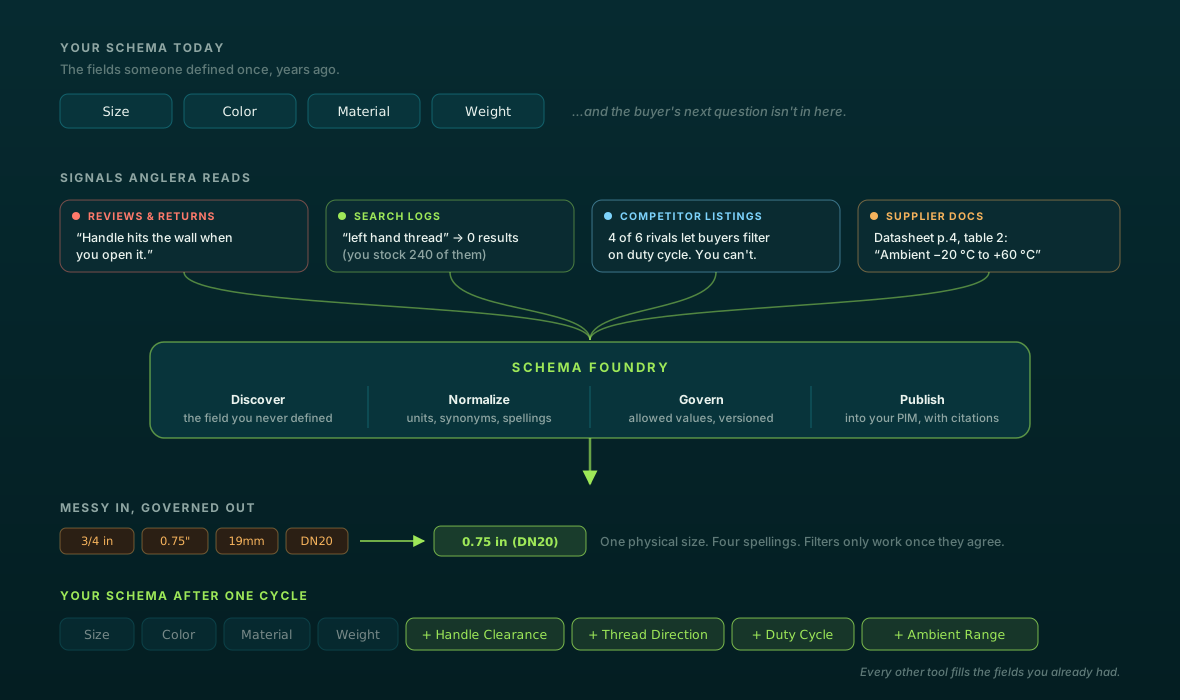
Values are normalized into a governed, versioned set of allowed values — so a filter works, and keeps working after the next import.

Nominal Size
3/4 in0.75"3/4"19mm3/4 inchDN20
0.75 in (DN20)

Six suppliers, six spellings, one physical size. Filters only work once they agree.

Finish
BlkblackBLACK MATTEMatte BlkRAL 9005
Black — Matte

Free text makes a colour filter useless. A governed value makes it a facet.

Material
SS316316 StainlessStainless Steel 316A4 Stainless
Stainless Steel — 316 / A4

Same alloy, four vocabularies, plus a trade name. Buyers search all of them.

And the part nobody else does

We don't just fill the template you handed us.

Filling the fields you defined has an invisible ceiling: a catalog can hit 100% complete and still miss the attribute that loses the sale, because completeness is measured against a schema someone drew years ago. Schema Foundry reads competitor listings, buyer searches, review complaints and your supplier docs, and proposes the fields you never defined — which is where apollon stops.

How Schema Foundry works
Schema Foundry: signals from reviews, search logs, competitor listings and supplier documents reveal attributes missing from your schema; the Foundry discovers, normalizes and governs them, so your schema ends the cycle with more fields than it started with.

What apollon does

apollon is a Pforzheim, Germany software company whose OMN platform combines PIM, DAM, channel management and BPMN-based workflow management on one product data source. It serves retail, mail-order, manufacturing and automotive teams, and publishes to online stores, marketplaces, print catalogues and, with OMN 7, AI assistants via an MCP server.

Pricing: Quote-based. Essential, Professional and Enterprise editions are all priced on request; cost depends on product count, users and modules, with support tiers and add-ons such as marketplace and ERP interfaces billed separately.

apollon website

When apollon is the right call

European retailers, mail-order houses and manufacturers who want PIM, DAM, print catalogue production and BPMN-modeled approval workflows in one platform, hosted in Frankfurt or on their own infrastructure, with ERP connectors for systems like SAP, Dynamics 365, abas and Xentral.

We'd rather tell you here than in month three of an implementation.

Capability verdicts reviewed against apollon's public documentation on October 16, 2026. Vendors ship quickly — if something here is out of date, tell us and we'll correct it.

See it on your own SKUs.

Bring one category and your supplier files. In 30 minutes you'll see it enriched — complete, structured, and consistent enough to launch on — plus the attributes your schema didn't have yet.

Book a demo