
ADI Global Distribution Is Finally Its Own Company
ADI Global Distribution ranks #7 on MDM's 2026 Top Distributors list. After 97 years as a subsidiary, it starts trading independently in August 2026.
Part of Distributor Playbooks — strategy teardowns of every company on the MDM Top Distributors lists.
Three days from now, on July 20, 2026, Resideo Technologies sets the record date for the last corporate maneuver in a 97-year run during which this distributor has never once been its own boss. Modern Distribution Management ranks ADI Global Distribution No. 7 among electrical and electronics distributors on its 2026 Top Distributors list, crediting it with roughly $4.78 billion in FY2025 revenue built on security, residential AV, and an expanding datacom-networking business. What that ranking can't capture is that it's the last one where ADI's scale shows up as a line inside somebody else's annual report. On August 4, 2026, ADI starts trading on the NYSE under its own ticker, ADIG, for the first time in its history.
An alarm shop that became a distribution machine
ADI's lineage runs back to 1929, when Maurice Coleman founded the Alarm Device Manufacturing Company, ADEMCO, in New York to build custom alarm systems, according to the company's own history. ADEMCO went public in 1960 and was bought three years later by Pittsburgh Railway Company, which renamed itself Pittway in 1967. Through the 1980s Pittway kept acquiring smaller alarm and electronics makers, and rather than let a dozen newly acquired sales forces compete with each other, it routed everything through a single distribution arm, ADEMCO Distribution, rebranded ADI in 1987. That one structural decision is the thread that survives every ownership change since: ADI's value was never really the hardware, it was the network that could move anyone's hardware to the installer's truck.
Passed between two industrial parents
Honeywell bought Pittway, and ADI with it, in 2000 to bulk up its home and building controls business, then used the channel to push into Europe and Canada with the Gardiner Groupe acquisition in 2006 and Burtek in 2007. For eighteen years ADI was a captive distribution engine inside a conglomerate many times its size, useful and profitable but not something Honeywell ever broke out as its own investment case. That changed in 2018, when Honeywell spun ADI, along with its home-controls manufacturing businesses, into a new standalone company called Resideo Technologies, which began trading as NYSE: REZI that October.
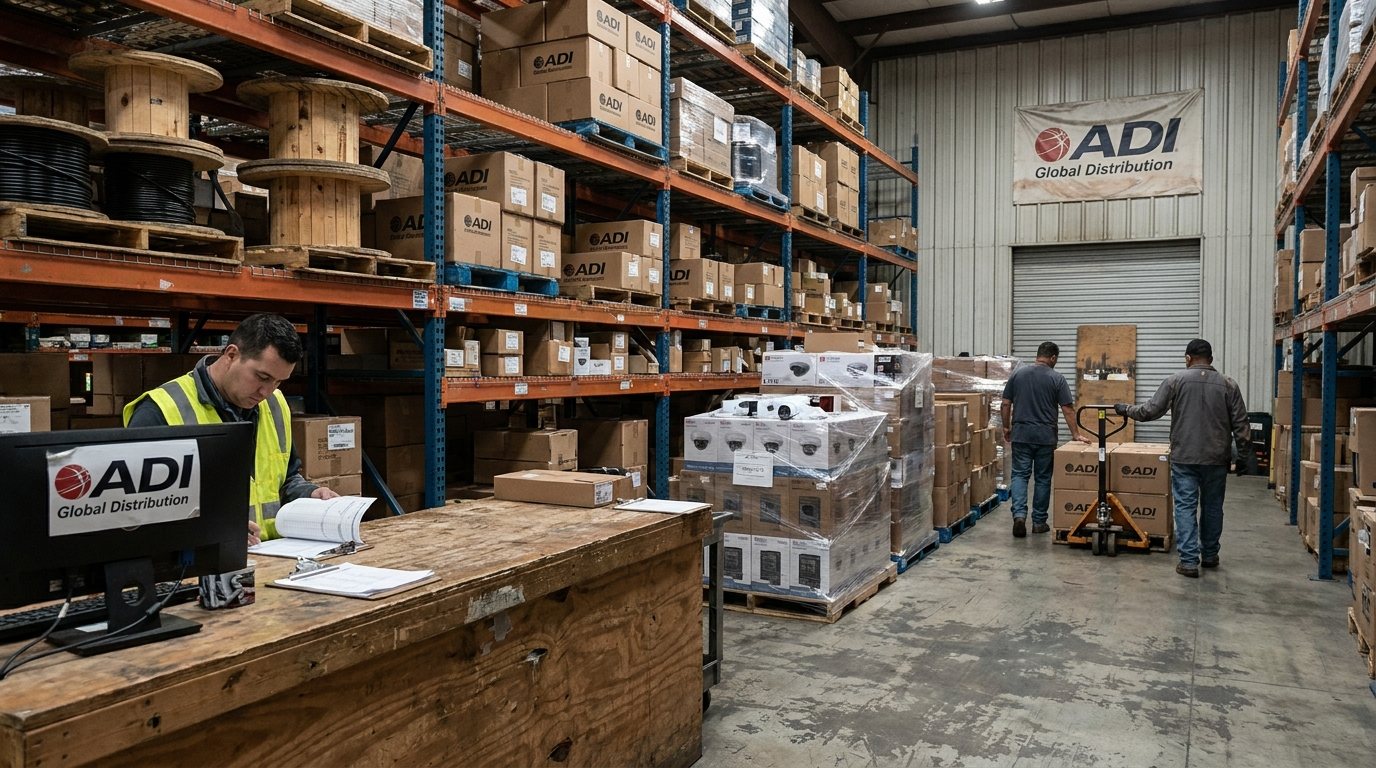
Except "standalone" undersold it. Resideo was a manufacturer's ticker with a distributor stapled inside it. Resideo's identity to investors was Honeywell Home thermostats and security sensors; ADI just happened to be the channel Resideo also owned for selling everyone else's networking, AV, and security gear alongside its own hardware. Today that channel runs on real scale: more than 100,000 customers, 500,000-plus SKUs from over 1,000 brands, a footprint of 190-plus locations worldwide, and house labels of its own — Araknis in networking, Control4 in whole-home automation, Access Networks, Clare and Clare Vision in security, OvrC in remote device management — sold through branch counters and e-commerce alike, per ADI's own site. None of it showed up as a distinct market cap. It showed up as a segment note.
The insight: ADI has never run its own balance sheet
That's the pattern worth naming plainly, because it's easy to miss under the press-release language of "unlocking value." A distribution business that has been ranked in MDM's top tier for years, that clears $4.78 billion and touches a $65 billion North American addressable market, has spent the entirety of its 97-year existence as somebody else's segment: Pittway's, then Honeywell's, then Resideo's. The MDM No. 7 placement this year is the last one earned inside that arrangement. Starting in August, every dollar of growth or shrinkage is ADI's alone to explain.
The financing behind the split makes the moment concrete rather than symbolic. To fund the separation, ADI arranged $400 million in 7.125% senior notes due 2034, a $600 million term loan, and a $500 million revolving credit facility, and used the proceeds to pay a distribution back to Resideo and cover transaction costs, according to reporting on the deal. A company that spent 97 years leaning on a manufacturer's balance sheet now opens its public life carrying real leverage, part of it raised specifically to cut a check to the parent it's leaving. Independence and debt arrived in the same transaction.
What ADI says it will do with the freedom
At back-to-back Investor Days on July 13 and 14, 2026, both companies laid out separate financial frameworks for the first time. ADI's, detailed in trade coverage, targets 4% to 6% revenue growth a year through 2030, pushing toward roughly $6 billion, with adjusted EBITDA growing faster than 10% annually and margins climbing above 8%. The growth plan leans on categories ADI already leads — security, residential AV, fire and life safety — while explicitly calling out ProAV and datacom as where it wants to grow into, alongside an omnichannel push and "strategic tuck-in M&A." Incoming CEO Rob Aarnes, who has run ADI as president since 2018, put it plainly: "ADI has been a leader in specialty distribution with the best talent in the industry and we are looking forward to showcasing our tremendous growth potential as a standalone company."
The tension in the plan
The honest complication is that ADI is choosing to chase its fastest-growing category, datacom-networking, at exactly the moment it loses the cushion of a diversified industrial parent. Tuck-in M&A funded by a balance sheet that now carries $1 billion-plus in fresh debt is a different exercise than tuck-in M&A funded inside a $4-billion manufacturer. The MDM ranking that opened this piece measured ADI as it existed under cover. The one MDM publishes in 2027 will measure something that has never existed before: ADI answering only for itself.
A century of distribution history rarely turns on a single record date, but this one is close. The unglamorous mechanics that built ADI's reputation, branch density, a catalog deep enough to outfit a job site from one order, and the discipline to keep 500,000 SKUs findable, are the same mechanics every distributor in this series lives or dies by.