
The Mid-Market Distributor's AI Org Chart Should Be Mostly Empty
Why a $150M distributor hiring AI engineers or a Chief AI Officer is copying a $1B+ company's org chart it can't afford to run.
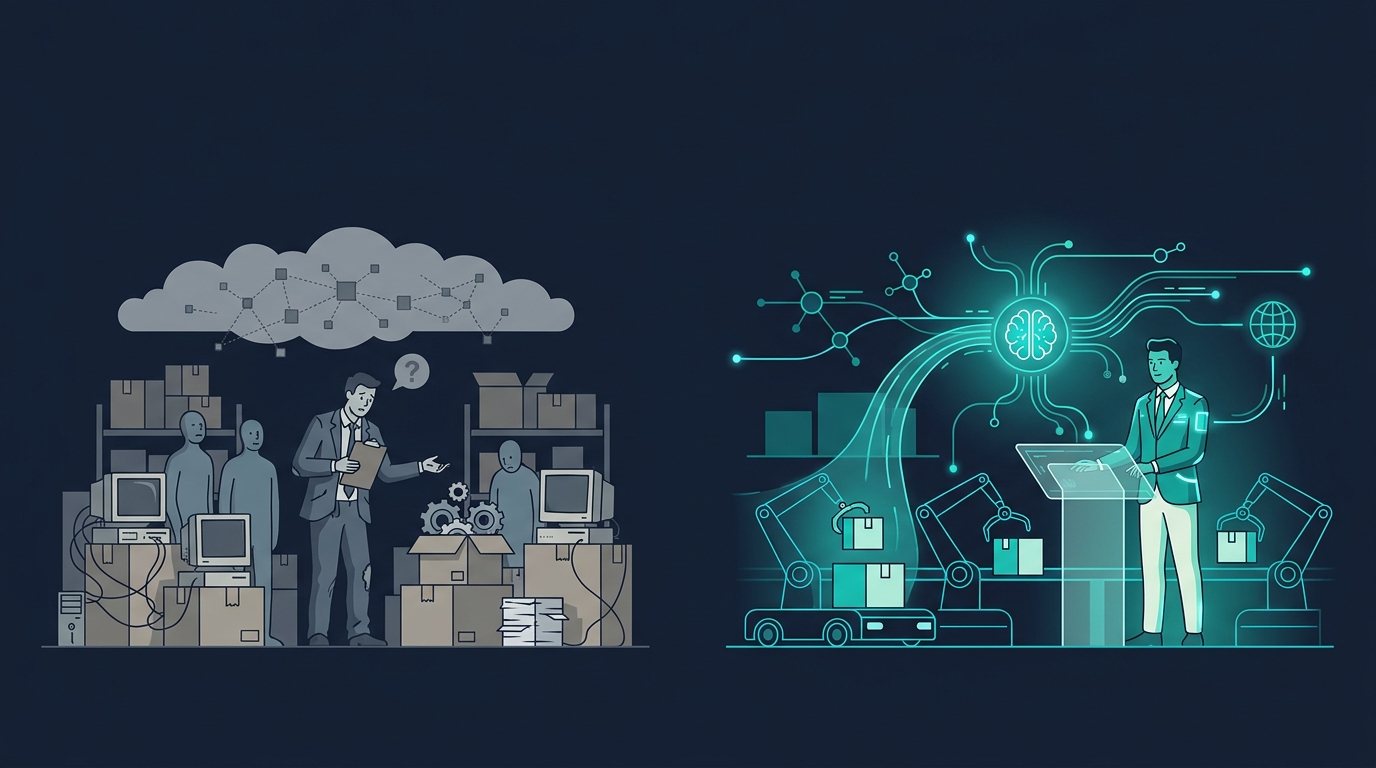
Every distributor with an IT budget line is being told the same thing right now: hire AI talent or fall behind. That advice is correct for companies with a data estate large enough to need governing and a balance sheet that can absorb a $250,000 machine learning engineer as a line item nobody questions. Below roughly $1 billion in revenue, it's a costume. Buy the outcome per workflow, and spend the payroll on the people AI is actually making more valuable.
The talent war is a public-company story
Distribution Strategy Group has documented a real hiring wave: W.W. Grainger posting an "AI Enablement Lead" role at $176,900 to $294,800 a year, Ingram Micro and TD SYNNEX building out AI product and governance functions, machine learning engineers in Chicago clearing $195,000 with seniors well past $250,000. That's not exaggerated. It's also not a story about the median distributor.
Grainger did roughly $17.5 billion in revenue last year. Ingram Micro and TD SYNNEX operate at global technology-distribution scale, with data volumes and system counts that genuinely require someone whose full-time job is model governance. When Distribution Strategy Group's coverage widens to argue distributors broadly are "betting big" on Chief AI Officers, the examples doing the betting are almost always the same handful of public names. The trade press covers what's visible, and what's visible is the top of the industry. The National Association of Wholesaler-Distributors puts total industry revenue at $8.6 trillion, with small and mid-sized firms accounting for roughly 40% of it — thousands of companies that will never see a Grainger-scale AI budget and shouldn't try to run one.
What an AI hire actually does in year one at $150 million
Here's the part the hiring narrative skips: what does that engineer build, once hired?
At a $150 million distributor, the honest answer is usually a pipeline that stitches together a data warehouse, an ETL job, a vector store, and a chat interface — the exact stack a vertical AI vendor already runs in production for a dozen other distributors, priced as a subscription instead of a payroll commitment. The mid-market build-vs-buy math backs this up starkly: vendor-led and co-build AI partnerships succeed roughly 67% of the time, versus about 33% for pure internal builds, a gap driven by talent scarcity and the pace at which foundation models move out from under a homegrown system. Separately, 63% of CFOs cite a lack of qualified internal talent as the biggest obstacle to their GenAI initiatives — which is the same shortage that's driving the six-figure bidding war in the first place. You're not hiring your way out of a scarcity; you're bidding in it, against companies with ten times your budget.
And the broader labor market makes the bid worse every quarter. Demand for AI-skilled workers is running roughly 3.2 times supply across in-demand roles, with a wage premium north of 50% attached to advanced AI skills. A mid-market distributor competing for that talent isn't losing to Grainger on culture or mission. It's losing on money, every time, and it will keep losing on money as long as it insists on competing in that market instead of buying around it.
A title is not a capability
The Chief AI Officer question deserves its own skepticism, separate from the engineer-hiring question. A CAIO's job is to govern a company's data and model estate — but governance requires something to govern: a defined data estate, clean enough and centralized enough that oversight is a real function rather than a slide deck. Most mid-market distributors don't have that. Their product data lives across a legacy ERP, a decade of manufacturer spreadsheets, and whatever a category manager patched together in the last catalog refresh.
Hire a CAIO into that environment and you get, almost by structural default, what governance researchers are now calling the "vanity role" — a title granted without budget authority or a real mandate, the kind that tends to disappear within 18 to 24 months once the board asks what it accomplished. Adoption of the title has exploded — one estimate puts 76% of large organizations as now having a CAIO, up from 26% a year earlier — but a title chasing a trend line isn't the same as a function with something to run.
| Public-company reality | Mid-market reality | |
|---|---|---|
| Data estate | Centralized, high-volume, multi-system | Fragmented across ERP, spreadsheets, one PIM if you're lucky |
| AI hire's year-one job | Governs and scales existing infrastructure | Rebuilds a pipeline a vendor already runs |
| Right buy signal | Build proprietary advantage | Buy the outcome, keep the headcount |
Where the payroll should actually go
None of this means mid-market distributors should sit out AI. It means the org chart entry shouldn't be a headcount line for people who write model code — it should be outcomes bought per workflow, from vendors who specialize in exactly one distribution problem: pricing, forecasting, or product data. What that frees up is payroll for the roles AI makes structurally more valuable rather than obsolete: category managers who can now own three times the SKU count because enrichment stopped eating their week, product-data owners who translate a manufacturer spec sheet into something a search engine and an AI shopping agent can both read, pricing analysts who spend their time on strategy instead of spreadsheet reconciliation.
Anglera's own Top Distributors 2026 index and its underlying Digital Readiness Index methodology measured this directly across 200-plus distributors: readiness — clean catalog data, machine-readable product pages, structured search — tracks operating archetype and discipline, not in-house AI headcount. The distributors scoring well aren't the ones with a Chief AI Officer. They're the ones whose product data is in usable shape, however they got there.
That's the whole case for the empty org chart. Your PIM stores the data; a vendor can do the enrichment work in weeks, not a year of pipeline-building, without a rip-and-replace project or a new C-suite seat. Spend the headcount budget on the people who turn clean data into revenue, and let the AI hiring arms race stay a story about companies ten times your size.