
Core-heavy catalogs: enrich once, then keep pace with releases
Heritage and replenishment brands don't need continuous enrichment. Here's the project-plus-cadence model that fits an 80-90% carryover catalog.

A fast-fashion label might refresh a third of its assortment every six weeks. A workwear brand that has sold the same waxed-canvas jacket since 2011 does not. If your catalog is 80-90% carryover, the enrichment problem you have is not the one most product-data vendors are built to solve. You don't need a system that keeps up with weekly drops. You need one thorough pass over the core line, done right, followed by a light touch that keeps pace with the two or three releases a year that actually change anything.
Most enrichment tooling is priced and designed around churn. It assumes new SKUs constantly, images constantly, a live feed that needs continuous cleanup. That model makes sense for a marketplace seller or a brand launching capsule drops monthly. It's the wrong shape for a boot brand, a knife maker, an appliance line, or a distributor of fasteners and fittings where the bulk of revenue comes from styles that have been in the line for years and will still be in the line next year.
The core catalog is a fixed cost, not a subscription
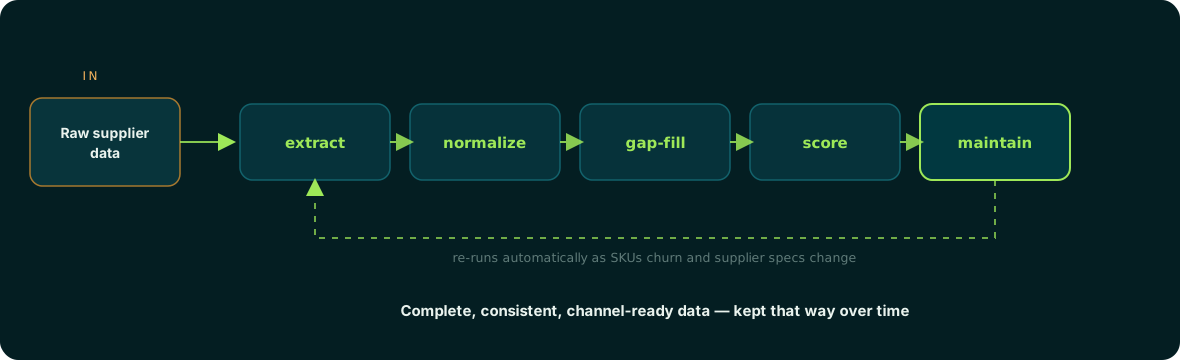
Treat the core catalog as a project, not a service. If 85% of your SKUs are carryover, the enrichment work on that 85% is mostly a one-time normalization exercise: pull every tech pack, spec sheet, and legacy ERP field for those styles, extract the attributes that are missing or buried in free text, reconcile the ones that conflict across systems, and validate against imagery where a spec sheet is silent or wrong. Do it once, thoroughly, and that work holds. A jacket's shell fabric, insulation weight, closure type, and care instructions don't change because a new season started.
This is where the arithmetic works in the brand's favor. Manual enrichment benchmarks run around 30-45 minutes per SKU when someone is opening a tech pack, checking a spec sheet, and typing values into a PIM by hand. For a catalog of 3,000 carryover SKUs, that's 1,500-2,250 hours of skilled labor to do properly, which is why most teams never actually do it properly. They do a rushed pass at launch and never revisit it. Automating extraction and validation against source documents (imagery, spec sheets, existing PIM fields) compresses that timeline from a multi-quarter slog to a project measured in weeks, which is the same 30-day window Anglera targets for a first pass regardless of catalog size, because the work is bounded: it's finite documents against a finite SKU list, not an open-ended stream.
Then a cadence, not a pipeline
Once the core is clean, the ongoing work shrinks to what actually changes: new releases each season, discontinued styles that need to be flagged rather than silently dropped from feeds, and the occasional correction when a source document turns out to be wrong. For a brand with two seasonal drops and 10-15% new-style turnover a year, that's a quarterly or semi-annual enrichment pass on the new SKUs, plus ongoing monitoring for data quality issues as fields drift or get overwritten upstream. That's a fundamentally different cost profile than continuous, real-time enrichment, and it should be priced and staffed like the lighter workload it is.
The mistake heritage brands make here runs in both directions. Some never invest in the deep pass and live indefinitely with thin, inconsistent attributes on their bestsellers because nobody wants to "boil the ocean" for a catalog that isn't changing. Others buy a continuous-enrichment platform sized for a fast-fashion churn rate and pay for capacity they don't use ninety percent of the year. The hybrid model, a project plus a light maintenance cadence, matches spend to how the catalog actually behaves.
The real reason the one-day backfill matters
The most underrated capability in this model isn't the initial pass. It's the ability to add a brand-new attribute across the entire line in a day, months or years after the original enrichment. Planning questions don't stop evolving just because the catalog does. A demand planner six months into using better attribute data will inevitably ask a new question: how does sell-through vary by closure type, by insulation weight band, by country of origin, by a durability rating nobody was tracking last year. If answering that question means a new multi-week enrichment project every time, planning teams stop asking. They revert to guessing, or they build the analysis around whatever attributes happen to already exist rather than the ones that would actually explain the variance.
A catalog that's already been extracted and normalized once, image by image and document by document, is in a very different position than one that's still in free text. Adding a field means re-running extraction against source material already on file and re-validating, not starting from scratch. That's the difference between a planning team that can test a hypothesis this week and one that has to wait a quarter, and it's the actual payoff of doing the deep pass carefully the first time.
Budgeting the hybrid model
The table below is illustrative, not a quote, but it reflects how the cost curve should look for an 80-90% carryover catalog.
| Phase | Scope | Cadence | What it buys |
|---|---|---|---|
| Deep pass | Full core catalog, all attributes | One-time (weeks) | Normalized, validated baseline across every existing SKU |
| Seasonal cadence | New/updated SKUs from each release | Quarterly or semi-annual | Consistency as the line grows, without re-touching carryover |
| Attribute backfill | One new field, all SKUs | As needed, ad hoc | Answers a new planning question without a new project |
| Quality monitoring | Full catalog, spot checks | Ongoing, lightweight | Catches drift, conflicting sources, and stale values |
Budget the first line as a project cost. Budget the second and fourth as a light retainer. Treat the third as a standing option, not a scoped engagement, since the whole point is that it shouldn't require one.
None of this requires ripping out the PIM or ERP the brand already runs. The system of record stays the same; the deep pass and the maintenance cadence both write back into it. For a heritage or replenishment-driven brand, that's the more honest way to think about product data: not as an ongoing subscription to enrichment, but as an asset you build once and keep current, so that whatever question demand planning asks next has an answer already sitting in the data.