
The Catalog Is the New Branch: How Specialists Outgrow Their Geography
A specialist's catalog is the new branch — it scales at content cost, not real-estate cost, and it's leaking share from branch-heavy incumbents.
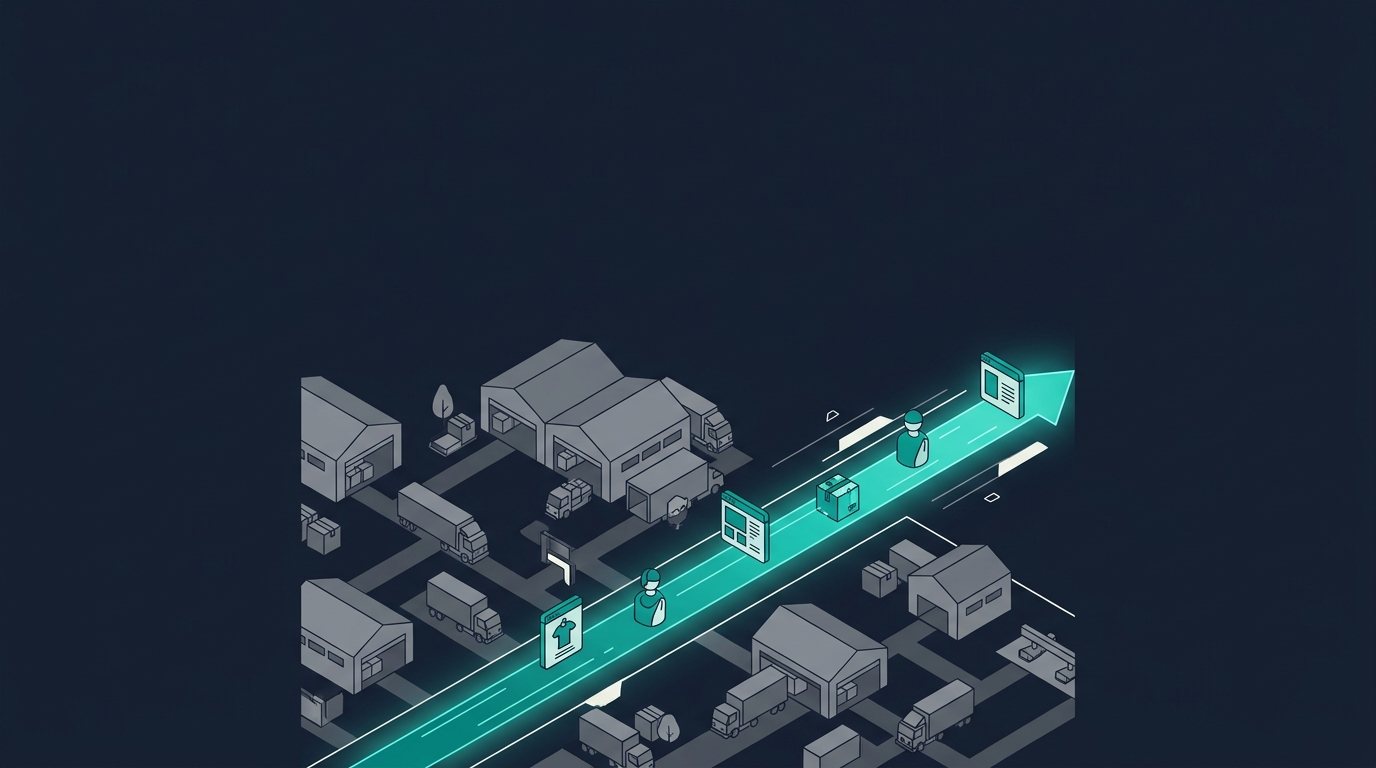
A regional or vertical specialist doesn't need a branch in your territory anymore. It needs a product page that answers a spec question better than your website does, and a shopping cart that doesn't make the buyer call to find out. That's not a hypothesis — it's visible right now in the gap between distributors built to be searched and distributors built to be visited.
The trade press found the symptom
Distribution Strategy Group has been circling this for a year. Its February 2025 conversation with Voomi CEO RJ Cilley described a marketplace aggregating HVAC inventory into what Cilley called a "national sales platform" — giving suppliers "access to new customer segments and regions" without opening a single branch. A month later, DSG's piece on ISA framed digital investment as existential rather than optional. And back in 2022, the same outlet ran the opposite argument — how distributors keep the branch alive in a digital world, treating the branch as the thing worth defending.
Read together, those three pieces describe a pendulum, not a mechanism. DSG is right that something is shifting. It hasn't said why a catalog beats a branch on the specific economics that make the shift durable, or which incumbents are actually exposed. That's the gap this column fills, using our own measurement of 200-plus distributors rather than anecdote.
Out-spec'ing, not out-marketing
The mechanism is simpler than "digital transformation" makes it sound. A specialist with a deep, attribute-complete, findable catalog doesn't need to out-market an incumbent in a new territory — it needs to out-spec it on the one product page a buyer lands on at 9pm trying to confirm a part number before a Monday install. Anglera's Top Distributors 2026 index sorted 200+ distributors into six operating archetypes and then measured — not surveyed, measured, five live product pages per company against a 100-point Digital Readiness Index — and the pattern is stark. DXP Enterprises, a technical specialist, runs its real storefront on a separate domain from its corporate site because the two are architecturally split; its commerce transparency pillar sits at 8.4 of 20. DH Sutherland, an aerospace-adhesives specialist with roughly $8 million in disclosed revenue against distributors a thousand times its size, still manages a 47 DRI score and the second-highest buyer-answerability pillar in its whole archetype — because every product page ends in the same clean "Contact," filterable by manufacturer and type, no login required. That's a company with no branch network at all competing on catalog clarity against distributors with hundreds of locations.
The mechanism generalizes past HVAC and aerospace. B2B buyers now treat a thin product page as a reason to leave. Sana Commerce's 2025 B2B Buyer Report found 75 percent of B2B buyers willing to switch suppliers for a smoother online experience, with incomplete product information as one of the top-cited frustrations. A buyer doesn't need to know your firm exists to defect from it — they need Google, or increasingly an AI shopping agent, to hand them a competitor's page that actually answers the question. That's the market Voomi and ISA are chasing. It's also the market a catalog-native distributor like DigiKey or a well-run technical specialist like DH Sutherland is already winning without calling it a growth strategy.
Content cost, not real-estate cost
Here's the part the trade press keeps skating past: the two models scale on completely different cost curves. Our branch-density archetype — 62 distributors, the largest group in the index — grows by opening branches. Elliott Electric Supply put a first Carolinas branch in Charlotte; F.W. Webb has a new Somerdale, NJ location planned for 2026; Richards Building Supply bought its way into Colorado. Every one of those moves is a lease, a local inventory position, and a counter staff. Mordor Intelligence pegs offline branch and inside sales at roughly 72 percent of the industrial distribution market as of 2025 — real, still dominant — against online channels growing at an 8.18 percent CAGR through 2031. That's not decline. It's a cost structure quietly losing share, branch by branch, to one that doesn't require a lease at all.
A catalog-native or technical-specialist competitor scales the other way: by adding structured attributes, spec sheets, and searchable pages to an existing footprint. That's a content and data operation, not a real-estate operation, and it's why a company with $8 million in revenue and no branches can post a competitive answerability score against distributors twenty-five ranks above it in our index. The marginal cost of a new page is nowhere near the marginal cost of a new branch. Every dollar Voomi's aggregation model or a specialist's own product-data investment adds to catalog depth compounds across every future buyer session in every territory at once, forever, with no incremental lease.
The exposed flank
The distributors most exposed to this aren't the ones ignoring digital. They're the ones whose digital presence is, structurally, a store locator with a login page. Our branch-density research found this almost literally: Winsupply's corporate domain doesn't route to a national storefront at all — it routes to hundreds of individually branded local-company sites. CED's own domain redirects to an unrelated company. Hajoca's homepage tells buyers outright that ordering happens through your local store. Even Home Depot Pro, backed by trillion-dollar-market-cap capital, gates its own homepage behind Register Now and Log In prompts. None of that is negligence — it's the branch-owned operating model working exactly as designed, at scale. But it means the median measured branch-density distributor in our index scores 58 on the DRI, mid-pack, with product data depth as the consistent soft spot: four of nine measured companies in that archetype score below 15 out of 35 on that pillar, with median attribute counts as thin as three per page. That's a customer base one good specialist product page away from starting to leak, quietly, one SKU search at a time, long before a sales VP notices the branch's foot traffic hasn't moved.
What this means for the incumbent
None of this argues for tearing up a branch network that took decades to build — the relationship a counter employee has with a contractor is still real, and no catalog replicates it entirely. It argues for treating the catalog as the other half of the footprint: the part that competes for the buyer who never calls, searches at midnight, or routes through an AI agent instead of a rep. That's the layer Anglera builds on top of whatever PIM or spreadsheet a distributor already runs — closing attribute gaps, building the spec-complete pages a specialist competitor is already shipping, without touching the branch network at all. The catalog doesn't replace the branch. It's just the one piece of the footprint that scales without a lease.