
The distributor's guide to answer-engine optimization (AEO)
How distributors get cited by ChatGPT, Perplexity, and AI Overviews: what AEO means, how it differs from SEO, and a concrete product-data playbook.

A buyer researching a replacement part or a spec'd component increasingly starts in a chat window, not a search box. They ask a question, get a synthesized answer with two or three sources attached, and never see the ranked list of ten blue links your SEO program was built to win. Answer engine optimization (AEO) is the discipline of making sure your catalog is one of those sources. For distributors, that discipline runs through product data, not marketing copy, and most catalogs aren't built for it yet.
What AEO actually is
AEO is the practice of structuring information so that AI systems — ChatGPT, Perplexity, Gemini, Claude, Google AI Overviews — can extract it confidently enough to cite it in a generated answer. It sits next to SEO, not in place of it: you still need pages that rank, but ranking is no longer the finish line. The finish line is getting quoted inside an answer the buyer never has to click through to verify.
The urgency isn't theoretical. A G2 survey of more than 1,000 B2B software buyers found that 51% now begin research in an AI chatbot rather than a traditional search engine, up sharply from the year before (Demand Gen Report, on the G2 survey). Distributors selling physical goods aren't exempt from that shift — a procurement or maintenance buyer asking an AI assistant "what gasket fits this pump" behaves the same way a software buyer does.
How AEO differs from SEO
| Traditional SEO | Answer engine optimization | |
|---|---|---|
| Unit of competition | A whole page | A single fact or attribute |
| Success metric | Ranking position, click-through | Being cited, or quoted directly |
| What wins | Keywords, backlinks, page authority | Verified, structured, current data |
| Format that performs | Long-form prose | Tables, lists, labeled attributes |
| Freshness window | Matters over months | Matters over days to weeks |
That freshness gap is easy to underestimate. Perplexity's retrieval pipeline visits roughly ten pages per query but only cites three or four of them, and it favors recently updated content heavily — analysis has found content refreshed in the last 30 days gets cited at multiples of the rate older content does (Yext, how AI engines decide what to cite). A spec sheet last touched two product cycles ago isn't just stale for humans; it's functionally invisible to the retrieval layer.
Why product data, not copy, decides citations
This is the part distributors get backwards. Marketing teams optimize the words around the product — the intro paragraph, the category description, the brand story. But across ChatGPT, Perplexity, Gemini, and Claude, verified structured data accounts for more than half of distinct citation sources, according to Yext's analysis of citation patterns — well ahead of narrative content of any kind. Answer engines are extraction machines: they scan for Product schema, attribute tables, and clearly labeled specs, and they cite what they can parse without guessing.
A distributor's actual bottleneck usually isn't the front-end copy. It's the underlying attribute data — dimensions, materials, compatibility, certifications — sitting in a supplier flat file, a decade-old ERP export, or a PIM field that was never fully populated. If that data is thin, inconsistent, or buried in an abbreviated description, there's nothing for an answer engine to extract with confidence, no matter how well the surrounding page copy is written.
Raw supplier feed description (as-is):
BRKT STL 1/4IN ZINC PLTD 4-HOLE UNIV MT
Enriched, quality-scored attribute table:
| Attribute | Value |
|---|---|
| Product type | Mounting bracket |
| Material | Steel |
| Thickness | 0.25 in |
| Finish | Zinc-plated |
| Mounting pattern | 4-hole, universal |
| Compatible fastener size | 1/4-20 |
| Certifications | RoHS compliant |
| Source | Extracted from manufacturer spec sheet, quality-scored |
Only the right-hand table gives a model something it can quote as a fact rather than paraphrase as a guess.
Ask an answer engine: "What's a universal 4-hole steel mounting bracket rated for outdoor use, and who has it in stock?"
If thickness, finish, and mounting pattern live in structured, verified fields, an answer engine can match that query directly to your SKU. If they're compressed into a 40-character abbreviation string, the model has no defensible reason to name your part over a competitor whose spec sheet already spells it out.
A concrete AEO playbook for distributors
- Audit before you write anything. Pull a sample of your top-selling SKUs and check whether core attributes — dimensions, materials, compatibility, certifications — are actually populated, current, and consistent, not just present as a field name.
- Fix the data before the copy. Rewriting product page prose won't move citations if the underlying attributes are thin. Prioritize gap-filling and verifying attributes against supplier or manufacturer source documents over rewriting marketing language.
- Structure it for extraction. Convert comparison-style information into tables and labeled attribute lists. Add
Productstructured data (schema.org) so both search engines and AI crawlers can parse specs without inferring them from prose. - Refresh on a cadence, not a project cycle. Treat pricing, availability, and spec accuracy as a maintenance function that runs continuously, since recency measurably affects citation rates.
- Score confidence, don't guess. Flag which attributes are verified against a source document versus inferred, so you're not shipping hallucinated specs that get quoted and later contradicted.
- Start from whatever you already have. You don't need a new PIM to begin. A flat file or a current ERP export is enough of a starting point to run steps one through five.
Where this connects
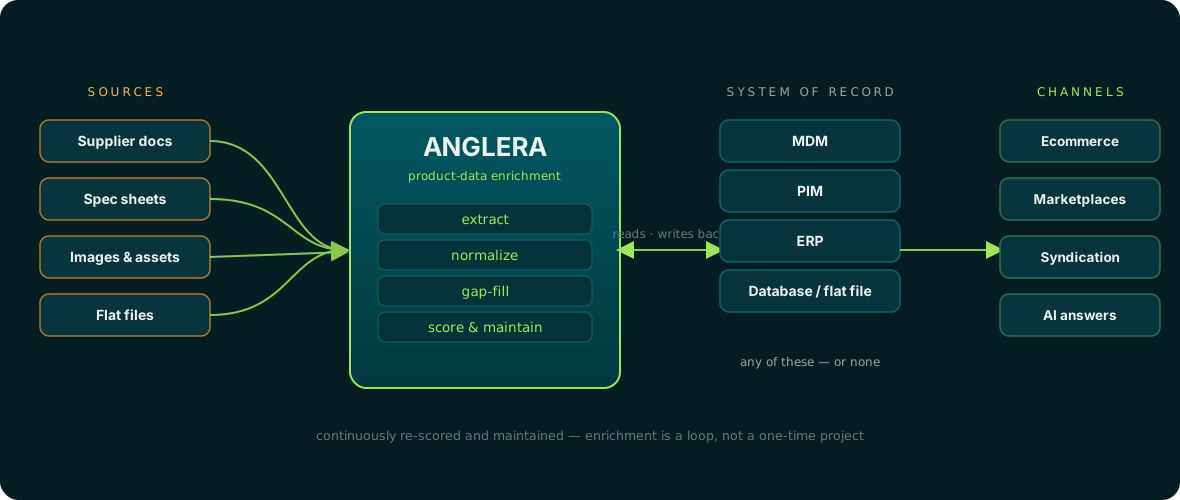
AEO makes visible a problem distributors have carried for years: product data that was good enough for a sales rep to interpret was never good enough for a machine to trust. Anglera's enrichment layer plugs into whatever a distributor already runs — Akeneo, Salsify, inriver, Stibo, Syndigo, Pimcore, Informatica, or nothing formal at all — and gets attributes gap-filled, verified against source documents, and quality-scored in about 30 days, without a rip-and-replace project. Your PIM stores the data. Anglera does the work of making it legible to the answer engines your buyers are already asking.
Hero photograph by Bernd 📷 Dittrich on Unsplash