
If every competitor shows the same datasheet, the cheapest one wins
Syndicated content makes every distributor's product page identical. Search consolidates duplicates, AI engines cite one answer, and the only lever left is price.

Open three distributor websites and pull up the same contactor, the same PEX fitting, the same safety glove. Same title. Same bullet order. Same photo angle. Same PDF, byte for byte. That's not laziness — all three subscribe to the same content service, and the service delivered exactly what it promised: the manufacturer's record, everywhere.
Now be the buyer for a second. The three pages answer identically, so the pages stop mattering. The decision collapses to the two fields the pool doesn't syndicate: price and lead time. Content sameness doesn't just fail to differentiate you — it actively deletes every other reason to pick you.
Search engines are built to collapse sameness
Duplicate detection is one of the oldest problems Google solved. When many URLs carry substantially the same content, it clusters them and picks one representative to rank; the rest get filtered (Google Search Central). Google's own people have said the quiet part about manufacturer descriptions specifically: when everyone reuses them, uniqueness has to come from somewhere else on the page, or the page competes on domain-level signals it can't control (Search Engine Journal).
For a mid-sized distributor, that's a rigged game. The syndicated page cluster gets one winner, and the winner is decided by authority and scale — which means the national player or the marketplace, not you.
AI answer engines are worse, on purpose
Classic search at least showed ten links. An answer engine shows one synthesized answer. When a contractor asks an assistant "what's the difference between these two ball valves" or "1-inch full-port brass ball valve, lead-free, threaded," the model reads whatever product data it can reach, resolves duplicates, and cites what added information to the answer.
Identical syndicated records give it nothing to prefer. A page that carries the attribute the question actually hinges on — port style, lead-free certification, thread standard, temperature rating, the cross-reference from the part number the buyer already has — gives it a reason to ground the answer in your catalog. Distinctive, structured, machine-readable data is the whole game in AI discovery; we've covered the mechanics in the 5 gaps that filter you out of AI shopping.
Manufacturer copy answers the manufacturer's questions
There's a subtler failure inside the sameness: even if you were the only site publishing it, the manufacturer's record is written from the factory's point of view. It describes what the product is — series, dimensions, listing marks. A distributor's buyer is asking what the product does in their situation: Will it fit behind a 4-inch wall plate? Is it compatible with the panel I installed last year? What do I use to replace the discontinued part in my reorder file? Can I get it in the pack size my crews actually consume?
Those answers live in your quote history, your inside-sales call notes, your returns reasons, your counter conversations. No pool will ever syndicate them, because no manufacturer possesses them. They are, almost by definition, the only content moat a distributor has.
The differentiation levers a distributor actually controls
Content that wins the click and the citation when the baseline record is commoditized:
| Lever | What it looks like on the page |
|---|---|
| Application answers | "Fits" / "works with" / "replaces" statements a buyer can act on |
| Cross-references | Competitor and predecessor part numbers, mapped and searchable |
| Buyer-shaped attributes | The filters your customers use, populated — not just the factory's spec block |
| Owned copy | Descriptions written to your buyer's vocabulary, with the syndicated text demoted to a spec tab |
| Evidence | Cited values from the actual cut sheet, so procurement can verify without a phone call |
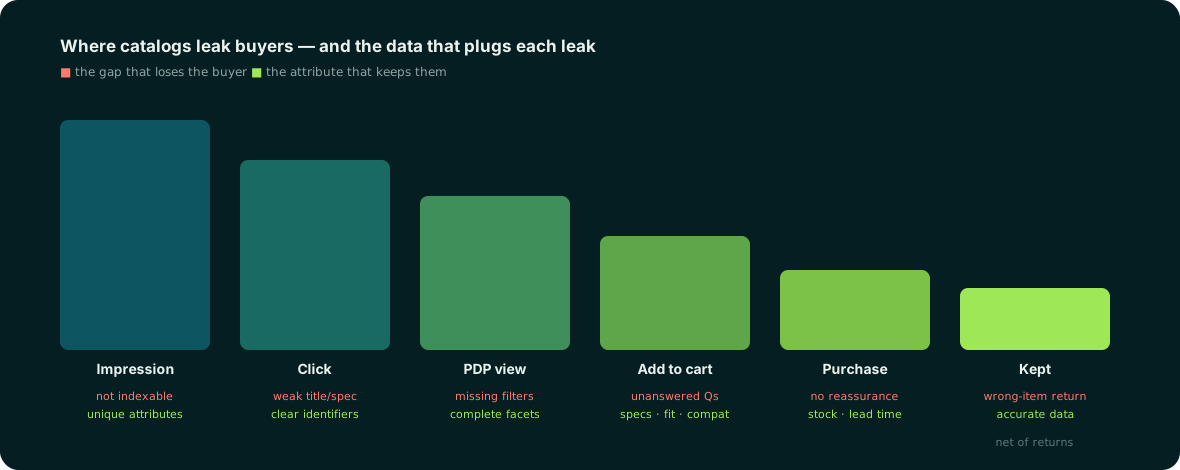
None of this requires abandoning the subscription. The pooled record stays useful as verified baseline and imagery. The point is placement: the pool is the floor you stand on, not the shelf you show. Rent the floor if the price is right — see our vendor-by-vendor breakdowns of AD eContent, DDS, IDEA Connector, and the rest of the pool landscape — but build the shelf out of content you own. The match-rate math behind that split is in the number your subscription doesn't advertise, and the full argument is the shared content pool trap.