
The shared content pool is the distributor's Achilles heel
Content subscriptions promise a finished catalog. What they deliver is the same catalog as every other subscriber — with the gaps in exactly the SKUs where you make your margin.

A distributor sits at the receiving end of product content syndication. Manufacturers author a record once. A pool — a buying-group content program, a manufacturer-authorized library, an industry data warehouse — normalizes it and pipes it to every subscriber. The pipe works. That is exactly the problem: when the pipe works perfectly, every distributor who sells that SKU publishes the same title, the same bullets, the same three images, the same PDF.
Subscribing to one of these services feels like solving product data. You sign, you map, and forty thousand SKUs light up with manufacturer-authorized content that used to be blank. For the first ninety days it is genuinely the fastest content win available to a distributor, and nothing in this post argues otherwise.
The trap is what the subscription quietly settles for you afterward. Three structural facts come with pooled content, and none of them are fixable from inside the pool.
1. The match rate is lower than the demo
Pool coverage is quoted in the vendor's terms: manufacturers signed, SKUs in the library. Your catalog is a different denominator. An item file built over decades carries regional brands the pool never signed, private-label lines it will never carry, kitted and cut-to-length items that exist only in your ERP, and superseded part numbers your customers still order by. The overlap between "SKUs the pool has" and "SKUs you sell" is routinely far below what the logo wall implies — and the unmatched remainder is not random. It skews toward the products only you carry, which is to say the ones that were your differentiation before the website existed.
Matching is also not a one-time event. MPN formats disagree, UPCs are missing upstream, pack/each units of measure collide, and every new line you pick up restarts the crosswalk. We wrote up the mechanics separately in the match-rate problem.
2. You don't own what you're publishing
Pool content is licensed, not transferred. That has consequences that don't show up until they hurt:
- Cancel and it goes dark. The day the subscription ends, the descriptions, images, and spec tables it fed are contractually gone. Ten years of "your" catalog turns out to be a rental.
- You can't freely rework it. Rewriting, extending, or redistributing licensed content is bounded by the license. The content you'd most like to improve is the content you're least entitled to touch.
- Your roadmap is their roadmap. New attributes, new taxonomies, better images arrive when the pool ships them to everyone, not when your category strategy needs them.
3. Everyone gets the same record
This is the structural one. A pool's economics only work because one manufacturer record serves every subscriber. So the pool is not just failing to differentiate you — it is architecturally incapable of it. Your product page for a given SKU is, by design, a byte-for-byte sibling of your competitor's page for that SKU.
Search engines see that. Google has said for years that it consolidates duplicate and near-duplicate pages rather than ranking all of them (Google Search Central), and its guidance to merchants with manufacturer-supplied descriptions is blunt: add something unique or expect to compete on other signals (Search Engine Journal). AI answer engines are harsher still: they synthesize one answer per question, and when five distributors offer identical content, the model has no content-based reason to cite yours. What's left to compete on is price and freight. That is the commoditization endgame: the pool turns product content — the one asset where a distributor could out-work competitors — into a shared utility, and moves the whole fight to margin.
What the pool is actually for
| The pool delivers | The pool cannot deliver | |
|---|---|---|
| Coverage | A fast baseline for the SKUs it matched | The unmatched tail where your margin lives |
| Trust | Manufacturer-authorized specs and assets | Values mined from cut sheets the pool skipped |
| Format | Normalized attributes, one taxonomy | A schema shaped by how your buyers filter |
| Ownership | A license, renewed annually | Content that survives cancellation |
| Position | Parity with every other subscriber | A page that reads differently from theirs |
Treat that left column with respect. Baseline parity is worth having, and for commodity SKUs where you'll never invest in content, licensed sameness is a rational choice.
Own the difference, rent the baseline
The way out is not to cancel the subscription in anger. It is to stop treating pooled content as your shelf and start treating it as one raw material among several.
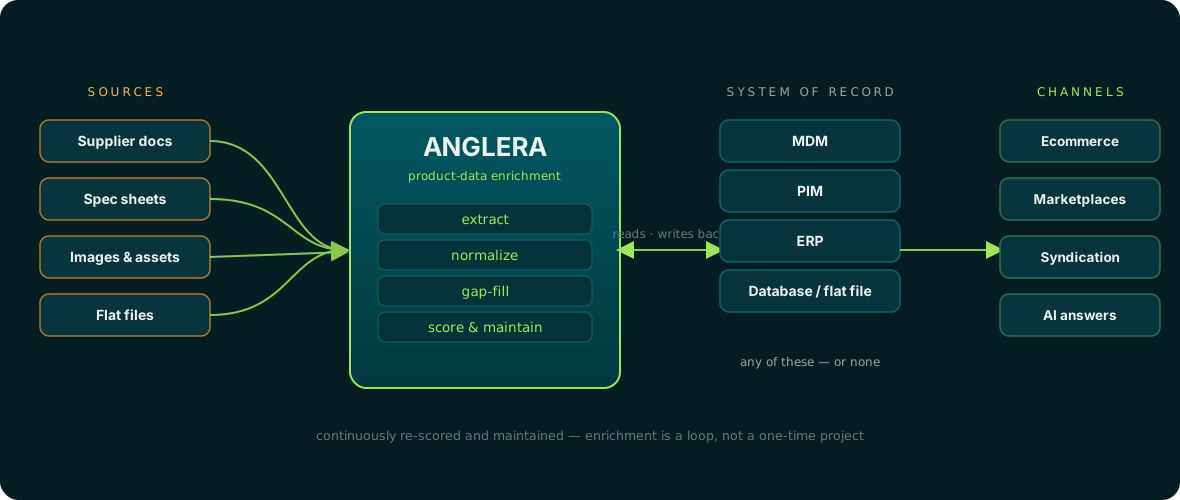
That means grounding your catalog in sources you're entitled to build on — manufacturer cut sheets, spec PDFs, and supplier portals, extracted with a citation on every value — then aligning the result to your buyers: the attributes they filter on, the application questions they ask your inside sales team, the cross-references they search by. The output lands in your PIM as content you own outright, layered over (and filling in around) whatever the pool provides. Every SKU the pool can't match gets built the same way, so the tail stops being blank.
Do that continuously rather than as a one-time project and the asymmetry compounds: subscribers to the pool stay identical to each other by construction, while your catalog keeps accreting owned, differentiated, buyer-shaped content they can't license.
We've written per-vendor breakdowns of how this plays with the pools distributors actually use: AD eContent, DDS, IDEA Connector, Trade Service, Etilize, and Icecat. The verdict is the same shape in every one: keep the pipe if it's earning its fee. Just don't mistake the pipe for a moat.