
How Ferguson Outgrew the British Company That Bought It
Ferguson tops MDM's 2026 Plumbing list at No. 1. The stranger story: it grew big enough to rename, then shed, the UK parent that once owned it.
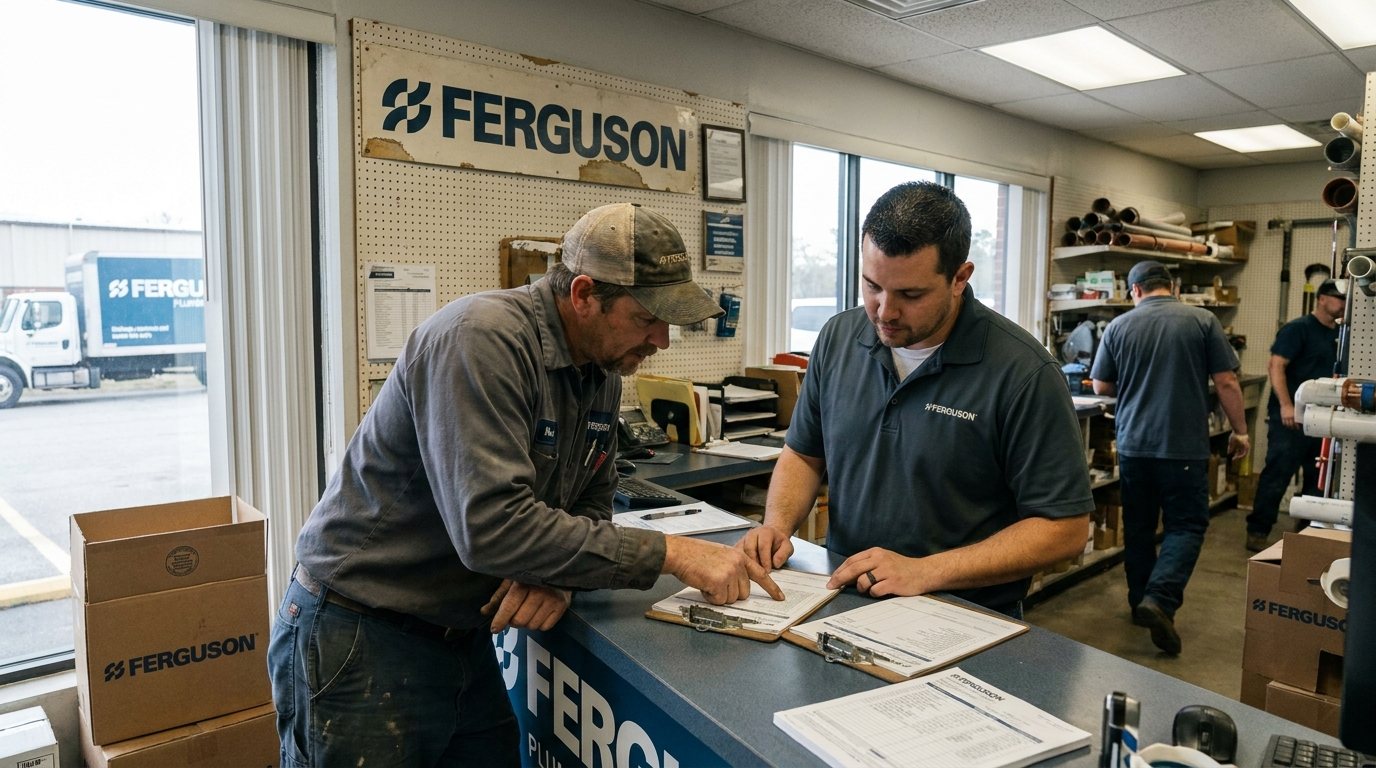
Part of Distributor Playbooks — strategy teardowns of every company on the MDM Top Distributors lists.
Ferguson opens 2026 at No. 1 on MDM's Top Distributors list for Plumbing, climbing to No. 1 in PVF as well, with a No. 3 finish in HVACR and top-12 placements across Industrial Supplies, MRO, Building Materials and JanSan. MDM credits the company with $31.3 billion in 2025 revenue, roughly 35,000 employees and about 1,800 locations. That scale is the least interesting thing about Ferguson. The stranger story is how a Newport News, Virginia plumbing supply house ended up owning the name of the British conglomerate that bought it.
A Virginia plumbing shop, bought and swallowed
Charles Ferguson, Ralph Lenz and Johnny Smither started Ferguson Enterprises in Newport News in 1953 as a plumbing and heating distributor. Growth was steady rather than spectacular for two decades, then in 1982 the company was acquired by Wolseley plc, a UK building-materials conglomerate, for $30.7 million. On paper that was the end of Ferguson as an independent story: an American plumbing wholesaler folded into a much larger British parent.
It didn't play out that way. Ferguson kept growing inside Wolseley's portfolio, expanded into new US regions, and merged with Familian Corporation of Los Angeles in 1999 to push further west. By the 2010s the US plumbing and HVAC business wasn't just Wolseley's biggest division, it was effectively the company. In 2017 Wolseley plc changed its own corporate name to Ferguson plc, an unusual move: the acquired subsidiary's brand replaced the acquiring parent's identity on the London Stock Exchange ticker.
The insight: the subsidiary became the parent, then went home
That renaming is the hinge of Ferguson's story, and it is worth stating plainly because it is easy to miss on the company's own history page: most distributors that get bought by a bigger conglomerate stay divisions. Ferguson became the whole company. It didn't stop there. In January 2021, Ferguson divested its remaining UK retail operations to private equity firm Clayton, Dubilier & Rice for £308 million, cutting the last operating tie to the country its parent came from. That same year it shifted its primary stock listing to the New York Stock Exchange. By August 2023 it qualified as a US domestic filer under SEC rules, and in August 2024 it completed a full corporate reorganization, replacing Ferguson plc with a new Delaware parent, Ferguson Enterprises Inc., while the old Jersey-incorporated entity was renamed and quietly wound down to a shell.
Forty-two years after a British company bought a Virginia plumbing wholesaler, the wholesaler finished the trade: it kept the growth, took the name, and sent the foreign incorporation home. Few companies in distribution have a founding story that ends with them out-lasting and out-scaling their own acquirer this cleanly.
| Year | Event |
|---|---|
| 1953 | Ferguson Enterprises founded in Newport News, VA |
| 1982 | Acquired by Wolseley plc (UK) for $30.7M |
| 1999 | Merges with Familian Corporation, expands to the West Coast |
| 2017 | Wolseley plc renamed itself Ferguson plc |
| 2021 | Divests UK operations to CD&R; primary listing moves to NYSE |
| 2023 | Qualifies as a US domestic filer |
| 2024 | Redomiciles as Ferguson Enterprises Inc., a Delaware corporation |
What the machine looks like today
Underneath the corporate history is a distribution business built on density and specialization. Ferguson runs nearly 1,700 to 1,800 branches (the figure moves with each quarterly close) plus more than 270 high-end showrooms that sell fixtures directly to homeowners and designers, feeding a separate residential channel alongside its core wholesale trade counter business. About 5,000 outside sales reps call on contractors and job sites; a further 5,000-plus associates run national accounts. Digital has become a real second leg rather than a defense against Amazon: digital orders grew 28% year over year to reach 46% of pro sales in fiscal 2024, and Ferguson has been consolidating its e-commerce identity, merging its Build.com consumer brand into the main Ferguson site in 2025.
The other constant is acquisitions. Ferguson has done roughly 50 deals over the past five years and closed fiscal 2025 with nine of them in specialty categories like waterworks, environmental products and duct supply, adding about $300 million in annualized revenue. MDM put full fiscal 2025 sales at $31.3 billion, up 5% on the year, with acquisitions contributing a modest but steady one point of growth and non-residential construction driving the rest.
The tension worth naming
Ferguson is buying and pruning at the same time, and both are visible in the same fiscal year. While closing nine tuck-in deals, the company also recorded $14 million in restructuring charges tied to branch closures in Canada and sold a shuttered US distribution center. That is not contradiction so much as discipline: a company this size can add specialty capability through M&A in one region while rationalizing underperforming footprint in another, and treat both as normal maintenance rather than crisis. The risk sits in the mix, not the mechanics. Ferguson's growth is now split between an M&A engine that adds a point of revenue a year and a non-residential construction cycle that can swing much harder than that, and the model has to keep both moving in the same direction to keep compounding at this rate.
The Plumbing #1 ranking MDM hands Ferguson each year measures the branches, the trucks and the revenue. It doesn't capture the part of the story that is actually unusual: a company that grew past the parent that bought it, took its name, and then went and got its own address back.