
Locke Supply Co: How an Employee-Owned Distributor Wins
Locke Supply Co charted at Elec #39 on MDM's 2025 Top Distributors list and does not appear on the 2026 lists. Here's how a 100% employee-owned wholesaler built 200+ branches without a PE backer.
Part of Distributor Playbooks — strategy teardowns of every company on the MDM Top Distributors lists.
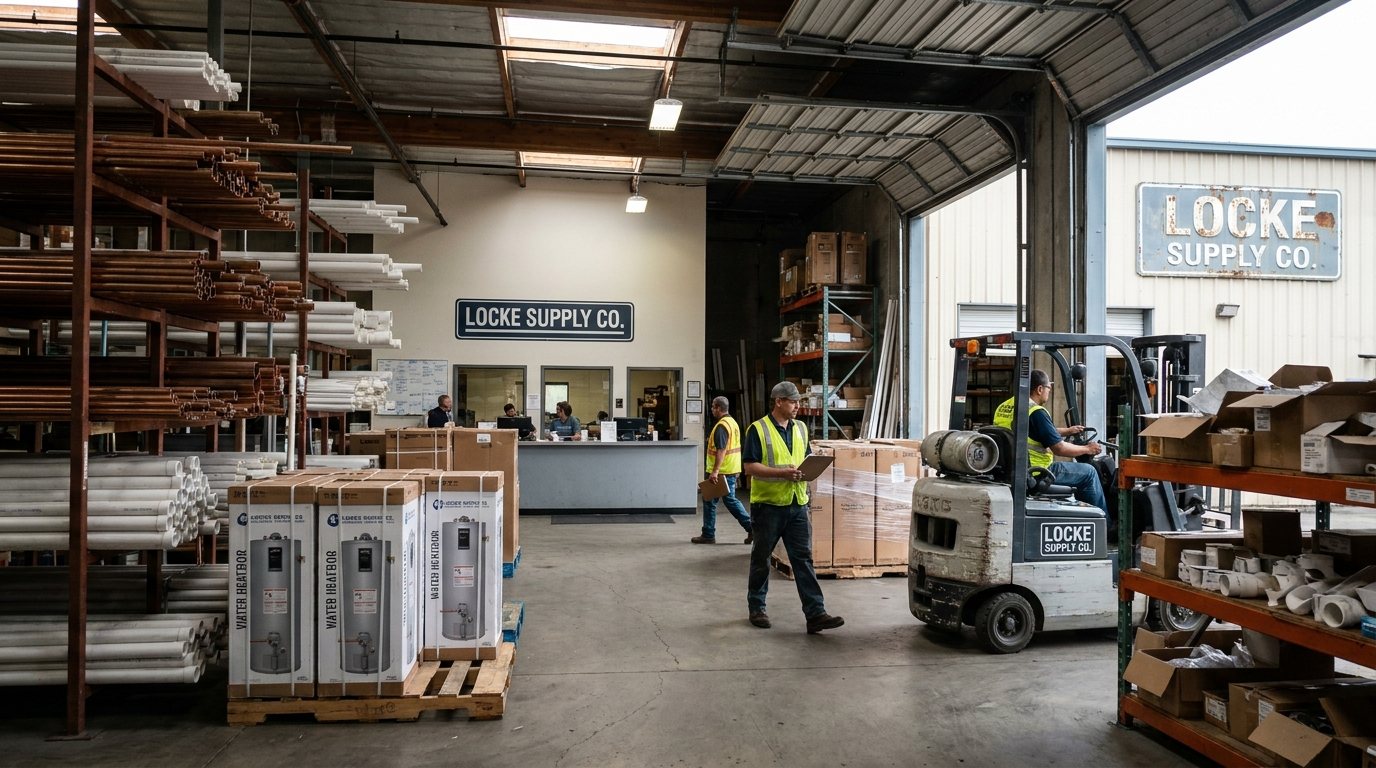
Locke Supply Co. charted at #39 on the electrical side of Modern Distribution Management's 2025 Top Distributors list, the annual ranking of North America's largest wholesale distributors, on $738 million in 2024 revenue, but does not appear on MDM's 2026 lists. That placement undersells the company slightly: Locke started, and still largely operates, as a plumbing house, with electrical and HVAC layered on top. The more interesting fact is who owns it. In a channel where private equity has spent two decades buying up regional wholesalers, Locke Supply is a 100 percent employee-owned S-corporation, and has been since the year 2000.
A mobile store, not a fixed one
Don and Wanda Locke opened a wholesale plumbing supply outlet in Bartlesville, Oklahoma in 1955, a two-person operation with no other employees. The business relocated to Oklahoma City within two years, and in 1958 it opened a second branch, according to the company's own history published on lockesupply.com. That second branch mattered more than the number suggests. It set the pattern Locke has repeated for almost 70 years: rather than build a handful of mega-branches, put a smaller store within reach of every contractor in the territory, then let density do the selling. Today that adds up to more than 200 store locations across six states — Oklahoma, Texas, Missouri, Kansas, Arkansas and Virginia — a footprint PHC&P Pros traced back to the same "take the store to the customer" logic Don Locke used when he opened that 1958 branch.
Virginia is the outlier on that list, and it tells its own story. Locke bought RESCO, a three-location Richmond electrical distributor, in 2019 — what Electrical Trends called "Locke's first foray outside its marketplace." Nearly every other Locke branch sits inside a contiguous Southwest cluster it built organically over decades. The Virginia beachhead is the exception that shows what Locke does when it wants a new region: it buys a small, already-profitable local operator instead of parachuting in a greenfield branch, then leaves the backfilling for later.
Ownership as the actual strategy
The employee-ownership structure is not a footnote, it is the mechanism that explains everything else Locke does. Don Locke converted the company to a 100 percent ESOP before his death in 2000, according to PHC&P Pros, trading family ownership for employee ownership rather than a sale to a strategic buyer or a private equity sponsor. That decision runs against the grain of the wholesale plumbing and electrical channel, where consolidators like WinSupply's franchise-style rollups and PE-backed regional platforms have absorbed dozens of family distributors over the past fifteen years.
An ESOP changes the math on big, slow-payoff bets. Locke has just finished one: a $150 million, 1.5-million-square-foot headquarters and distribution center in southeast Oklahoma City's OKC 577 development, a four-year build the company marked alongside its 70th anniversary in 2025, per Oklahoma Farm Report. Roughly 400 of the company's headquarters staff work out of the new facility. A PE-owned distributor sizing that investment against a five-to-seven-year hold period runs a very different calculation than an ESOP company answerable to the associates who will still be working there in twenty years. It also owns Cloak Freight, its own trucking and third-party logistics operation based at the new hub, meaning the same private-fleet logic that vending-machine and technical-sales distributors use to lock in accounts here shows up as controlled linehaul between 200-plus branches instead.
That same long-horizon culture shows up in who runs the place. Oklahoma Farm Report highlighted John Orman, Locke's Head of Innovation, who was hired at 18 while still in high school — a promote-from-within path that is common to talk about in distribution and rarer to actually staff a headquarters function with.
The tension worth naming
The plain insight here: Locke Supply competes at real scale, $738 million and 200-plus branches, without ever taking outside capital to get there, in a sector where nearly every peer of comparable size has. That buys patience for capital projects and immunity from a sponsor's exit clock. It also means growth funds itself branch by branch and acquisition by acquisition, out of retained earnings and ESOP-friendly debt, which is a slower flywheel than a PE-backed platform doing five tuck-ins a year. Locke has effectively traded speed for control. Seventy years in, on the evidence of a $150 million headquarters it just built for itself, that trade still looks like the right one.
Timeline
| Year | Milestone |
|---|---|
| 1955 | Don and Wanda Locke open a wholesale plumbing outlet in Bartlesville, OK |
| 1958 | Second branch opens, setting the multi-branch model |
| 2000 | Company converts to a 100% ESOP; Don Locke dies |
| 2019 | Acquires RESCO, a three-location Richmond, VA electrical distributor |
| 2025 | Opens $150M, 1.5M-square-foot HQ and distribution center; marks 70th anniversary |
Distribution rewards the companies willing to fund the unglamorous parts, the extra branch, the owned truck, the catalog nobody outside the trade ever sees, years before the payoff shows up on a P&L. Locke Supply built its whole ownership structure around being able to do exactly that.