
Reece USA: A Melbourne Family's $1.9 Billion American Bet
Reece USA ranks #3 in plumbing on the 2026 MDM Top Distributors list. Here is how a 105-year-old Australian family business built it through the MORSCO acquisition.
Part of Distributor Playbooks — strategy teardowns of every company on the MDM Top Distributors lists.
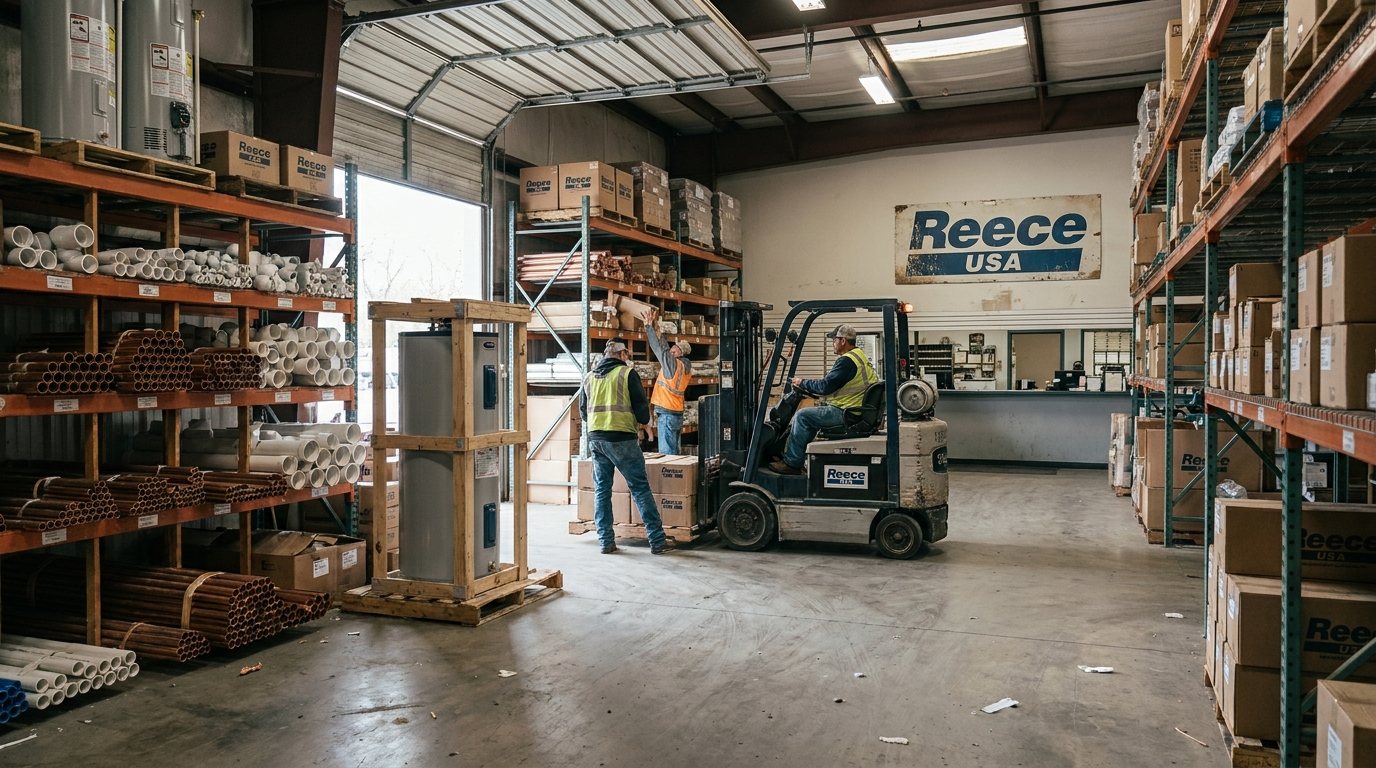
Reece USA lands at #3 on MDM's 2026 Top Distributors list for plumbing, with $3.3 billion in FY2025 revenue (ended June 30, 2025). What the ranking does not show is that Reece USA is not really an American company at all. It is the US arm of a 105-year-old Australian family plumbing supplier that, in 2018, made the single largest bet in its history to get here.
From a truck in Melbourne to a public company the Wilsons still run
Harold Joseph Reece started the business in 1920 selling plumbing fittings out of the back of a truck around Melbourne before opening his first store in Caulfield, according to Reece Limited's company history. The company stayed a small Australian retailer for decades until Les Wilson joined the board in 1958 and began quietly buying shares. By 1969 regulators had cleared the Wilson family as majority owners, and the family has controlled the business ever since, holding roughly 70 percent of the stock into the 2020s even after Reece listed publicly. Alan Wilson, Les's son, ran the company from 1970 and became executive chairman in 2008. His son Peter Wilson now holds the CEO and chairman role.
That detail matters more than it sounds. American plumbing distribution has spent two decades getting rolled up by private equity and public holding companies. Reece is the opposite case: a family that has owned the same trade-counter business for three generations, still setting strategy, still willing to swing for a bet the size of MORSCO.
The bet: $1.9 billion for MORSCO
In May 2018, Reece announced it would acquire MORSCO, a Fort Worth-based plumbing and waterworks distributor, for $1.9 billion, according to the same company history. It was Reece's first real push outside Australia and New Zealand, and it roughly doubled the size of the group overnight. MORSCO was not a single chain. It was itself a roll-up of regional wholesalers built over years by private-equity ownership before Reece, giving the family company an instant footprint across the US South, Southwest, and Pacific.
The timing looked aggressive at the time and looks even more aggressive in hindsight: Reece bought into the US housing and construction cycle two years before COVID disruption and roughly four years before the interest-rate cycle that has since cooled new-home construction. A family business known for patience had just made its biggest, least patient move ever.
The insight: Reece never renamed what it bought
The distinctive part of Reece's US strategy is what it did not do. Most acquirers in distribution eventually collapse acquired names into one master brand, chasing marketing efficiency and a single national story. Reece did not. Today Reece USA operates as a portfolio of a dozen-plus distinct trade names, including Farnsworth Wholesale, Morrison Supply, Murray Supply, DeVore & Johnson, Express Pipe & Supply, L&B Pipe & Supply, Todd Pipe, Schumacher & Seiler, and Fortiline as its dedicated waterworks division.
That is a deliberate house-of-brands choice, not an oversight. A regional plumbing contractor in Texas still calls their counter Morrison Supply, with the local reps and relationships that name carries, while the balance sheet, buying power, and back-office systems sit behind it as Reece Inc. The corporate identity is invisible at the counter. That is unusual discipline for an acquirer this size, and it is the thing a competitor's strategy team should actually study: Reece bought scale without asking its customers to relearn who they call.
Growing through a soft market, not around it
Reece Group's fiscal year 2025 (ended June 2025) was rough. Chairman and CEO Peter Wilson called it "a turbulent year," with earnings hit by soft conditions in both Australia/New Zealand and the US, where housing-market weakness pulled US segment revenue down. Yet the group still completed bolt-on acquisitions during that same soft year, continuing the pattern of buying through the cycle rather than pausing for it.
Fortiline, Reece USA's waterworks arm, kept expanding even as the broader market cooled. It acquired Belair Road Supply to push into Maryland and Delaware and extended its footprint coast to coast into California, moves that read less like opportunism and more like a standing policy: use the down part of the cycle to buy share cheaply, because the family that owns the parent company is not managing to a quarterly stock price. In September 2025, Fortiline promoted Keith Young, a 13-year company veteran who had led the Belair Road Supply deal, to president, a signal that the M&A engine is a career path inside Reece, not a bolted-on corporate development function, according to MDM's coverage of the promotion.
The tension worth naming
The trade-off in Reece's model is real. Family control means slower capital-raising discipline than a PE sponsor would tolerate, and a soft US housing cycle lands directly on the same balance sheet that funds every other part of the group, including the Australian home market. A distributor that bought its way to scale during good times now has to prove the same appetite works during a bad one. So far the bolt-on acquisitions have kept coming, which is the closest thing to an answer the company has given.
Reece USA's #3 plumbing ranking is really a proxy for how well a century-old family retailer executed the hardest transition in distribution: buying an entire country's worth of regional relationships and keeping every one of those relationships intact under someone else's name.
That is the pattern this series keeps finding: the companies that win distribution rarely win on the showroom floor. They win in the unglamorous machinery behind it, the branch networks, the catalogs, and the supply relationships nobody outside the trade ever sees.