
How Hajoca Turns 450 Branches Into Owner-Run Businesses
Hajoca ranks #4 in MDM's 2026 plumbing distributor list by treating branch managers as owners across 60+ trade names, then buying HVAC scale to match.
Part of Distributor Playbooks — strategy teardowns of every company on the MDM Top Distributors lists.
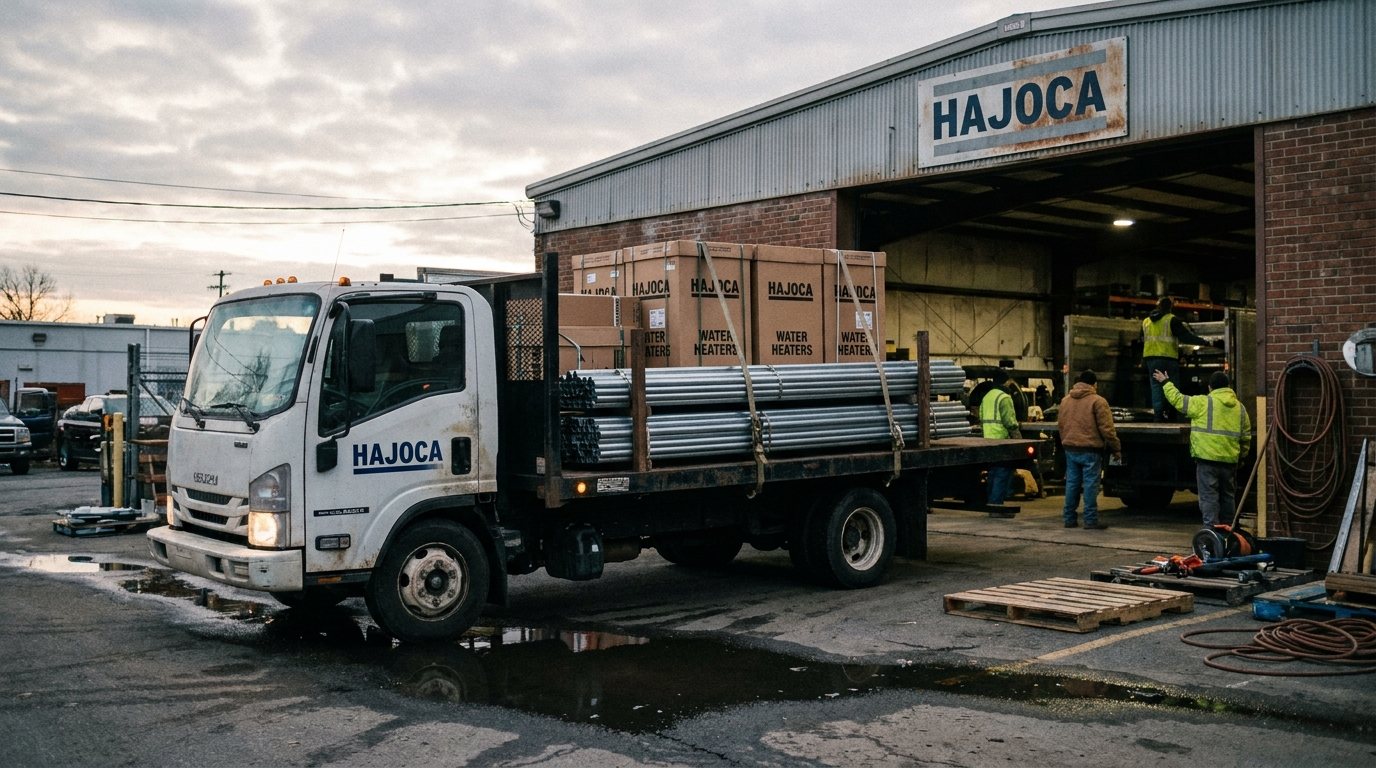
Hajoca Corporation landed at #4 on the plumbing list and #36 in industrial supply in Modern Distribution Management's 2026 Top Distributors report, the annual ranking of North America's largest wholesale distributors. What the ranking doesn't show is that Hajoca runs its 450-plus locations less like a corporation and more like a federation of small businesses whose managers get paid, and act, like owners.
The insight: profit centers, not branches
Hajoca doesn't call its locations branches. It calls them Profit Centers, and the distinction is the whole strategy. Each one is run by a Profit Center Manager who, according to the company's own careers site, operates with "the same high degree of responsibility, autonomy, and accountability as an owner" and takes home a direct share of whatever profit that location generates. Inventory decisions, local pricing, hiring, even which manufacturers to lean on: those calls sit with the person running the location, not a regional VP three states away.
This is a genuinely unusual structure in a sector that has spent the last decade consolidating into centrally managed roll-ups. Most of Hajoca's plumbing-distribution peers standardize aggressively as they scale, because uniformity is what lets a national buyer manage a national footprint. Hajoca scaled to over 450 locations across more than 40 states while deliberately keeping decision rights local. It is closer to a franchise model than a distributor org chart, except there's no franchise fee and no separate legal entity. The company just underwrites the risk and lets the manager run the store.
Where the model came from
The company traces to 1858, when William S. Cooper put up $200 to start a Philadelphia shop grinding key stops for plumbers. Thomas J. Jones joined in 1862 and Joel Cadbury in 1867; the trade name adopted in 1887, HAJOCA, is a portmanteau of their surnames, HAines, JOnes, and CAdbury. By 1927 the company had grown to 14 locations and merged with three other firms to form Hajoca Corporation outright.
The detail worth pausing on: Hajoca describes 1981 as the year it became "privately owned once again," language that implies a period of public or externally controlled ownership before a management-led buyback. That single sentence is nearly all the public record says about it. What's documented on the other side of 1981 is more telling: the company reorganized around exactly the profit-sharing, decentralized structure it runs today, and it has stayed privately held ever since, resisting both a public listing and the private-equity roll-up wave that has swallowed most of its plumbing-distribution peers.
Sixty names, one company
Acquisitions get folded in without being renamed. Hajoca operates under more than 60 different regional trade names, a legacy of 1980s-era acquisitions where the company chose to keep local brands intact rather than repaint every truck and storefront with a single corporate identity. A contractor in one metro may know the counter as a name that has nothing to do with Hajoca on the sign, while the balance sheet, purchasing scale, and two national support centers, in Lafayette Hill, Pennsylvania and Baton Rouge, Louisiana, sit underneath as shared infrastructure.
That's the trade-off worth naming plainly: local trust versus centralized leverage. Sixty brand names is sixty sets of customer relationships that don't evaporate when a family-owned wholesaler sells. It is also sixty potential variations in systems, catalogs, and pricing discipline that a single-brand competitor doesn't have to manage. Hajoca has bet, for four decades, that the goodwill is worth more than the friction.
The HVAC land grab
Where the model is being tested in real time is HVAC. Hajoca launched a dedicated national HVAC division in May 2022 under 22-year company veteran Marshall Maedgen, the same month it struck a partnership with the Larson family's Gustave A. Larson Company and Applied Product Solutions to build out refrigeration and HVAC-parts scale. The buying has kept going: American Refrigeration Supplies, a Phoenix-based HVAC-R distributor founded in 1940 and owned by Kitchell since 1970, joined Hajoca in early 2026, adding 34 branches and two distribution centers across seven southwestern states and pushing Hajoca's HVAC-focused footprint past 175 locations, according to ACHR News and PHC Pros.
Hajoca also bought forward instead of sideways: in June 2025 it acquired Onsemble, an AI software startup for contractors founded by Rick Klau, a former Google Ventures partner who already sat on Hajoca's board, to run as what the company called "a dedicated digital innovation engine" inside the organization, per MDM. It's a small deal by dollar size but a clear signal: the company that built its moat on local autonomy is now buying the software layer to keep every one of those 60-plus brands digitally current at once, rather than leaving it to each Profit Center manager to figure out alone.
The tension underneath the moat
The bet cuts two ways. A model built on Profit Center autonomy and dozens of legacy trade names is exactly the kind of structure that makes standardized digital tooling, unified catalogs, and consistent product data hard to roll out company-wide. Hajoca's HVAC acquisition spree and its Onsemble purchase both look like an admission that decentralization, the thing that has kept the company entrepreneurial and independent for a century and a half, needs a centralized backbone underneath it to keep scaling. Whether that backbone gets built brand-by-brand or all at once is the strategic question Hajoca is answering right now, acquisition by acquisition.
Distribution rewards get decided less by who has the most locations and more by who can turn a century-old branch network, a stack of legacy trade names, and a warehouse full of SKUs into something a contractor can actually find and trust. Every company in this series is fighting that same unglamorous war on catalogs, branches, and data, whether or not its org chart looks anything like Hajoca's.