
F.W. Webb: How a Family-Owned Distributor Outlasted 160 Years
F.W. Webb ranks #6 in Plumbing and #9 in HVACR on MDM's 2026 Top Distributors list. Here's how a Depression-era buyout built a 160-year family dynasty.
Part of Distributor Playbooks — strategy teardowns of every company on the MDM Top Distributors lists.
F.W. Webb lands at No. 6 in Plumbing and No. 9 in HVACR on MDM's 2026 Top Distributors list, with additional placements in Industrial Supplies and Gases & Welding Supplies, on $2.6 billion in 2025 revenue. What the ranking doesn't show is the part that makes F.W. Webb unusual among its peers: it is still owned by the same family that bought it out of near-collapse during the Great Depression, in a plumbing distribution sector where most large regional players have long since sold to private equity or gone public.
A wholesale house that outlived three names
The company traces to April 11, 1866, when New Jersey native John Van Ness Stults opened a wholesale plumbing supply shop on Elm Street in Boston, one of the city's first. Seven years later he partnered with Henry W. Mansur to form Stults & Mansur. In 1888, Henry McShane, a Baltimore manufacturer, bought the firm and installed his brother-in-law, Frank W. Webb, to run the Boston branch. Webb liked what he saw enough to buy it outright in 1899, and by 1900 the operation carried his name for good, according to the company's own 160-year history page and a retrospective in Supply House Times.
That's three ownership changes and two name changes in the company's first 34 years. Then, in 1933, at the bottom of the Depression, Roger W. Pope, whose father had been a working plumber in Swampscott, Massachusetts, pooled resources with four partners and bought F.W. Webb Manufacturing. It was a strange moment to bet on a wholesale plumbing house. Construction had cratered, and half the country's independent distributors of that era didn't survive the decade. Pope's bet paid off, and it is the hinge the rest of the company's history swings on.
Three generations, no exit
Roger Pope's son John became president in 1961. John's son Jeff joined the sales floor in 1980 and took the presidency in 2003, according to PHCP Pros coverage of the family's succession. Jeff Pope still owns and runs the company today. In 2022, Boston Business Journal ranked F.W. Webb No. 3 on its list of family-owned businesses in Massachusetts, a distinction the company still promotes on its own site.
That's the unique insight of this profile: plumbing and HVAC distribution has consolidated hard over the past two decades. Public and PE-backed rollups dominate the largest tiers of the MDM rankings, buying up regional wholesalers to build national scale and eventual liquidity events for their owners. F.W. Webb has spent 92 years running the opposite play. It buys other family plumbing supply houses. It does not sell itself to become one of somebody else's acquisitions. The company completed roughly a dozen tuck-in acquisitions in the past three years alone, including Rising Sun Plumbing Supply and Steinberg Plumbing Supply in October 2024, per Industrial Distribution. It is the acquirer, never the target, and the Pope family has been comfortable enough with that arrangement for three generations to never need a different one.
Density over reach
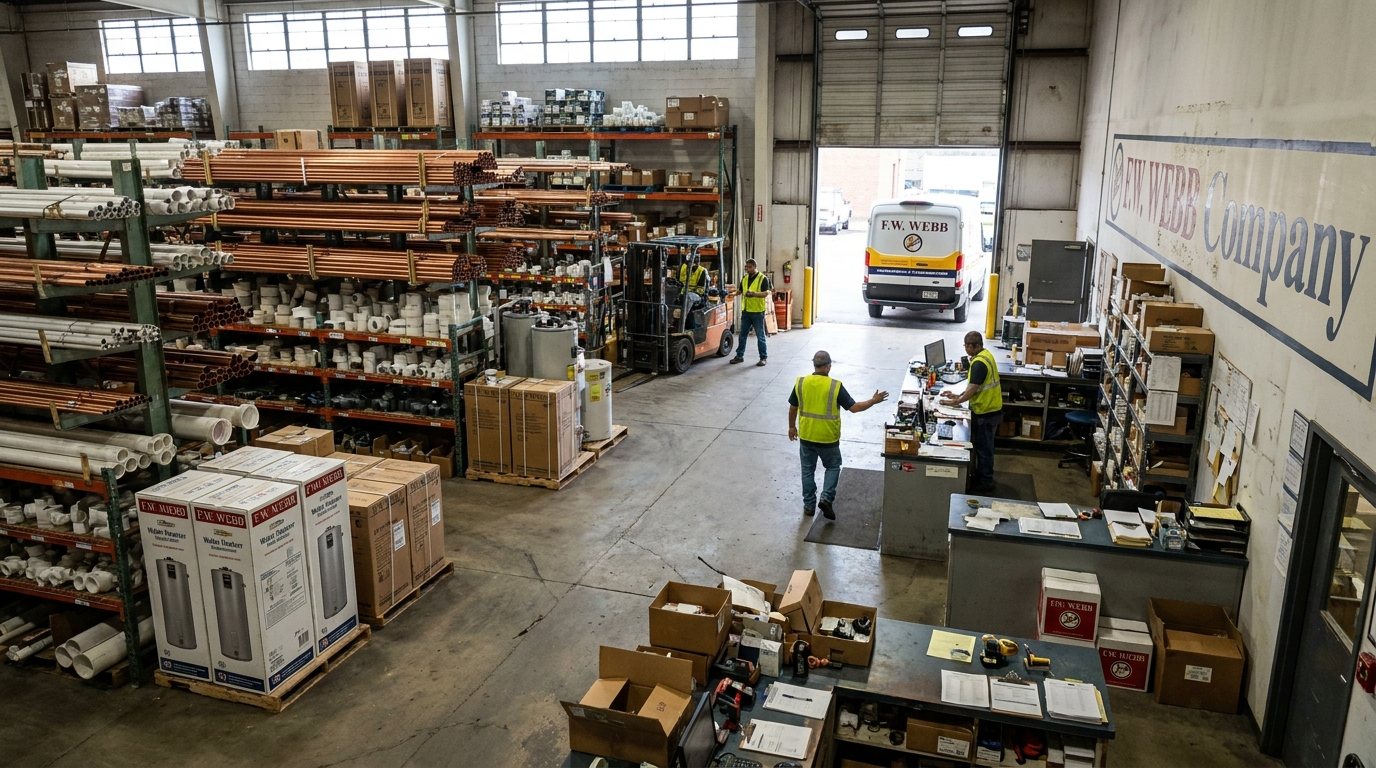
F.W. Webb never chased a national footprint. It operates more than 100 locations across nine states, all in the Northeast, an intentional ceiling rather than a limitation. The company would rather own every plumbing, HVAC, and industrial supply niche within a tight geography than compete thinly across the country. That shows up in how it has spent its capital lately: an 84,000-square-foot Boston flagship that opened in January 2024, a facility in Swanzey, New Hampshire nearly four times the size of the branch it replaced, and an expanded Rochester, New York location that opened in June 2025, according to MDM's coverage.
The acquisitions follow the same logic. Rather than buying scale in adjacent regions, F.W. Webb buys categories inside its existing footprint. Its Water Works Division, built through the acquisition of Water Works Supply Corp, extends the company from indoor plumbing into municipal infrastructure supply without opening a single new state. An expanded January 2025 partnership with Rheem, giving F.W. Webb the manufacturer's full HVAC line across the Northeast, works the same way: deepen what's already covered rather than reach for what isn't.
The wholesaler that also runs storefronts
The other structural choice that sets F.W. Webb apart from most pure-play wholesale distributors is Frank Webb Home, a chain of nearly 50 retail kitchen, bath, and lighting showrooms operating under its own consumer-facing brand. Most B2B plumbing distributors treat showrooms, if they have them at all, as a small counter attached to the wholesale warehouse. F.W. Webb built Frank Webb Home into a real retail operation, complete with working displays where customers can run water through the faucets and showerheads they're considering, and it keeps opening new locations, including recent showrooms in Middlebury, Vermont and Stamford, Connecticut.
It's a bet that a plumbing distributor's contractor relationships and product knowledge translate into a defensible homeowner-facing business, not just a marketing add-on. Running both channels well, wholesale discipline on one side and retail merchandising on the other, is a harder operating problem than most distributors choose to take on, and it's a bet that only makes sense for a company willing to hold the business for decades rather than sell it for the highest multiple.
The distributor's real product
Public rankings measure F.W. Webb in the categories buyers search for: plumbing, HVACR, industrial supplies. What the 160-year arc actually shows is a company that treated ownership itself as a strategic asset, and used the stability that comes from never needing to sell to build slowly, in one region, for nearly a century. That kind of patience is a rarer moat in distribution than any single warehouse or SKU count.
This piece is part of Anglera's Distributor Playbooks series, profiling the operators who keep North America's branches, catalogs, and supply chains running.