
Noun phrase optimization: the five questions a product phrase answers
AI shopping assistants retrieve products by noun phrase, not keyword. Here's the five-question anatomy of a product phrase — and the attribute column behind each answer.

Nobody types "wall art metal large abstract" into an AI assistant. They type "large abstract metal wall art for the living room," and the assistant doesn't treat that as four keywords to match — it treats it as one concept with four refinements. Amazon's shopping assistant (Rufus, renamed Alexa for Shopping in May) works this way explicitly: it extracts the noun phrases from a conversation and retrieves products whose listings express those concepts, whether or not the literal string appears in the title.
Seller circles have started calling the response to this noun phrase optimization — organizing product language around the complete phrases shoppers and agents actually search in, instead of the keyword fragments that legacy search rewarded. The framing is right. But most of the advice stops at the copywriting layer, and that's the part we'd push back on: a noun phrase isn't copy. It's a stack of claims, and every claim in the stack has to be backed by a structured attribute on the SKU, or the phrase falls apart the moment an agent checks it.
A phrase is a stack of claims
Take a query from a harder catalog than wall decor: "UL-listed dimmable 150W LED high bay light for 30-foot ceilings." Grammatically that's one noun phrase — a head noun ("high bay light") wearing four modifiers. Each modifier narrows the candidate set without ever changing what the product is. And each one is a filter the agent will apply against your data:
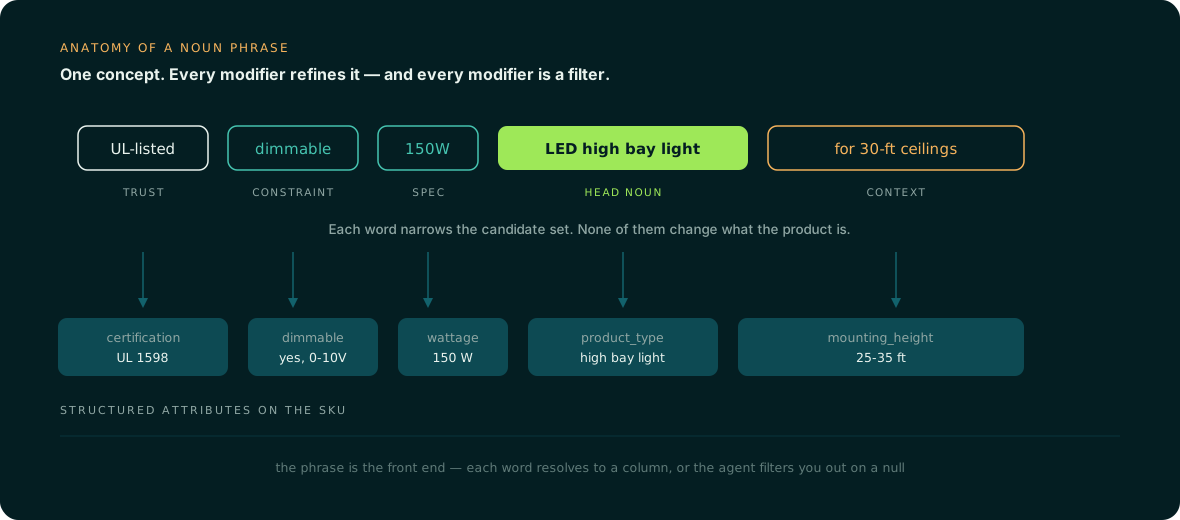
An agent handling that query extracts the constraints — features, specs, context — and searches connected catalogs for products that satisfy them. "Dimmable" isn't matched against your marketing paragraph; it's matched against a dimmable field, a spec table row, or schema markup. If the value lives only in a PDF cut sheet, the SKU silently fails a filter it actually passes in real life. You didn't lose the sale on relevance. You lost it on a null.
The five questions a phrase can answer
Decompose enough real queries and the modifiers sort into five families. This is the anatomy worth internalizing — not as a title-writing formula, but as a checklist of what your data can currently prove:
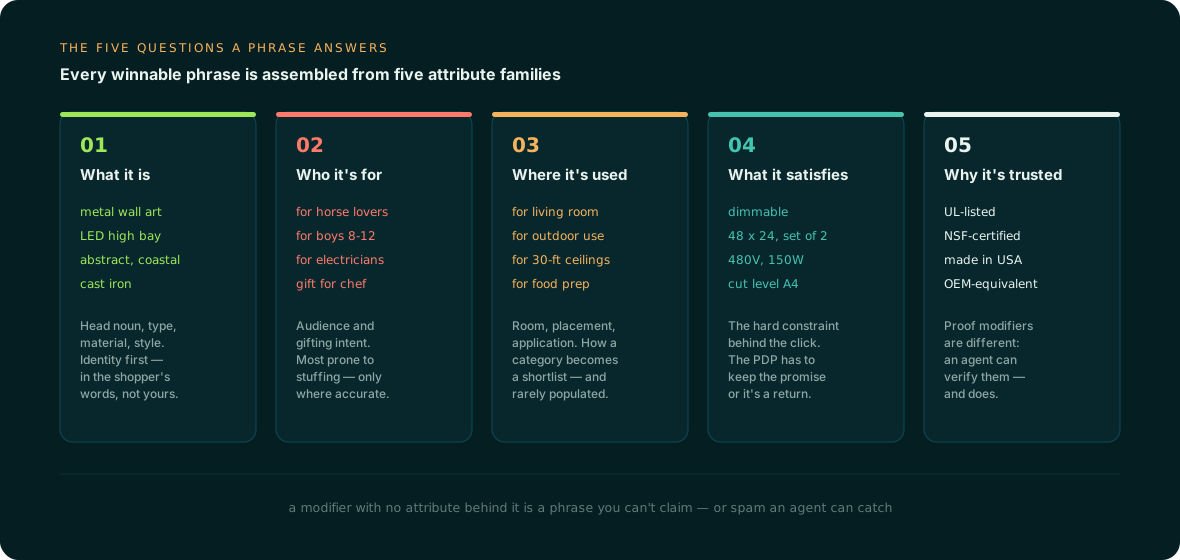
What it is. Head noun, product type, category, material, style. Identity comes first because everything else refines it — get the head noun wrong ("wall decor" when shoppers say "wall art," "luminaire" when contractors say "high bay") and no amount of modifier coverage recovers it.
Who it's for. Audience, recipient, gifting intent: "for horse lovers," "for boys age 8–12," "for electricians." Agents match audience phrases against profile and conversation context — and this is the family most prone to stuffing, so it only belongs on SKUs where it's genuinely accurate.
Where it's used. Room, placement, application, occasion: "for living room," "for outdoor use," "for 30-foot ceilings," "for food-prep areas." Context is how a shopper turns a category into a shortlist, and it's usually the least-populated attribute family in the catalog because nobody's ERP requires it.
What it must satisfy. The hard constraints behind the click: dimmable, 48 x 24, set of 2, 480V, cut-resistance level A4. These are the modifiers the PDP has to keep the promise on — a constraint phrase that survives retrieval but fails on the spec sheet becomes a return.
Why it's trusted. UL-listed, NSF-certified, OEM-equivalent, made in USA. Proof modifiers are different in kind from the other four: they're claims an agent can independently verify, and increasingly does.
Not every phrase uses all five slots — "for the living room" answers where, "UL-listed" answers why trust it — but every winnable phrase for a SKU is assembled from these families. Which means your phrase inventory isn't something you brainstorm. It's generated by the attribute columns you've actually filled.
The phrase is the front end. The attribute is the receipt.
This is where noun phrase optimization stops being a copywriting tactic and becomes a data-completeness problem. Three consequences follow:
| If the attribute column is... | Then the phrase... | And the agent... |
|---|---|---|
| Filled and accurate | Is claimable — title, bullets, schema can all express it | Retrieves the SKU and can verify the claim |
| Empty | Can't honestly be assembled | Filters the SKU out of queries it should win |
| Contradicted by the phrase | Is a forced phrase — spam | Detects the mismatch and discounts the listing |
The third row has teeth now. Agent-commerce guides document assistants dropping brands after detecting mismatched claims and elevated return rates — accuracy and consistency outrank cleverness. A modifier you bolt onto a title without a structured value behind it used to be harmless keyword garnish. To a system that cross-checks the title against the spec table, the schema markup, and the review corpus, it reads as a lie about the product.
The audit, then, runs backwards from how most teams approach listing optimization. Don't start with the title. Pull the top fifty queries you should win in a category, decompose each into its five slots, and map every modifier to the attribute column that would back it. Every modifier without a column is a phrase you're invisible for. Every column without accurate values is the same. What's left — the phrases where every slot has a verified value behind it — is the language your titles, bullets, and markup should be assembled from. Structured attribute coverage is already one of the strongest levers for AI recommendation visibility; the noun-phrase lens just tells you which attributes are worth filling first.
Your PIM stores those columns; it doesn't fill them. Anglera does the work — reading the cut sheets, spec PDFs, supplier feeds, and imagery behind each SKU to populate the identity, context, constraint, and certification attributes that phrases decompose into, and flagging conflicts instead of guessing past them. A noun phrase is a stack of claims. Anglera's job is making sure every claim in the stack has a receipt.
Sources:
- Amazon — Meet Alexa for Shopping, your personalized, agentic AI assistant
- Francesca Tabor — Noun Phrase Optimization: The New SEO for Amazon Rufus and AI Search Engines
- Paz.ai — How to Structure Product Data for AI Agents
- UCP Hub — Product Feed Optimization for AI Shopping Agents: The 2026 Distribution Guide
- Evolve Media — Ecommerce AI Search Glossary 2026