
RESCO: How a Member-Owned Co-op Beat the Transformer Shortage
RESCO ranks #37 on MDM's 2026 Electrical Top Distributors list. Its cooperative-to-cooperative supply chain beat the industry's worst transformer shortage.
Part of Distributor Playbooks — strategy teardowns of every company on the MDM Top Distributors lists. New to the 2026 lists.
In Modern Distribution Management's 2026 Top Distributors report, RESCO ranks #37 among electrical distributors, with $404 million in revenue. That puts it well below the billion-dollar national chains that dominate that list. RESCO isn't trying to out-scale them. It is owned by the rural electric cooperatives it supplies, and that ownership structure, not branch count, is what makes it worth studying.
A cooperative born to supply cooperatives
On April 30, 1936, representatives of 14 rural electrification projects in Wisconsin organized the Wisconsin Rural Electric Cooperative Association, one year after the federal Rural Electrification Administration began pushing power lines into the parts of the country investor-owned utilities had decided weren't worth the wire. The new association's job was mundane and essential: buy poles, wire, transformers and hardware in bulk so the fledgling co-ops stringing lines across Wisconsin farmland didn't have to negotiate alone against manufacturers.
In 1972, the organization renamed itself Rural Electric Supply Cooperative to reflect what it had become: a multistate wholesale distributor supplying the materials and equipment rural electric cooperatives need to run their operations, according to RESCO's own history. The company marks its 90th anniversary in 2026, the same year it lands at #37 on MDM's Electrical list.
The insight: a cooperative supply chain, top to bottom
Here is the detail that most coverage of RESCO skips past. One of RESCO's key suppliers for distribution transformers, the single most supply-constrained category in electrical distribution for most of the last four years, is ERMCO, a transformer manufacturer wholly owned by Arkansas Electric Cooperatives Inc. RESCO president and CEO Matt Brandrup told Cooperative.com in 2024 that during the worst of the transformer shortage, when for-profit manufacturers were quoting lead times stretching past two years, RESCO's relationship with ERMCO kept its own transformer fulfillment down to 14 to 20 weeks.
That is not a vendor discount. It is a cooperative buying from a cooperative to supply cooperatives, and it held up precisely when the commercial market broke. Most electrical distributors compete on inventory depth and negotiating leverage built through purchase volume. RESCO's leverage runs through common ownership instead. The manufacturer, the distributor and the end customer are, in a real sense, drawn from the same membership. It is the kind of structural advantage that shows up in a crisis, not in a sales deck.
Patronage, not profit
RESCO is a not-for-profit cooperative. Margin above operating costs is returned to members as patronage capital rather than paid out to shareholders or plowed into growth for its own sake, per the company's about page. Brandrup has described the model's real function as binding, not just financial: "The cooperative model bonds the employees of the cooperative to our owner-members in a very unique way," he said in comments posted on RESCO's site.
That framing matters more than it sounds. Electrical and industrial distribution has spent a decade absorbing private equity roll-ups. RESCO's ownership structure is close to fireproof against that kind of consolidation, because its owners are electric cooperatives that need reliable supply, not investors looking for an exit. There is no cap table to sell.
The trade-off is real too. A member-owned nonprofit with nine warehouses and $404 million in revenue does not have access to the capital markets that let a Sonepar or a WESCO fund acquisitions at national scale. RESCO grows by adding capacity where its members need it, not by buying market share.
Building capacity for the next shortage, not the last one
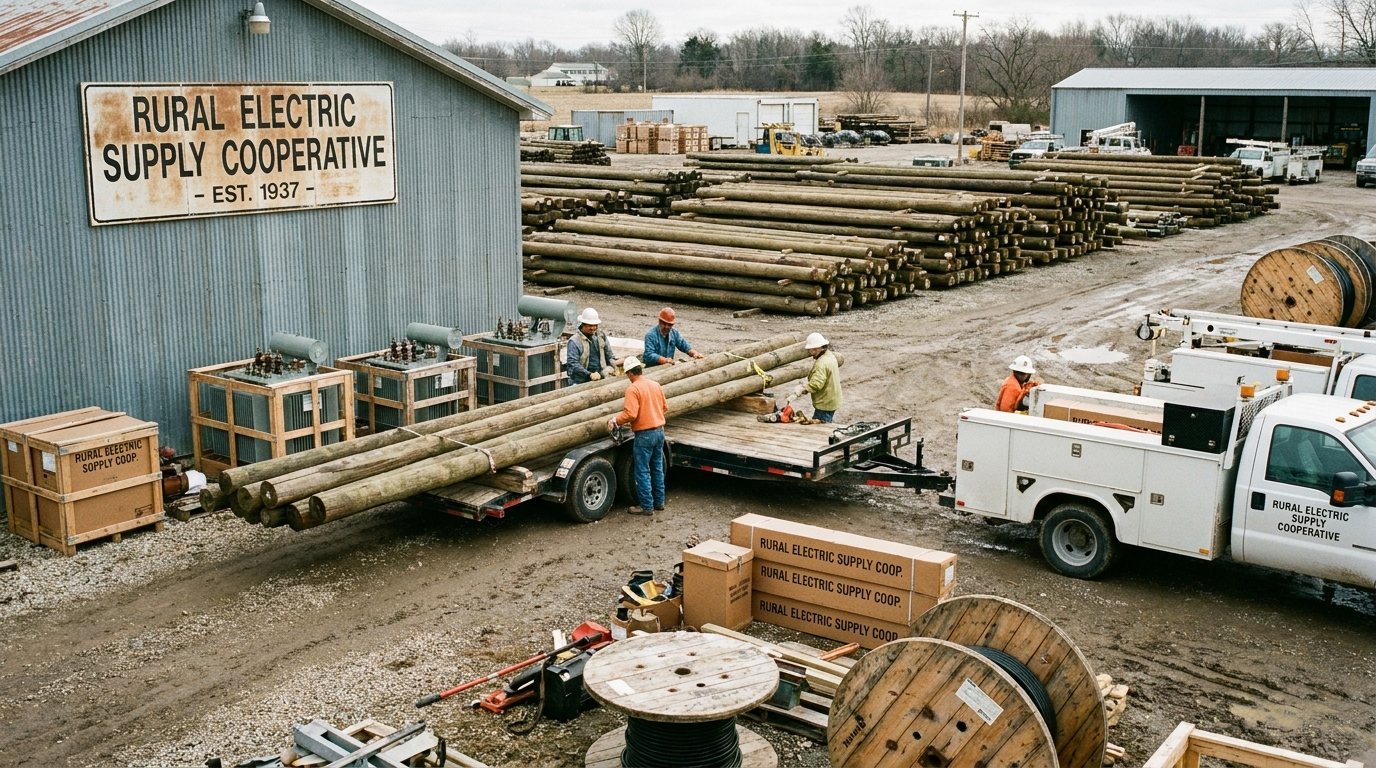
That shows up in RESCO's recent expansion. During the 2021 to 2024 inflation run, when Brandrup said material costs rose roughly 40 percent cumulatively since 2020, RESCO more than doubled its available inventory to over $50 million in stock, expanded warehouses in Michigan and Minnesota, added a distribution center in Iowa, and began work on a Wisconsin logistics facility adding 120,000 square feet of storage. In early 2026, RESCO broke ground on a new 72,000-square-foot facility in Dilworth, Minnesota, scheduled to open in 2027 and built specifically to serve member cooperatives and municipal utilities across Minnesota and the Dakotas.
Across nine warehouses spanning 11 states, the pattern is a distributor investing ahead of the next supply disruption rather than reacting to the last one. Buy early, hold deep inventory, keep transformers moving even when the broader market can't. That is what a member-owned utility supplier is structurally built to do. Its owners are the ones who get hurt by a stockout, so the incentive to over-invest in resilience runs straight through the ownership.
The technical layer
RESCO also operates EUSCO, a manufacturer-representation arm that layers engineering support, technical assistance and certified meter technician services on top of the core distribution business, according to the company's about page. For member cooperatives making significant equipment purchases, that pairs procurement with technical judgment, a combination that larger investor-owned electrical distributors often outsource to manufacturer reps whose incentives don't fully match the buyer's.
RESCO's 90 years say less about longevity for its own sake and more about what a cooperative can build when it answers only to the members it serves: warehouses stocked ahead of the crisis, a transformer supply chain that held during the worst shortage the industry has seen in a generation, and a catalog built for utilities rather than shareholders. In distribution, the plumbing, the inventory and the ownership structure matter as much as the brand on the truck.
This profile is part of Anglera's Distributor Playbooks series, covering the operating models behind the companies on MDM's 2026 Top Distributors lists.