
Winsupply: The Distributor Built Like 680 Small Businesses
Winsupply hit $8.4B not by centralizing branches like its peers, but by giving each one away in pieces. Here is how that bet from 1958 still shapes it.
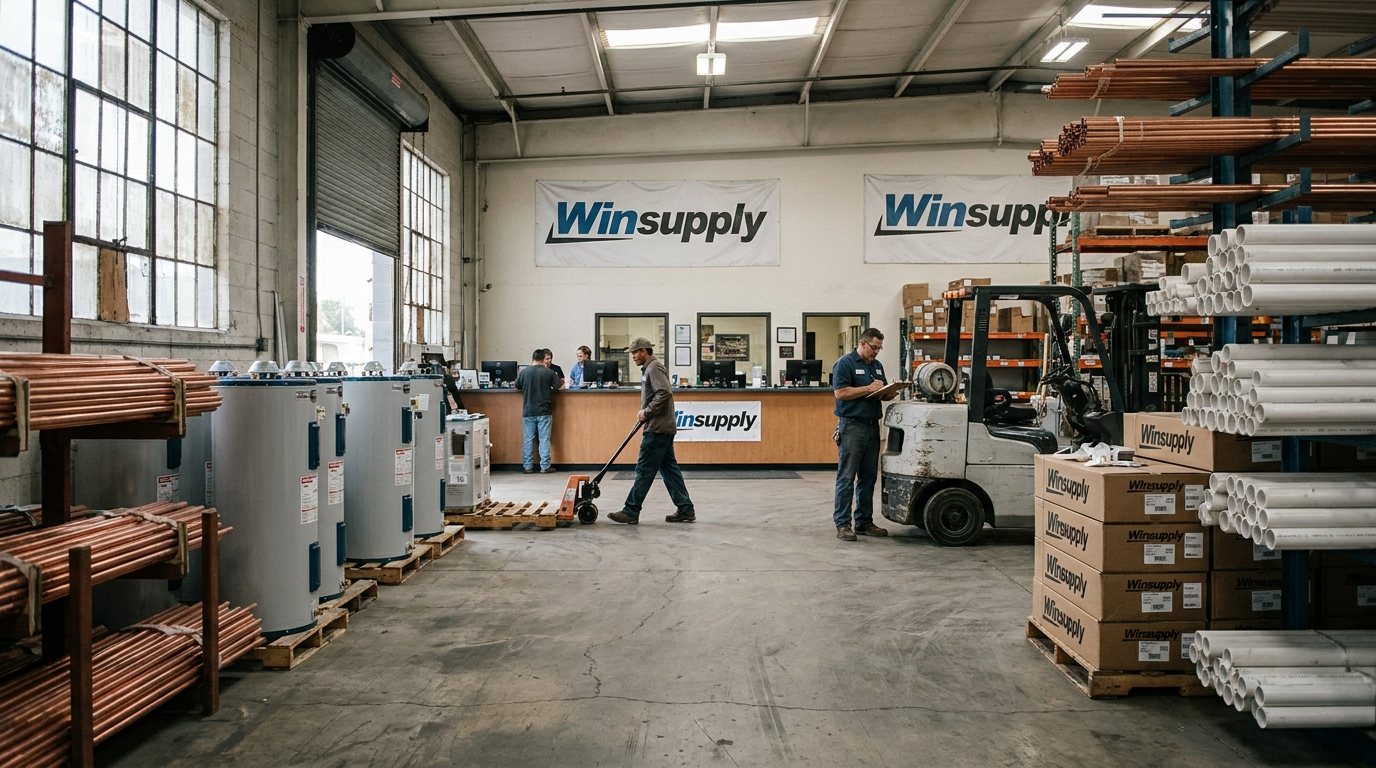
Part of Distributor Playbooks — strategy teardowns of every company on the MDM Top Distributors lists.
Winsupply lands at #2 in Plumbing, #4 in HVACR, #5 in Industrial PVF, #21 in Electrical/Data/Security (down from #17 in 2025), #21 in Industrial Supplies and #15 in Safety on MDM's 2026 Top Distributors lists, the annual ranking from Modern Distribution Management of North America's largest wholesale distributors. The Dayton, Ohio company did $8.4 billion in revenue for the fiscal year ended January 2026, per MDM, across a footprint of more than 680 operating companies. Almost none of those companies are named Winsupply, and that is the entire point of how it got here.
A fire in Pueblo, not a business plan
The company's origin story is less "three friends had a vision" than "three friends had a bankruptcy on their hands and no better idea." In 1956, Dick Schiewetz, Bob Kuhns Jr. and Steve Wolfe Sr., three Dayton businessmen, incorporated a company called Primus Inc. to provide financing and management help to struggling small companies. It was a workout shop, not a wholesaler.
The turn came in 1958, when a fire destroyed the Pueblo, Colorado branch of N.O. Nelson Company, a St. Louis-based construction wholesaler founded in 1875. Primus bought the damaged branch's fixed assets and installed a local operator to run it as an independent entity. By the end of that year, the parent company had gone bankrupt and Primus had acquired nearly all of what remained. That single salvaged branch became, in Winsupply's own telling, its first "Local Company," per the company's history page.
What could have been a one-off asset purchase instead became a template. Over the following decades the company built out shared infrastructure piece by piece: Dapsco for business services in 1963, Carmen Inc. for group purchasing in 1972, Distro for sourcing and logistics in 1982. Operations consolidated under the WinWholesale name in 2005, and the group rebranded as Winsupply in 2015. The company's own name is barely on any of its stores. In city after city the door reads Winnelson, Winlectric, Winwater, Windustrial, Wintronic, Winpump or Winair, plus dozens of acquired names left alone entirely.
The insight: it never stopped being a holding company for entrepreneurs
Here is the part that does not show up on the About page in those words: Winsupply is not really a distribution chain that happens to have local managers. It is closer to a private-equity holding company that happens to sell pipe fittings, and it has run that structure for seventy years while its sector consolidated in the opposite direction.
Every one of its 680-plus Local Companies is a separate C-corporation, majority-owned by Winsupply, with the local president and team able to hold up to roughly 40 percent of the equity, according to reporting from Distribution Strategy Group. The president sets local pricing, hiring, and customer strategy. Winsupply supplies the balance sheet, the buying power, the IT stack, and the e-commerce platform. Profits flow back to local owners as dividends, and equity typically grows with tenure and performance, so a branch manager who joined at 28 can retire holding a meaningful stake in a business worth tens of millions.
That is structurally unusual in a distribution landscape where the dominant playbook of the last two decades has been the opposite: a private equity sponsor buys a founder-run distributor, strips out the founder's authority, centralizes purchasing and pricing, and preps for a multiple-expansion exit. Winsupply took the founder-authority piece and made it permanent and repeatable, granting it to hundreds of operators instead of one, while still consolidating the parts of the business, capital, technology, freight, vendor terms, where scale actually helps. It solved the tension between local entrepreneurial hustle and national buying power by not choosing, and by never selling.
Where it is spending the scale it built
The proof that the model still compounds is in what Winsupply does with its balance sheet now. The company is adding roughly 1.6 million square feet of distribution capacity over two years, headlined by a 1.17-million-square-foot center near Atlanta and a 254,000-square-foot expansion in Oklahoma City, according to the company's own announcement. That framing, capacity built explicitly "to support local entrepreneurs," is not incidental language. It is the model's thesis stated as a press release.
It is also modernizing the parts a decentralized network typically neglects. Digital sales sit around 15 percent of revenue today, a figure the company has said it wants to grow, and it took a minority stake in Mined XAI, a Dayton-based explainable-AI firm, to build predictive inventory and purchasing models across the network, per Digital Commerce 360. And the acquisition engine keeps running at the Local Company level rather than through one big roll-up deal: Industrial Sales Co. in Kansas, United Lighting & Supply in Florida, R.A. Novia & Associates in Connecticut all closed within roughly a year of each other, each one becoming its own semi-autonomous node rather than a branch folded into an existing one.
The trade-off worth naming
The honest tension in this model is speed of central control. A distributor with 680 semi-independent owners cannot flip a national pricing strategy or a vendor rationalization overnight the way a fully centralized competitor can, because each local president has real authority and, often, personal capital riding on the decision. Winsupply has bet that the entrepreneurial energy and retention that model buys, in a labor-tight trade like plumbing and HVAC distribution, is worth more than the speed it gives up. Seventy years and $8.4 billion later, across six separate MDM verticals, that bet still looks like it is paying for itself.
Distribution's biggest advantages rarely announce themselves. They live in who owns the branch, what the catalog says, and how fast the truck shows up.