
How fastener distributors manage product data for thousands of SKUs
Fastener distributors manage thousands of SKUs by storing each part as structured attributes per category, then generating titles, filters, and feeds from them.
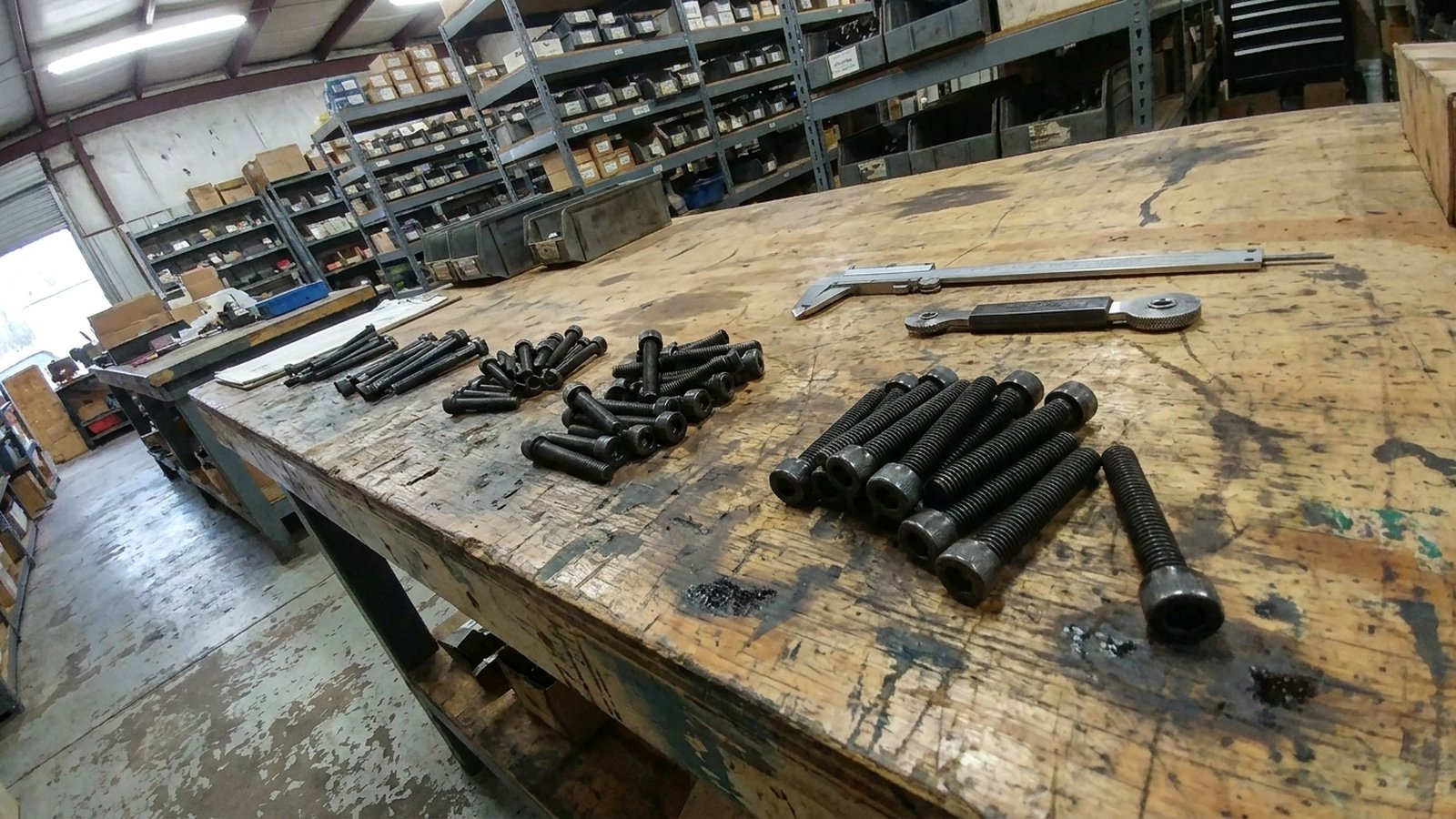
Fastener distributors that manage thousands of SKUs well treat every part as a set of structured attributes (thread size and pitch, length, grade or property class, material, finish, head and drive, standard, pack quantity) held in one record per SKU, scoped by product class. Titles, search filters, ERP descriptions, and marketplace feeds are then generated from those attributes rather than typed by hand, so 400 near-identical hex cap screws stay consistent and findable.
The hard part is getting clean values into those fields when most rows start as a terse ERP description like HCS 3/8-16X1 G5 ZP.
Why fastener product data is harder than most categories
A fastener is defined almost entirely by its attributes. Two SKUs that differ only in pitch, finish, or grade look identical in a photo and behave very differently in an assembly. DDS lists the attribute surface for a single bolt as thread size, pitch, threads per inch, grade or class, tensile strength, proof load, hardness, material, alloy designation, finish, coating type, head style, drive type, length, diameter, wrench size, thread direction, and applicable standards (DIN, ISO, ASTM, SAE), and puts typical fastener distributor catalogs at 40,000 to 500,000 SKUs.
Three things multiply the work:
- Variant explosion. One hex cap screw style crossed with every diameter, length, thread series, grade, and finish produces hundreds of SKUs per family.
- Two measurement systems. Inch parts follow the Unified Thread Standard, where
3/8-16 UNCmeans 16 threads per inch and the fine-thread3/8-24 UNFis a different part (Unified Thread Standard). In metric designations the standard coarse pitch can be omitted, soM8andM8x1.25describe the same thread (ISO metric screw thread). If your data stores both spellings, your filters split one size into two. - Grade semantics. Inch strength grades come from SAE J429, where Grade 5 carries a 120,000 psi minimum tensile strength through 1 inch and Grade 8 carries 150,000 psi (Portland Bolt on SAE J429). Metric carbon-steel parts use ISO 898-1 property classes such as 8.8 instead (ISO 898). A single
Gradetext field that holds5,Gr5,8.8, and a stainless class likeA4-70is not filterable.
How fastener distributors structure product data for thousands of SKUs
The working model has four layers, whether the record lives in a PIM, an ERP item master, or a spreadsheet.
1. A class per part type. Hex cap screw, socket head cap screw, carriage bolt, hex nut, flat washer, threaded rod. Each class owns its attribute list. The ETIM classification standard is a useful public reference: its Bolt class (EC003861) defines 28 features, including Thread size (metric), Thread size (imperial), Pitch thread, Thread per inch, Length to bottom side head, Full thread, Surface protection, Head form, and Left-handed thread (ETIM class EC003861). Its JSON-based ETIM xChange format carries that data between trading partners (ETIM North America).
2. Category-scoped attributes. A nut does not need Length; a washer needs OD and ID. ERP and PIM vendors build for this directly. 10X ERP describes attributes scoped by category so that a fastener "shows thread and grade" while a hose shows bore and burst pressure (10X ERP PIM).
3. Controlled values with units split out. Length is a number plus a unit, not the string 1in. Finish is a pick-list (Zinc Plated, Zinc Yellow, Black Oxide, Hot-Dip Galvanized, Plain), not free text. Thread size and pitch are separate fields so M8 and M8x1.25 resolve to one value. Our guide on how to structure product attributes and values covers the data-type decisions in more detail.
4. Packaging as its own dimension. Fasteners are bought by the each, the box of 100, and the bulk carton. 10X frames the general problem as "buy by the case, stock by the each, sell by the foot" (10X ERP PIM). Pack quantity belongs in a field, and whether each pack size is a separate SKU or a unit-of-measure on one SKU is a decision you make once and apply everywhere.
What the big catalogs show you about attributes
McMaster-Carr, Grainger, and Fastenal are the reference points buyers already use, and their public pages are the best free spec for your own model. On McMaster-Carr's hex head screw category, the filters a buyer can apply include Thread Size, Length, Thread Pitch, Thread Spacing (coarse, fine, extra fine), Thread Type, Thread Direction, Material, Fastener Strength Grade/Class, Head Width, Head Height, Drive Style, Finish, and Specifications Met covering ASME, ASTM, DIN, IFI, ISO, and SAE (McMaster-Carr hex head screws).
Every one of those filters only works because the underlying field is populated, typed, and normalized on every SKU in the category. When you compare hex cap screw listings on Grainger and Fastenal, read them the same way: which fields lead the title, which are filterable, how pack quantity shows. A title that reads thread size, length, grade, finish in the same order on every row is a generated string, not copywriting. If you are building a Fastenal-style or Grainger-style product catalog for fasteners, that is the thing to copy: the field discipline underneath, not the page layout.
Generating consistent titles and filters from attributes
Once the attributes are clean, titles and facets become templates. A worked example for one class:
| Field | Example value | Used in |
|---|---|---|
thread_size | 3/8 | Title, filter |
thread_pitch_tpi | 16 | Title, filter |
thread_series | UNC | Filter |
length_in | 1 | Title, filter |
grade | Grade 5 | Title, filter |
material | Steel | Filter |
finish | Zinc Plated | Title, filter |
standard | from the source sheet | Spec table |
pack_qty | 100 | Title, price per unit |
Title template for the class: Hex Cap Screw, thread_size-thread_pitch_tpi x length_in in, grade, material, finish, pack_qty Pack. Output: Hex Cap Screw, 3/8-16 x 1 in, Grade 5, Steel, Zinc Plated, 100 Pack.
The rules that keep this consistent at scale:
- One template per class, not per SKU. Change the template, regenerate 3,000 titles.
- Never fill a slot with a guess. If
finishis empty, the title should drop the slot and the record should land in a review queue, not inherit a default ofPlain. - Filters read the same fields. If the title says
Grade 5and the facet saysGr. 5, a buyer filtering by grade misses the part.
Where the data actually comes from (and who does the work)
Most distributors are not short of a place to store fastener attributes. They are short of the values. DDS says most fastener distributors operate with little more than a part number and a basic ERP description (DDS). The values sit in manufacturer catalogs, spec sheets, the standards themselves, and abbreviations buried in that ERP string.
Getting them out is extraction plus normalization: parse HCS 3/8-16X1 G5 ZP into six fields, confirm against the manufacturer's sheet, map ZP and Zinc and Zn Plt to one finish value, and flag the row where the ERP says Grade 5 and the supplier sheet says Grade 8. For illustration, a 40,000-SKU catalog at 10 minutes of manual work per SKU is about 6,700 hours, before any new attribute gets added later.
This is the gap Anglera fills. Your PIM stores the data; Anglera does the work of extracting values from real source documents, normalizing them to your attribute model, scoring each value, and flagging conflicts for review instead of inventing an answer. It works with whatever you run today (a PIM, an ERP, a syndication platform, or a flat CSV export) and typically goes live in 30 days or less. Our page for fastener distributors covers how that runs for this category.
What goes wrong, and how to decide where to start
The failure modes repeat across catalogs:
- Attributes buried in the description. The ERP string is the only copy of the grade, so no filter can see it.
- Duplicate values.
Stainless,SS,18-8, and304 SSsit side by side in one facet. - Metric and inch mixed in one field.
Lengthholds25mmon one row and1"on the next, so sorting breaks. - Packaging confusion. The same screw appears as three SKUs with no
pack_qty, and buyers cannot tell which is the box. - Cleanups that decay. A project fixes the backlog, then new SKUs arrive in the old format.
To decide where to begin, rank classes by revenue and search volume, not by SKU count. Check your own search logs; core classes like hex cap screws, socket head cap screws, hex nuts, and flat washers are common candidates. Lock the attribute list and title template for those classes first, backfill them, then move down the list. If you are starting from almost nothing, our post on the catalog cold start for thousands of SKUs walks through sequencing, and our breakdown of fastener attributes goes deeper on the fields themselves.
Fastener data stays manageable when every SKU is a typed attribute record and every title and filter is generated from it. The work that decides whether that holds is filling and maintaining those values from source documents as the catalog grows. That ongoing, source-grounded enrichment is what Anglera runs alongside the systems you already have.