
The Macomb Group: Built by Owners, Grown by Acquisition
The Macomb Group grew from a 1991 leveraged buyout by two childhood friends into a 32-branch PVF distributor, ranked No. 8 in MDM's 2026 rankings.
Part of Distributor Playbooks — strategy teardowns of every company on the MDM Top Distributors lists. New to the 2026 lists.
In January 1991, two childhood friends from Harper Woods, Michigan, who had grown up playing Little League together, took out a leveraged loan and bought the small pipe shop where they'd both swept floors and packed orders years earlier. Thirty-five years later, that company, The Macomb Group, lands at No. 8 on the pipe, valves and fittings list in Modern Distribution Management's 2026 Top Distributors report, the annual ranking of North America's largest wholesale distributors. That is the hook. The story underneath it is a lesson in how a founder-owned company competes in a sector that private equity has been rolling up for a decade.
From warehouse floor to leveraged buyout
Bill McGivern and Keith Schatko did not inherit The Macomb Group. They earned their way into owning it. Both started at the bottom of what was then called Macomb Pipe & Supply, founded in 1977, working the sales counter and packing orders while they finished college. In January 1991, McGivern, Schatko and a third partner, Doug Howe, structured a leveraged buyout of the company, according to PHCP Pros' account of the milestone. That is a meaningfully different starting point than most companies on the MDM list, which tend to be either multigenerational family holdings or portfolio companies of a private equity sponsor. Macomb is neither. It is an operator-led buyout that never sold control.
The breakthrough came in 1999, when the company won the bulk-materials contract on Detroit Metro Airport's McNamara Passenger Terminal, a project McGivern later called "the catapult that defied the competition and put us in the big leagues." Winning a marquee infrastructure job as a small regional PVF house forced Macomb to prove it could handle scale, logistics and schedule risk that larger competitors assumed only they could manage. It is the kind of reference project that changes what a distributor is allowed to bid on next.
The insight: independent ownership, cooperative scale
Here is the part of the Macomb story that does not show up on the company's About page. PVF distribution has consolidated hard over the past ten years, with private equity platforms and strategic acquirers buying up regional pipe houses to build national footprints. Macomb has grown just as aggressively, adding acquisitions like Woodhill Supply in Ohio, Trident Fire & Fabrication in New Jersey and Leonhardt Pipe & Supply in the Southeast, plus a merger with Pennsylvania's Deacon Industrial Supply. But it has done all of that while staying privately held by the operators who bought it in 1991.
The mechanism that lets a founder-owned company compete against PE-backed scale is membership in Affiliated Distributors (AD), the buying and marketing cooperative that pools purchasing power across independently owned distributors so members get vendor terms closer to what a national chain would command, without giving up equity to get there. Macomb was named AD's PVF Division 2025 Member of the Year and leads one of AD's Executive Network peer groups, a role that puts its operators in the room shaping how the cooperative itself runs. That combination, owner-operated plus cooperative-scaled, is the non-obvious structural bet: Macomb gets the purchasing leverage of a much larger company without the debt load or the sponsor exit clock that comes with a PE-backed roll-up. It can acquire on its own timeline instead of a fund's.
What the acquisitions actually bought
The pattern in Macomb's recent deals is not simply "more branches." Each acquisition added a specific capability layer on top of straight PVF distribution:
| Acquisition | What it added |
|---|---|
| Woodhill Supply (Willoughby, OH) | A 300,000-square-foot, 25-acre distribution hub and HVAC/kitchen-and-bath lines |
| Deacon Industrial Supply (PA) | Mid-Atlantic distribution center supporting fabrication |
| Trident Fire & Fabrication (Carlstadt, NJ) | East Coast fire-protection fabrication capacity |
| Leonhardt Pipe & Supply (Southeast) | Fire-protection production capability across GA, NC, SC |
Keith Schatko, EVP and owner, described the Woodhill deal's logic plainly: the Willoughby facility would let Macomb "more quickly and efficiently serve our growing customer base" across a footprint that now "stretch[es] from the Midwest through the Mid-Atlantic and down through the Southeast," per Distribution Strategy Group's coverage. Fire protection and fabrication, not just commodity pipe, are the through-line. That is a deliberate move up the value chain: fabricated and coated pipe carries better margin and stickier customer relationships than reselling standard fittings, and it is much harder for a pure-play buying-group competitor to replicate on short notice.
Scale, without losing the name on the door
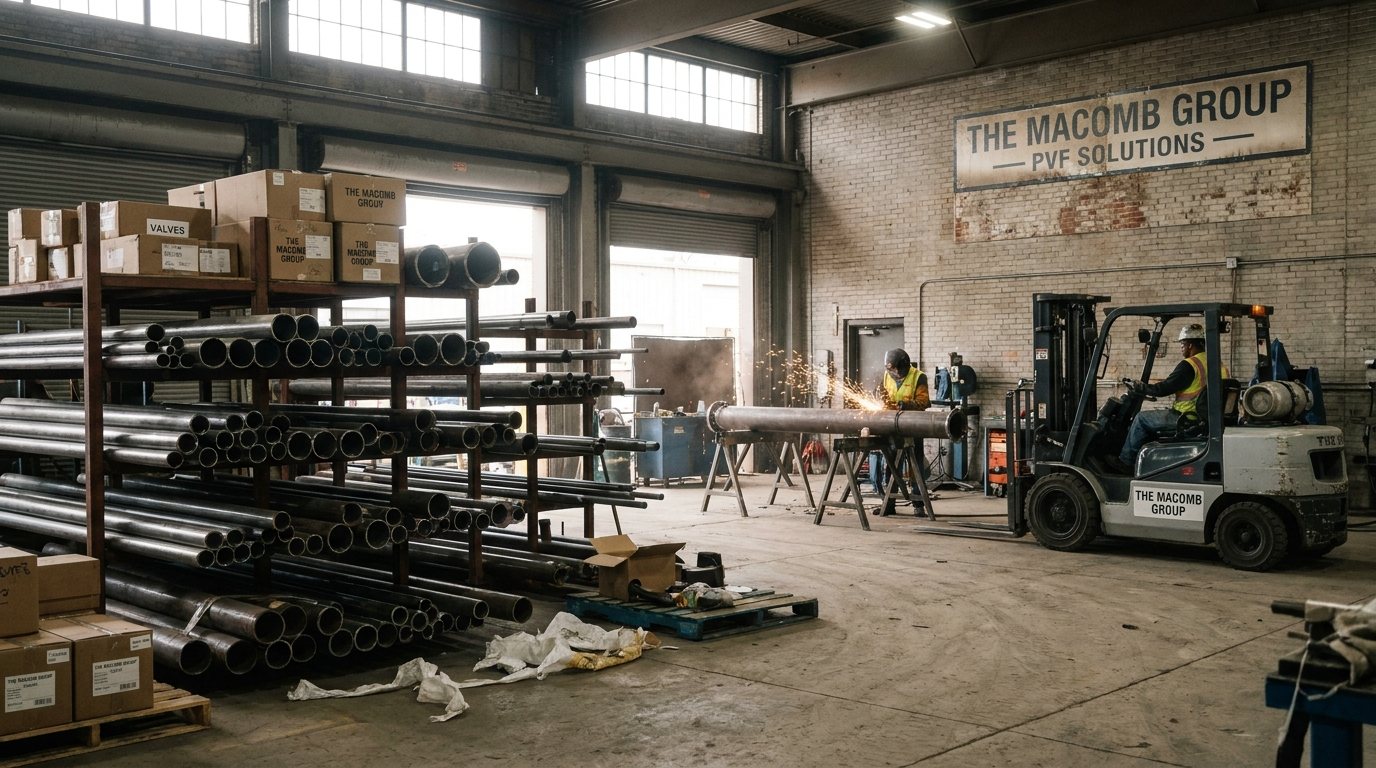
The operating footprint backs up the strategy. By 2026, The Macomb Group runs 32 branches across 11 states, employs more than 700 people, and operates a private fleet of over 200 trucks, up from 18 locations in seven states just five years earlier at the company's 30th anniversary. COO Scott Henegar credited the growth to unglamorous fundamentals: "doing the little things right, having correct material, delivering accurately, and delivering on time." The company also climbed to No. 5 nationally among industrial PVF distributors in Supply House Times' 2026 Premier 150 survey, its highest ranking yet, and posted a second consecutive year of double-digit growth heading into 2025.
McGivern's own description of the culture, staying "small enough to be nimble" even as the branch count triples, is the tension worth naming honestly. Buying-group scale and acquisitive growth are real advantages, but they also test whether an owner-operated culture forged by two guys who packed orders in Harper Woods can hold together across 11 states and 700 employees. So far the AD cooperative structure and the deliberate focus on fabrication and fire protection, rather than chasing every commodity PVF deal available, look like the mechanism keeping that promise intact.
Every distributor on the MDM list is, underneath the branch counts and truck fleets, a bet on how well a company can move the right part to the right job site on time. The Macomb Group's version of that bet still has the same two names on the paperwork from 1991.