
NFI Industries: The Jan-San Distributor With No Products
NFI Industries ranks #14 on MDM's 2026 Jan-San list without selling a single cleaning product. Here is how a fourth-generation trucking family built that model.
Part of Distributor Playbooks — strategy teardowns of every company on the MDM Top Distributors lists. New to the 2026 lists.
NFI Industries lands at #14 on the jan-san list in Modern Distribution Management's 2026 Top Distributors report, the annual ranking of North America's largest distribution companies, with more than $3.7 billion in total company revenue. Scroll the rest of that jan-san list and every other name sells cleaning chemicals, paper, or equipment under its own account. NFI does not. It is a 94-year-old, fourth-generation, family-owned trucking and warehousing company from Cherry Hill, New Jersey, and its presence on a product-category ranking is itself the story worth telling.
The company that shows up without inventory
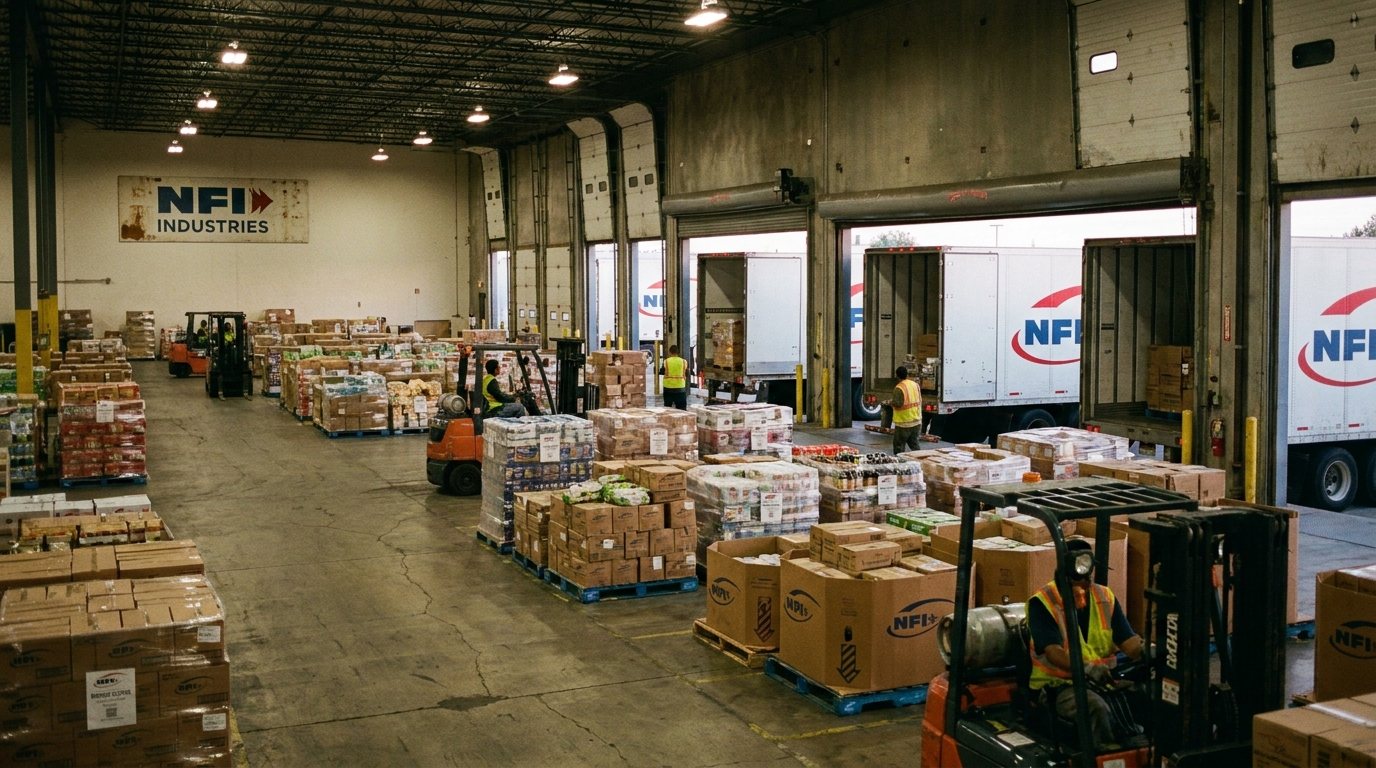
NFI never takes title to a case of degreaser or a pallet of hand soap. What it sells jan-san manufacturers and distributors is the infrastructure around the product: warehouse space, labor, transportation, and the systems that move goods from a plant to a retail shelf. Its consumer packaged goods logistics unit runs inventory management, co-packing, display builds, and multichannel distribution for CPG brands, with a stated ability to get product into major retail chains within one to two days of an order. That is a fee-for-service business, not a margin-on-goods-sold business, and it is why NFI's revenue in MDM's ranking comes from a completely different mechanism than the wholesaler two spots above it on the list.
That is the unique wrinkle in this profile: MDM's jan-san ranking, built to compare distributors by product revenue, has to fold in a company whose entire model is refusing to own the product. NFI is not competing with WAXIE or Network Services on price sheets or private-label chemistry. It is competing to be the outsourced supply chain that those companies, and the manufacturers behind them, would otherwise have to build themselves.
How the infrastructure got built
The company's roots have nothing to do with cleaning supplies. Israel Brown started National Hauling in 1932 in Vineland, New Jersey, with a single truck hauling gravel, according to NFI's own company history. His son Bernard "Bernie" Brown joined in the 1940s, won government freight contracts during World War II, and spent the next four decades pushing the business past trucking alone. Bernie lobbied for high-cube trailers, championed federal deregulation of the trucking industry in the 1980s, and put capital into warehousing and real estate at a time when most regional truckers stayed truckers. That decision to own dirt and buildings, not just trailers, is the hinge the modern company still turns on.
The third generation, brothers Sid, Ike, and Jeff Brown, took that warehousing bet and industrialized it. Sid Brown now serves as CEO. Under their run NFI stacked acquisitions to widen what it could offer a CPG or jan-san client under one contract: California Cartage in 2017 for port drayage, G&P Trucking in 2019 for Southeast density, SDR Distribution in 2023, which doubled the company's Canadian distribution footprint, and the freight brokerage arm of Transfix in 2024, which added roughly 15,000 carriers to NFI's network. The company now operates more than 70 million square feet of warehouse space and employs over 17,000 people, still fully owned by the Brown family. A fourth generation is already inside the business, required to work outside NFI first and to rotate through operating roles before touching strategy, the same apprenticeship model the company used on generation three.
The bet on volume over margin
That family-ownership fact matters more in trucking and 3PL than it would almost anywhere else in distribution, because NFI's direct public peers — XPO, Ryder, C.H. Robinson — are all publicly traded or private-equity-backed at scale. Staying independent across four generations while competing against capital markets for warehouse buildouts and automation spend is a harder trick than it looks, and it is one most logistics companies NFI's size have not pulled off.
The most recent evidence of where that capital is going is eCommerce. NFI told the trade press in a July 2026 announcement that it now processes more than 30 million eCommerce orders a year across direct-to-consumer, retail, B2B, marketplace, and returns channels, backed by more than 100 technology integrations, and it hired two new regional vice presidents to run that growth. Pair that with the automation already in its CPG warehouses, Frazier pallet mole systems, gantry racking, and automated guided vehicles, and the strategic picture is a company betting that jan-san and CPG brands will keep choosing to rent supply chain capacity rather than build it, especially as omnichannel order patterns get harder to forecast in-house.
The trade-off is real. Fee-for-service logistics scales with volume and labor cost, not with product margin, which means NFI's economics move differently than a traditional wholesaler's when freight rates or warehouse labor costs spike. It also means NFI has no pricing power over the products moving through its buildings, only over the service of moving them. That is a bet on being indispensable infrastructure rather than a bet on category expertise, and it is the opposite of how most names on the jan-san list compete.
Where that leaves the list
NFI's appearance at #14 is less a statement about jan-san market share and more a signal about how blurred the line between distributor and logistics provider has gotten in a category built on thin margins and heavy freight costs. A company that started with one truck hauling gravel in 1932 now shows up on a cleaning-products ranking having never sold a bottle of anything, because it figured out that the warehouse and the truck were the more durable business all along.
This series exists because distribution runs on the parts nobody outside the industry sees: the branch network, the catalog, the truck route, the data behind the order. NFI Industries is a reminder that sometimes the whole business is that infrastructure, with nothing else attached.