
Your PIM stores the data. Something still has to do the work.
PIMs store product data well but don't gap-fill, normalize, or keep it current on their own. Here's why AI buttons don't close that gap, and what does.

Every PIM vendor now ships an AI button. Generate a description, auto-tag an image, translate a title. Useful features, all of them. None of them answer the actual question a distributor with 40,000 SKUs across six supplier feeds is asking: who is going to sit down and make this data correct, complete, and current — not once, but every week, forever. A system of record was never built to be a system of labor. That distinction is where most catalog-ops budgets quietly go to die.
Storage and work are different jobs
A PIM is, at its core, a very good database with a very good UI. Akeneo, Salsify, inriver, Stibo, Syndigo, Pimcore, Informatica — they all do the same foundational thing well: give every SKU one governed home, enforce a schema, push clean feeds to channels. That's storage. It's not nothing. Before a PIM, a mid-size distributor's product truth lived across a dozen spreadsheets and an ERP field nobody trusted.
But storage assumes the data going in is already good. Real supplier feeds aren't. A commodity supplier ships a flat file with SS 1/4-20 X 1 HEX HD CAP SCR in the description field and nothing in a third of the attribute columns. That's not a PIM problem — the PIM will store that string faithfully forever. It's a data problem, and it existed before the PIM and survives after it, because nothing in the platform's job description says "go figure out what this abbreviation means, split it into structured attributes, and flag the missing thread pitch."
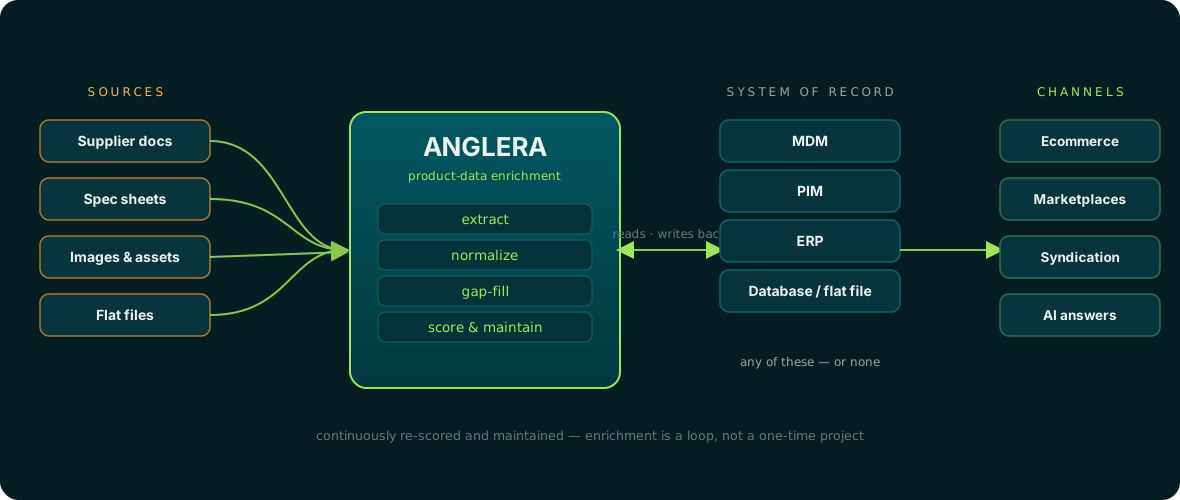
Why the AI button doesn't close the gap
Every major PIM now markets generative AI enrichment. Akeneo's AI Configurations can generate descriptions and auto-tag assets from existing product data and images; inriver has built AI-driven data quality checks and auto-mapping into its onboarding flow; Salsify focuses its AI on reshaping content per retailer syndication spec (Akeneo AI-enhanced enrichment docs). These are genuinely helpful for polishing copy on records that are already mostly complete.
They were not built to run as an unattended operating layer against a raw, gap-riddled supplier feed. The tooling assumes attributes exist to be rewritten, not invented from a scanned spec sheet. It assumes a human is previewing and approving output on a record-by-record basis, not that ten thousand SKUs need scoring, prioritizing, and continuous re-checking as suppliers push updates. A "generate description" button is a feature. A pipeline that ingests a flat file, scores every SKU for completeness, extracts missing values from the source documents that actually contain them, and re-runs itself when the feed changes is an operating model. Those are not the same category of thing, and treating the first as a substitute for the second is how catalogs stay half-enriched two years into a PIM rollout.
The stakes for getting this wrong are no longer abstract. Gartner has said that through 2026, a majority of organizations will abandon AI initiatives because the underlying data isn't ready to support them (Gartner: Lack of AI-Ready Data Puts AI Projects at Risk). A PIM full of governed-but-incomplete records is exactly that trap — well-organized emptiness.
What the gap costs, concretely
Raw feed, as received:
SS 1/4-20 X 1 HEX HD CAP SCR
Enriched attribute table:
| Attribute | Value |
|---|---|
| Product type | Hex head cap screw |
| Material | Stainless steel |
| Thread size | 1/4-20 |
| Length | 1 in |
| Head style | Hex |
| Drive type | External hex |
| Finish | Passivated |
| Country of origin | Extracted from supplier cert |
The left side is what most flat files and legacy ERP exports actually contain. The right side is what a buyer's filter, a retailer's syndication template, and an AI answer engine all need to do anything useful with the part. Nothing about moving that row into a PIM converts the left side into the right side. Somebody, or something, has to do that conversion, attribute by attribute, sourced from the manufacturer spec sheet or cert rather than guessed.
Ask an answer engine "1/4-20 stainless hex cap screw, passivated, 1 inch length" and it needs those discrete fields to match confidently — not a nine-word abbreviation it has to parse and hope. Structured, complete attribute data is measurably more likely to surface in AI-generated answers and shopping surfaces than sparse records, which is the practical reason this stopped being a nice-to-have (Google's 2026 structured product data guidance).
The operating model, not another platform
Manually doing that extraction — reading a spec PDF, cross-referencing a supplier's naming convention, typing values into eight attribute fields — runs in the neighborhood of 30 to 45 minutes per SKU when a merchandising team does it by hand. At 5,000 or 50,000 SKUs, that math is the real reason catalogs stay incomplete; it's not that teams don't know what "done" looks like, it's that nobody has the labor hours.
This is the specific gap Anglera works in. Your PIM stores the data. Anglera does the work: it plugs into whatever's already running — Akeneo, Salsify, inriver, Stibo, Syndigo, Pimcore, Informatica, or nothing more than a flat file export — and continuously scores every SKU for completeness, pulls missing values out of the actual supplier documentation, and re-checks records as source data changes. It's additive, not a PIM replacement, and it's live against a real catalog in weeks rather than a multi-year systems-integration project. The values come from the source, quality-scored against it, not invented.
The PIM question every distributor should be asking in 2026 isn't which platform has the shinier AI button. It's who, or what, is actually doing the recurring work of making the data in that platform trustworthy enough for a buyer, and increasingly an answer engine, to act on without hesitation.