
Pimp my PIM: a stock PIM parks your data — it doesn't drive it
A PIM is a beautiful garage for your product data. It still won't fill the gaps, clean the specs, or push to every channel. Here's the tune-up it's missing.
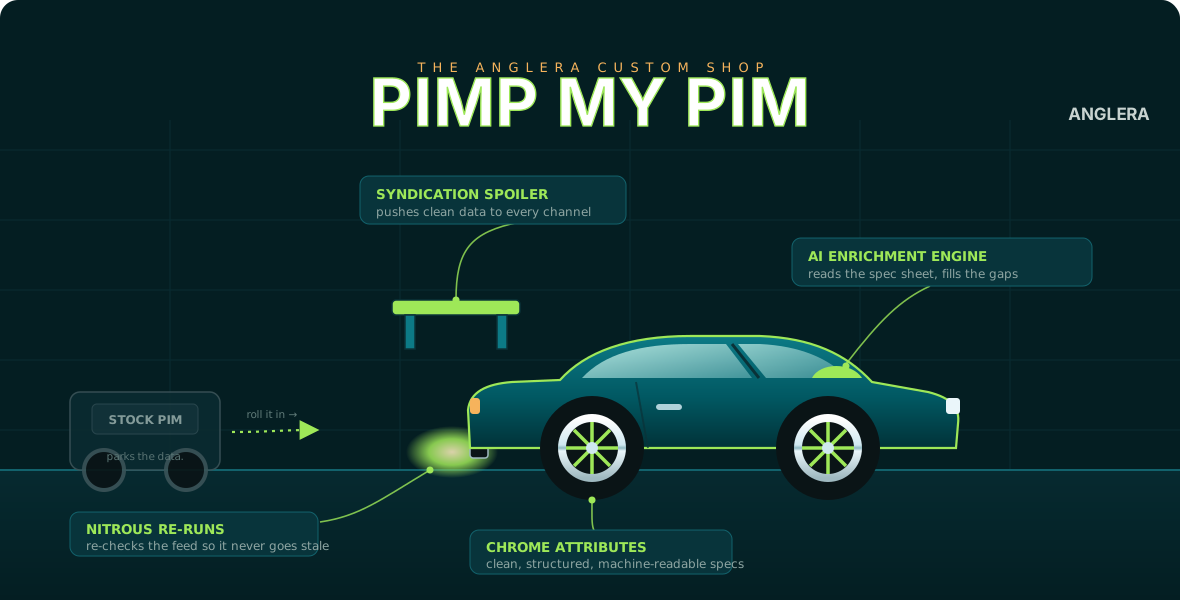
Let's be honest about what a PIM is: a very nice garage. Climate-controlled, every bay labeled, one governed home for every SKU. You back your product data in, close the door, and admire how organized it all looks. Then a customer — or an AI shopping agent — asks it to actually go somewhere, and you remember the thing about a garage. It doesn't drive. It parks.
That's not a knock on PIMs. Akeneo, Salsify, inriver, Stibo, Syndigo, Pimcore — they're excellent at what they were built for: storing product data, enforcing a schema, pushing feeds to channels. But somewhere along the way "system of record" got quietly sold as "the thing that makes your catalog good." Those are different jobs. One is a parking spot. The other is a pit crew. Your stock PIM shipped with the first and a sticker promising the second.
So let's pimp it.
The stock trim: looks great in the showroom
A fresh PIM rollout feels like progress because it is progress. Before it, your product truth lived in a dozen spreadsheets and an ERP field nobody trusted. After it, everything has one home. The demo looked incredible.
Then the real supplier feed shows up. A commodity vendor sends a flat file with SS 1/4-20 X 1 HEX HD CAP SCR jammed into the description, a third of the attribute columns blank, and a spec sheet PDF attached "for reference." Your PIM stores that string faithfully, forever. It does not know that SS means stainless steel, that 1/4-20 is a thread size, or that the thread pitch is missing entirely. It was never supposed to. Storing the mess correctly is the whole job — and the mess is still a mess.
This is the part the showroom never mentions. A PIM assumes the data going in is already good. Real catalogs aren't. So you hire the enrichment work back in as headcount, or a BPO, or a quarterly "data cleanup project" that's never actually done, because next week six suppliers push updates and you're behind again.
The AI button is a spoiler sticker
Every PIM now ships an "AI" button. Generate a description. Auto-tag an image. Translate a title. Genuinely useful features — and roughly as transformative as a spoiler sticker on a minivan. They polish records that are already mostly complete. They were not built to run unattended against a raw, gap-riddled feed and invent the missing thread pitch from the scanned spec sheet that actually contains it.
A "generate description" button is a feature. A pipeline that ingests the flat file, scores every SKU for completeness, extracts the missing values from the source docs, and re-runs itself when the feed changes — that's an operating model. Treating the first as a stand-in for the second is exactly how catalogs sit half-enriched two years into a rollout. (Gartner has said that through 2026 most organizations will abandon AI initiatives because the underlying data isn't ready — a PIM full of governed-but-empty records is that trap with a nicer paint job.)
The build sheet
Here's the difference between a stock PIM and one that's actually been pimped — same garage, real parts:
| Part | Stock PIM | Pimped PIM |
|---|---|---|
| Engine | Stores whatever you put in | AI enrichment fills every empty attribute from the source docs |
| Spoiler | Pushes the feed you already have | Syndication tuned to each channel's spec, from clean data |
| Rims | Attributes as received (blank, abbreviated) | Chrome attributes — structured, normalized, machine-readable |
| Nitrous | Enrich once, drift forever | Re-runs on every feed change so it never goes stale |
| Dashboard | "Records: 40,000" | Fill-rate and accuracy scored per SKU, so you know what's actually done |
The chassis — governance, one home per SKU, channel feeds — you keep. That part's good. What you're bolting on is the crew that makes the data correct, complete, and current, not once but every week.
Why bother pimping it at all
Because the shelf moved. A growing share of buying decisions now run through an AI agent that reads a product's structured data, weighs it against a few alternatives, and picks — before any human sees a page. Agents read schema, not hero images. The product that wins is the one whose attributes answer the question completely. A blank thread-pitch field isn't a cosmetic gap anymore; it's the reason you didn't get recommended.
A stock PIM gets you a clean, empty, beautifully governed record of that loss. Enrichment is what fills the tank.
Roll it into the shop
None of this means ripping out your PIM. It means admitting the garage was never the car. Your PIM stores the data — something still has to do the work, and that something is a layer that sits in front of your PIM, ERP, or flat file: it ingests the raw feed, scores every SKU, gap-fills from the sources that hold the answers, and keeps re-running as suppliers change. That's the layer Anglera is. Keep the garage. We'll tune the car.
Pimp my PIM. It's earned it.