
Gartner’s PIM definition has 17 features. None of them completes a product record.
We sorted all 17 features in Gartner’s 2026 PIM definition into six buckets by what each does to a record. The count that completes one is zero.
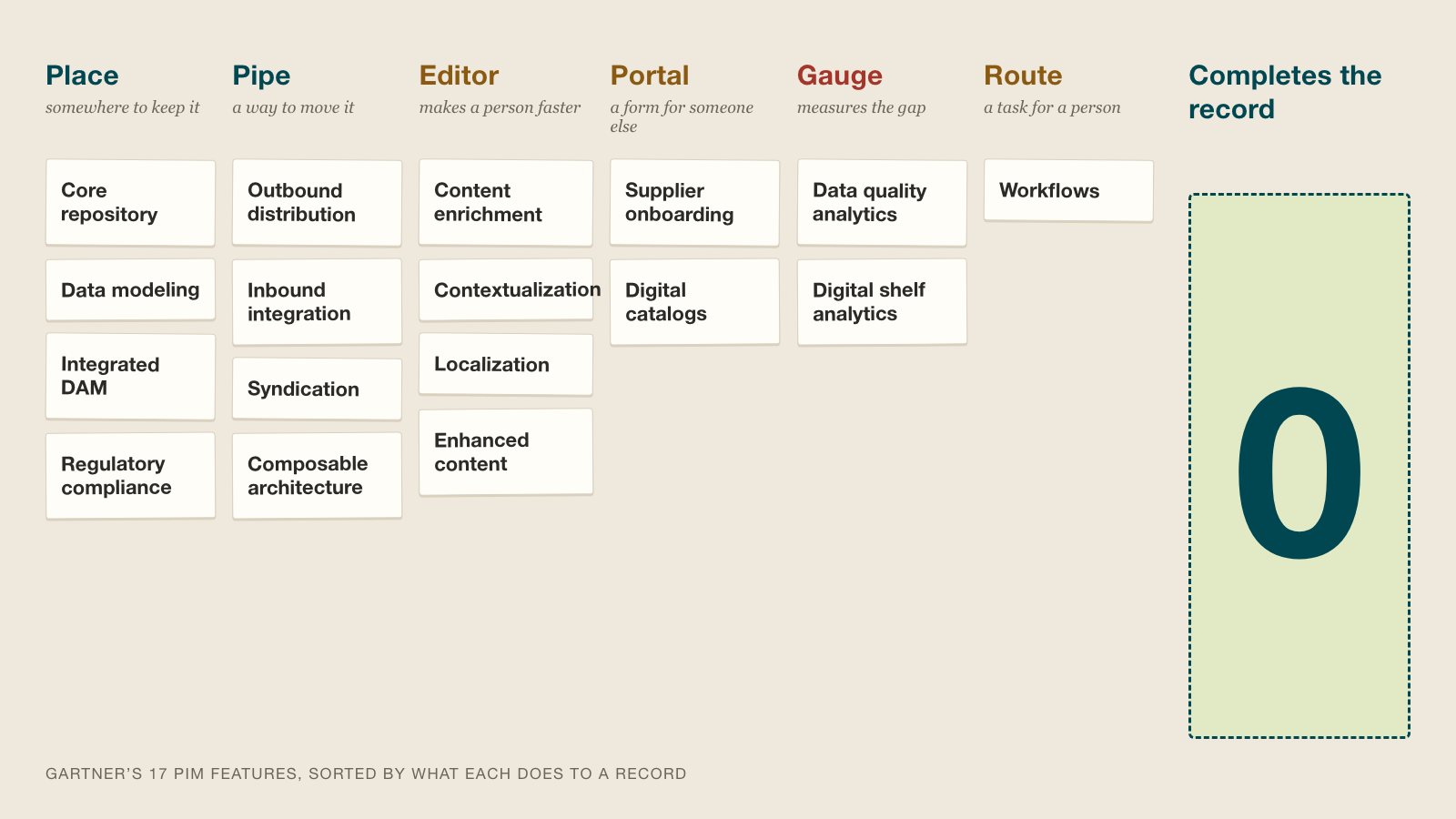
Gartner’s new Magic Quadrant for Product Information Management Solutions (12 October 2026) lists seven mandatory features and ten optional ones. We sorted all 17 by what each one actually does to a product record. Every feature landed in one of six buckets: a place to store data, a pipe to move it, a route that sends a task to a person, an editor that makes a person faster, a portal that asks someone else to type it, or a gauge that measures the gap.
The number of features whose job is to complete the record is zero.
That is not a gotcha, and it is not a flaw in the analysts’ work. It is an accurate description of the category. If you are reading the report to pick a platform (our 2026 PIM Magic Quadrant hub breaks down the placements), this is the one thing worth carrying into the budget meeting: the definition tells you what you are buying, and the work of filling the record is not in it.
The verb that matters is "enable"
Gartner defines PIM as software that enables organizations to centralize, enrich and validate product content before it goes out to channels. Internal teams manage attributes, relationships and channel requirements. External partners can contribute.
Read it for who does what. The software enables. The organization centralizes, enriches and validates. The standard definition of a PIM has always worked this way: a governed place for a team to do the work, plus the plumbing to ship the result.
So when the feature list comes out with no "complete the record" line, the definition is being consistent. The gap is real, and it is structural.
All 17 features, sorted
The six buckets:
- Place: somewhere to store or structure data.
- Pipe: moves data in or out.
- Route: sends a task to a person (or a service) to act on.
- Editor: a tool that makes the person doing the work faster.
- Portal: asks someone outside your team to supply the data.
- Gauge: measures completeness or performance.
| # | Feature (Gartner, our paraphrase) | Type | Bucket | The work still left over |
|---|---|---|---|---|
| 1 | Core repository: UI, validation rules, mandatory fields, external IDs | Mandatory | Place | Validation rejects a blank. It can’t fill one. |
| 2 | Data modeling: attributes, templates, variants, hierarchies | Mandatory | Place | The model defines 24 boxes for a ball valve. Someone fills them per SKU. |
| 3 | Workflows: process management and business rules | Mandatory | Route | The enrichment step at the end of the workflow lands in a person’s queue. |
| 4 | Content enrichment: tools to manage copy, SEO and channel content | Mandatory | Editor | An editor for copy. The specs the copy should describe still have to be found. |
| 5 | Contextualization: subcatalogs per channel or region | Mandatory | Editor | Each channel’s version needs its own values, not just its own view. |
| 6 | Outbound distribution: APIs, flat files, feeds | Mandatory | Pipe | Ships what is there. An empty field ships empty. |
| 7 | Inbound integration: ingest, map, normalize | Mandatory | Pipe | Maps the columns a supplier sent. Can’t map the ones they didn’t. |
| 8 | Syndication connectors | Optional | Pipe | The retailer template still rejects the record for missing values. |
| 9 | Integrated DAM | Optional | Place | Somebody still sources, checks and tags the images. |
| 10 | Localization | Optional | Editor | Translating an empty field gives you an empty field in 12 languages. |
| 11 | Data quality analytics: dashboards and scorecards | Optional | Gauge | Tells you 14,000 SKUs are incomplete. Doesn’t make them complete. |
| 12 | Enhanced (rich) content tools | Optional | Editor | A canvas for A+ content. The facts on it come from elsewhere. |
| 13 | Supplier onboarding portals | Optional | Portal | Moves the typing to the supplier, who sends what they have. |
| 14 | Digital catalogs and portals | Optional | Portal | Publishes the record to buyers, gaps included. |
| 15 | Regulatory compliance tools | Optional | Place | Fields for compliance data. The data sits in supplier documents. |
| 16 | Digital shelf analytics | Optional | Gauge | Shows the listing underperforming. The fix is upstream. |
| 17 | Composable, API-first architecture | Optional | Pipe | Makes the record easy to reach. Doesn’t change what’s in it. |
Tally: four places, four pipes, one route, four editors, two portals, two gauges. Zero features that take a SKU with 9 of 24 attributes and return it with 24.
The closest calls, and why they still land outside
Three features come near the line, so they are worth a closer look.
Content enrichment has "enrichment" in the name. In Gartner’s framing it is tooling to manage content: long-form copy, search and answer-engine content, channel variants. Many vendors attach generative AI to it. That AI drafts from what is already in the record. Ask it to write a description for a valve with no pressure rating and you get a well-written description with no pressure rating.
Inbound integration normalizes data on the way in. That is real work the PIM does, and it matters. But normalizing is reshaping values that arrived. A supplier feed with a third of the attribute columns blank arrives, gets mapped cleanly, and is still a third blank.
Data quality analytics is the one buyers most often mistake for the work. A good completeness dashboard tells you where to point effort. It does not supply the effort.
You will also see AI features across the vendor write-ups that suggest values or flag anomalies. Gartner is candid that several are recent, or recommendation-based, with a person reviewing and applying each suggestion by hand. That is assistance routed to your team, which puts it back in the editor bucket: a faster person, still a person. We cover the gap between an agent that assists and one that owns the outcome in why MCP servers still return empty fields.
The twist: Gartner names the thing the definition leaves out
Here is the part worth underlining. In the same report, Gartner’s market overview says the ability to enhance and optimize product information at the source, before syndication, is becoming a critical competitive advantage. It also says agentic commerce needs product data structured and rich enough for AI agents to interpret and act on.
Put those two observations next to the 17 features. The market overview says source-level enrichment is where advantage is moving. The definition, accurately describing what PIMs do, does not include it.
Both statements are true at once. The category is places, pipes, routes, editors, portals and gauges. The competitive edge is in what fills them. The space between those two honest descriptions is a line item that belongs in your plan.
Budget the work as its own line
Most PIM business cases carry three costs: license, implementation, and internal admin. The fourth cost, filling the records, tends to hide inside "internal admin" or get assumed away as something the platform will handle after go-live. We walk through how that hidden fourth cost compounds in the total cost of ownership is the work.
Rough math for a distributor with 20,000 SKUs that need attention: at a common manual benchmark of 30 to 45 minutes per SKU to research specs and fill a record, that is 10,000 to 15,000 hours. No feature in the list of 17 makes that number smaller on its own. Workflows schedule it. Dashboards count it. Portals push some of it to suppliers, who send back what they already had. The vendor cautions point the same way: by our count, 18 of the 48 cautions in the report describe a remedy that is effort by the buyer’s own team or a tool the buyer must add.
Three questions to add to your PIM RFP checklist:
- For a SKU with 9 of 24 category attributes filled, which feature produces the other 15 values, and where does each value come from?
- When the AI suggests a value, who reviews it, and how many suggestions per hour can that person clear?
- If completeness is 40% at go-live, what is the plan and the headcount to reach 90%?
Good PIM vendors will answer these straight, and the answers usually point to your team, a supplier or an agency. That is the honest shape of the category, and it is why we have called a PIM a very good filing cabinet: the drawers matter, and someone still has to fill them.
What fills the record
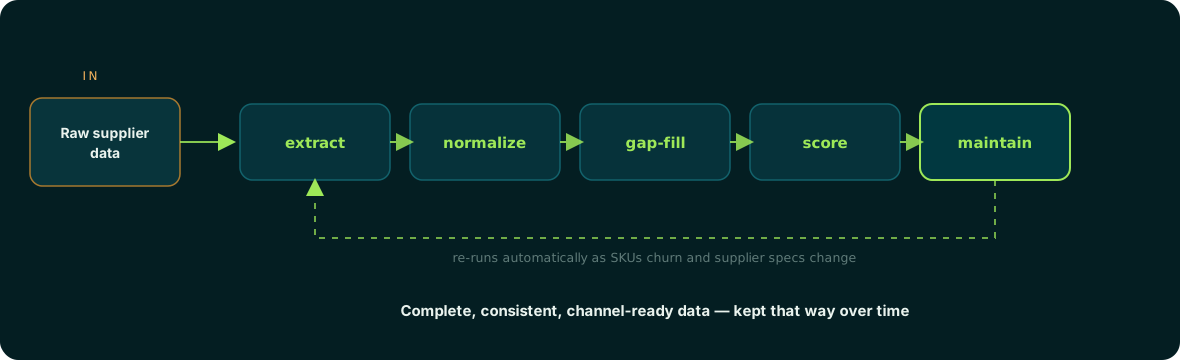
Anglera is not a PIM and is not in the report. It is the enrichment layer that works alongside whichever PIM you choose, from any of the 16 vendors to a flat file. It extracts missing values from supplier documents, attaches a citation to each value, scores quality against standards your experts set once, and writes the completed record back into the PIM. In one enterprise distribution pilot that meant 100,000+ SKUs enriched, 15 to 60+ attributes per product depending on category, and 81% of values extracted directly from a cited source.
Pick the PIM that fits your catalog. Then budget for the work, because the definition says plainly that it is not included. Your PIM stores the data. Anglera does the work. To see how far a live product page is from complete, grade one with the AI readability tool.