
PIM total cost of ownership: the line every evaluation leaves out
PIM TCO is licence, implementation and the team that fills the records. A worked 40,000-SKU example shows why the work is usually the biggest line.
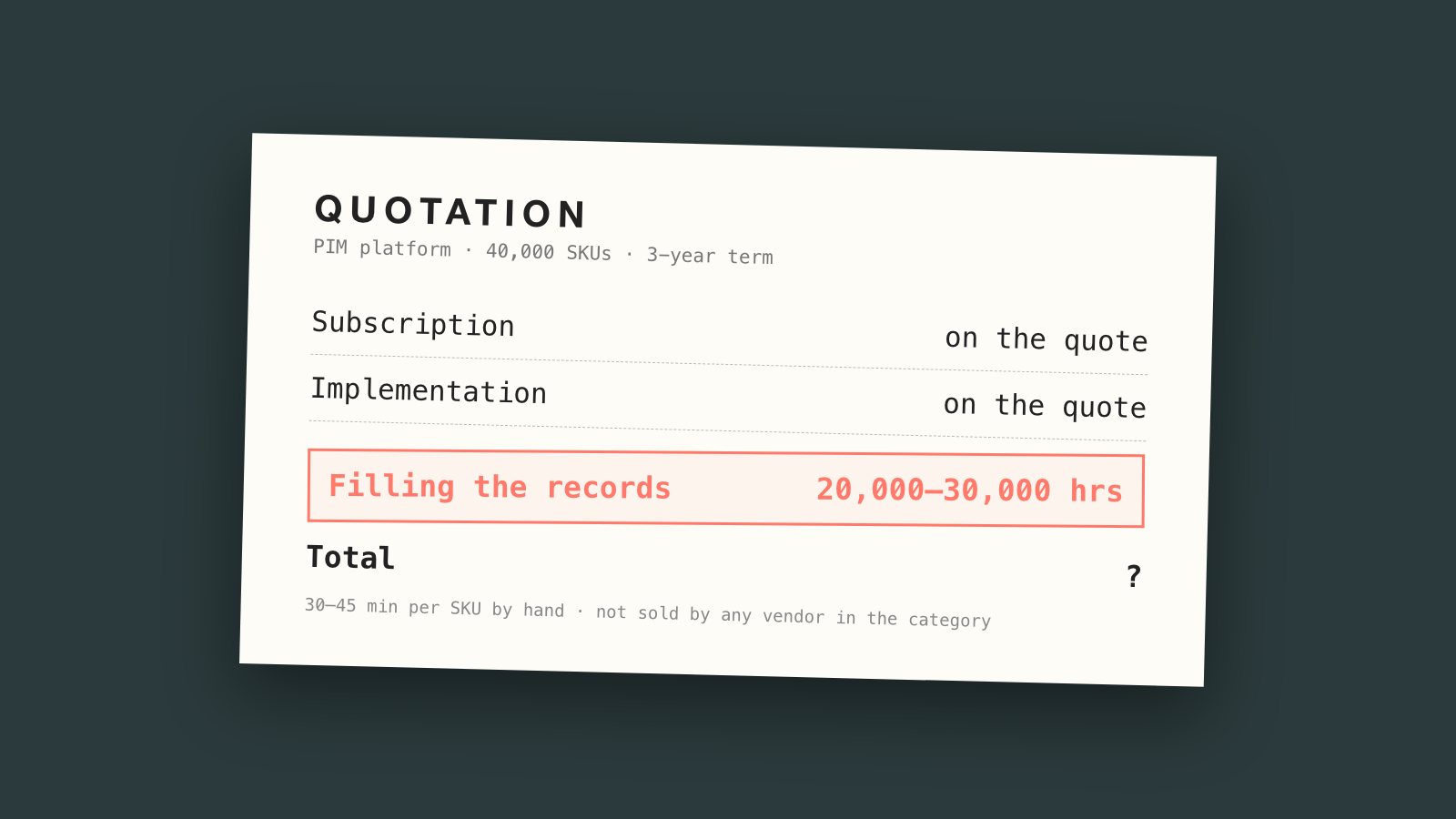
A 40,000-SKU distributor collects three PIM quotes. Each has two lines: a subscription and an implementation estimate. Procurement compares them, negotiates the renewal cap, and signs. Nobody prices the third line, which in this example comes to between 20,000 and 30,000 hours of someone’s time.
That third line is the work: researching, entering and maintaining the attribute values the PIM was bought to hold. It does not show up in any vendor’s quote because no vendor in the category sells it. Gartner’s 2026 Magic Quadrant for Product Information Management Solutions evaluates sixteen PIMs, and the category as Gartner defines it is software that enables a team. We cover the full report on the 2026 PIM Magic Quadrant hub.
The verdict: PIM total cost of ownership is licence plus implementation plus the work. For most mid-size and large catalogs, the work is the biggest of the three.
The lines that are in the quote
The visible costs are real and worth fighting over.
Licence. Usually priced by SKU count, channels, users and modules. Several of Gartner’s cautions in the 2026 report are about exactly this. Gartner notes that Centric Software’s editions and add-ons make pricing complex, that some Salsify customers report upcharges at renewal, that Stibo Systems charges separately for some AI capabilities, that Syndigo’s pricing has several variables including AI credits, and that insightsoftware requires a minimum 36-month contract.
Implementation. Configuring the data model, workflows, integrations and channel outputs, often with a systems integrator. By our count, 18 of the 48 cautions in the report describe work that lands back on the buyer’s team or tools the buyer has to add: building a taxonomy, custom integration, manual mapping and onboarding. Some of that shows up in the SOW. Much of it shows up later.
Negotiate both. But notice that every item above is a line someone will put in front of you. The biggest one isn’t.
The line that isn’t in any quote
Here is the math for a 40,000-SKU distributor with categories that average 30 attributes each, using the manual benchmark of 30 to 45 minutes per SKU (about 1 to 1.5 minutes per attribute to find the value in a spec sheet and enter it).
| Step | Low | High |
|---|---|---|
| SKUs | 40,000 | 40,000 |
| Attributes per SKU | 30 | 30 |
| Minutes per attribute | 1.0 | 1.5 |
| Minutes per SKU (30 × rate) | 30 | 45 |
| Total minutes (40,000 × per-SKU) | 1,200,000 | 1,800,000 |
| Total hours (÷ 60) | 20,000 | 30,000 |
| FTE-years (÷ 1,800 productive hours) | 11.1 | 16.7 |
| Illustrative cost at a $40 loaded hourly rate | $800,000 | $1,200,000 |
Swap in your own loaded rate. The hours are the point. Eleven to seventeen person-years is more than most catalog teams will ever be staffed for, so in practice the work does not get done. It becomes a backlog of thin records that cost money in search, filters, returns and feed rejections, which we traced in the cost of incomplete product data.
Then it recurs
A completed record does not stay complete. Suppliers reissue spec sheets, retire parts and change pack quantities. Channels add required attributes. New SKUs arrive every week. We cover the mechanics in what product data decay costs; here is the budget view, with assumptions you should replace with your own.
| Recurring driver | Assumption | Hours per year (30 to 45 min per SKU) |
|---|---|---|
| Rework from supplier changes and new channel attributes | 15% of 40,000 SKUs = 6,000 SKUs | 3,000 to 4,500 |
| New SKU intake | 10% catalog growth = 4,000 SKUs | 2,000 to 3,000 |
| Total recurring | 5,000 to 7,500 (2.8 to 4.2 FTE) |
Over three years, the work line in this example lands between 30,000 and 45,000 hours. Put that next to the licence and implementation figures and the evaluation looks different.
Five ways to staff the work
There is no free option. Each of these is used by real catalog teams, and each has a different cost shape.
1. An internal team. Your merchandisers know the products and the customers. Quality is high where they have time. The constraint is hours: hiring 11 people for a one-time backlog is rarely approved, and attrition takes the product knowledge with it.
2. Offshore BPO. Lower hourly rates and elastic headcount. The trade-offs are the spec you have to write, the QA you have to run, rework on technical categories, and the fact that you pay per record again every time data decays. Ask whether each value comes with its source; usually it doesn’t.
3. Supplier portals. An optional PIM feature where suppliers enter their own data. It works well with large, strategic suppliers who already maintain clean records. The long tail of smaller suppliers often submits incomplete files or nothing, and you get whatever quality each supplier sends.
4. An AI assistant inside the PIM. Faster drafting, translation and suggestions for a person working record by record. Gartner notes that some vendors’ AI is recent or mainly recommendation-based, with users reviewing and applying suggestions by hand, and it flags token costs as an open question for the category. The assistant shortens each task; a person still owns each record. We look at that distinction in assistants versus agents that own the work.
5. An enrichment layer that owns the work. A separate service that extracts values from supplier documents, scores each record and writes back into whatever PIM you choose. The trade-offs: another vendor relationship, and your experts have to set the quality standards up front so the system knows what "complete" means per category. The upside is that the cost stops scaling with hours per SKU.
That fifth option is where Anglera sits. It is not a PIM, and it works alongside any of the sixteen in the report. Each value carries a citation to its source document. In one anonymized enterprise-distribution pilot, Anglera enriched more than 100,000 SKUs, with 10,000 in a single overnight run. At Cresco Resco, one person working part-time rebuilt 23,000+ products. Live in about 30 days, starting from a flat file if that is what you have.
Put the third line in the business case
When you build the PIM business case, add a row under licence and implementation: SKUs × attributes × minutes, plus annual decay, and a name next to it. If the name is "the team, after go-live," the project has a gap that will outlast the software.
Your PIM stores the data. Anglera does the work. See how it works against your own catalog.