
Every PIM in the Magic Quadrant has an AI story. Most of it still hands the work to your team.
Ziggy, CLAIRE, Angie, Synapse, AgentWorkx: we sorted the AI in Gartner’s 2026 PIM Magic Quadrant into assist, detect-and-route, and agents. Then we tested it.
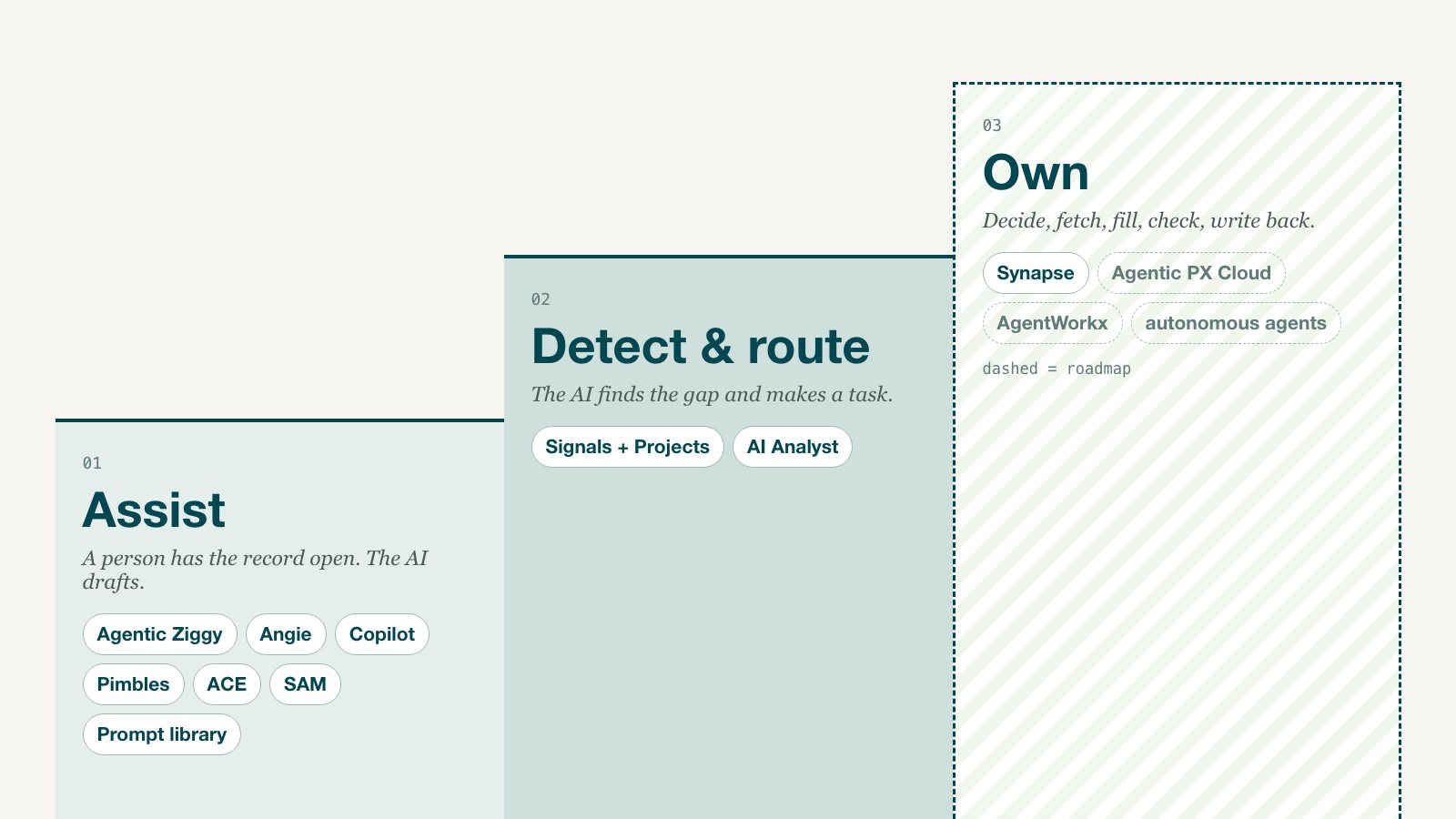
Count the AI product names in Gartner’s 2026 PIM Magic Quadrant and you pass a dozen: Ziggy, CLAIRE, Angie, Synapse, AgentWorkx, SAM, ACE, Copilot, AI Analyst, Pimbles. Sixteen vendors, and nearly every one now has an AI story.
Here’s the verdict after reading all sixteen write-ups for our Magic Quadrant hub: most PIM AI today helps a person fill a field, or finds gaps and turns them into tasks for that person. True agents, the kind that execute a multistep job without someone driving it, are mostly on roadmaps. That isn’t a knock on any vendor. It follows from what a PIM is for.
In June we argued that your PIM added an AI button, not an enrichment team. The Magic Quadrant lets us check that claim against the whole category. (Anglera isn’t a PIM and isn’t in the report. We write into the systems it evaluates.)
The named products
All descriptions below are our paraphrase of Gartner’s vendor write-ups. The last column is our reading of where the work lands once the feature has done its part.
| Vendor | AI product | What it does, per the report | Who still does the work |
|---|---|---|---|
| Akeneo | Agentic Ziggy | AI assistant and agent tooling in the PIM; Gartner says it is new enough that buyers should test it thoroughly | Your team prompts, reviews and accepts |
| Inriver | Inspire agent suite; Signals and Projects | Signals detects content gaps; Projects turns them into work packages; natural-language goals on the roadmap | Your team works the project |
| Salesforce (Informatica) | CLAIRE; Product Experience Agent | AI engine plus a product experience agent; AI-assisted supplier onboarding; governance agent on the roadmap | Your team supplies sources and reviews |
| Salsify | SalsifyIQ; Angie | AI layer plus a conversational assistant | The person asking Angie |
| Syndigo | Synapse; Agentic PX Cloud | Synapse, a recent agentic platform for autonomous task execution; multistep Agentic PX Cloud on the roadmap | Your team supplies the sources the agents work from |
| Stibo Systems | AgentWorkx | Framework for agents that clients build, on the roadmap | Your team builds and runs the agents |
| Pimcore | Copilot; SDK for AI agents | In-app copilot plus an SDK for developers to build agents | Your developers, then your team |
| Pimberly | Pimbles | Branded AI helpers inside the platform | Your team, record by record |
| Viamedici | SAM | AI for data modeling, mapping and error detection; Gartner says mostly recommendations users review and implement manually; autonomous agents planned | Your team implements each recommendation |
| Equadis | AI Content Engine (ACE) | AI content generation; Gartner notes Equadis manages some prompts on clients’ behalf | Shared: vendor tunes prompts, your team owns the output |
| Bluestone PIM | AI Analyst | Anomaly detection that suggests corrections | Your team accepts or rejects each fix |
| insightsoftware | GenAI prompt library | Prompts tuned for distributor use cases; Gartner says AI covers translation, attribute enrichment and basic content | Your team runs the prompts |
The other four (apollon, Base.com, Centric and Plytix) have no named AI product in the write-ups. Three of them show up through MCP work instead, which we cover in PIM MCP servers and empty fields.
Three tiers
Sort the table by what the software does on its own, and three groups appear.
Tier 1: Assist. A person has a record open. The AI drafts a description, suggests an attribute, translates a title, recommends a mapping. Ziggy’s assistant features, Angie, Copilot, Pimbles, ACE, the insightsoftware prompt library and Viamedici’s SAM recommendations all live here. Each makes one person faster on one record. The person is still the unit of throughput.
Tier 2: Detect and route. The AI scans the catalog, finds gaps or anomalies, and turns them into tasks. Inriver’s Signals and Projects is the clearest example: content gaps become projects for the team. Bluestone’s AI Analyst flags anomalies and suggests corrections. This is a real step up from a completeness dashboard, because it creates a work queue instead of a chart. But the queue lands on the same people. Detection and routing are not completion.
Tier 3: Agents. Multistep execution: decide what is missing, go get it, fill it, check it, write it back. Almost everything here is roadmap. Syndigo’s Agentic PX Cloud, Stibo’s AgentWorkx, Viamedici’s autonomous agents and Inriver’s natural-language goals are all described as coming. Syndigo’s Synapse is the nearest thing in production, and it is recent.
A few products carry “agent” in the name, like Akeneo’s Agentic Ziggy and Informatica’s Product Experience Agent. The name doesn’t decide the tier. The test below does.
What Gartner itself flags
Gartner is notably careful about this wave. Several write-ups describe AI that is recent, recommendation-based, or narrow in scope. In the market overview, Gartner expects MCP servers and AI assistants may become the primary interface for PIM, and in the same breath lists token costs, security and role-based permissions as unresolved.
There is a quieter issue under the interface question. An assistant that reaches the repository through the Model Context Protocol reads whatever is stored there. If the IP rating was never entered, a better interface returns a well-phrased blank.
Our four-question test
Before you credit any “AI agent” claim with doing the work, ask:
- Does it source values from documents outside the PIM? Supplier spec sheets, safety data sheets, manufacturer sites. If it only works from what is already in the record, it can rephrase but not complete.
- Does it cite them? Every value tied to a document and a location, so a reviewer can verify it in seconds.
- Does it run unattended at catalog scale? Tens of thousands of SKUs in a run, without a person opening each record.
- Does it re-run when the supplier changes? A revised spec sheet should trigger an update, not wait for the next audit.
Four yeses means the software owns the work. Anything less means it assists the person who does.
A worked example
You have 4,000 light fixtures missing an ingress protection rating. Channels reject the listings without it.
- Assist: someone opens each record and asks the assistant for help. If the spec isn’t in the record, they go find the PDF first. At 30 to 45 minutes per SKU for a full record, the backlog outlives the quarter.
- Detect and route: a gap signal fires, a project for 4,000 SKUs lands in one person’s queue. Better visibility, same hours.
- Passes the test: the system finds each supplier spec sheet, extracts IP65, cites the page, scores the value, writes it back, and updates the record when the supplier publishes a revised sheet.
That third path is what Anglera does. In one anonymized enterprise-distribution pilot, 81% of values were extracted directly from a cited source, with more than 800,000 attribute-level citations and 10,000 SKUs completed in a single overnight run. Your experts set the quality bar once; review is a guardrail, not babysitting, and it tapers as the output earns trust. The finished records go into the PIM you already run, where its AI features keep doing what they’re good at.
Use the AI you have. Add the work.
None of this argues against PIM AI. Assistants make editors faster, and detect-and-route features give managers a real queue. Keep them. Just don’t mistake a better interface to the repository for something that fills it, especially as AI shopping agents start reading your catalog directly and reward data structured for them.
Your PIM stores the data. Anglera does the work. To see where your own records stand, grade a product page and count the blanks an agent would find.