
11 of 16 PIMs now have an MCP server. Here’s what an AI agent finds when it walks in.
11 of 16 vendors in Gartner’s 2026 PIM Magic Quadrant have an MCP server shipped, piloted or planned. An agent can now read your PIM. Empty fields stay empty.
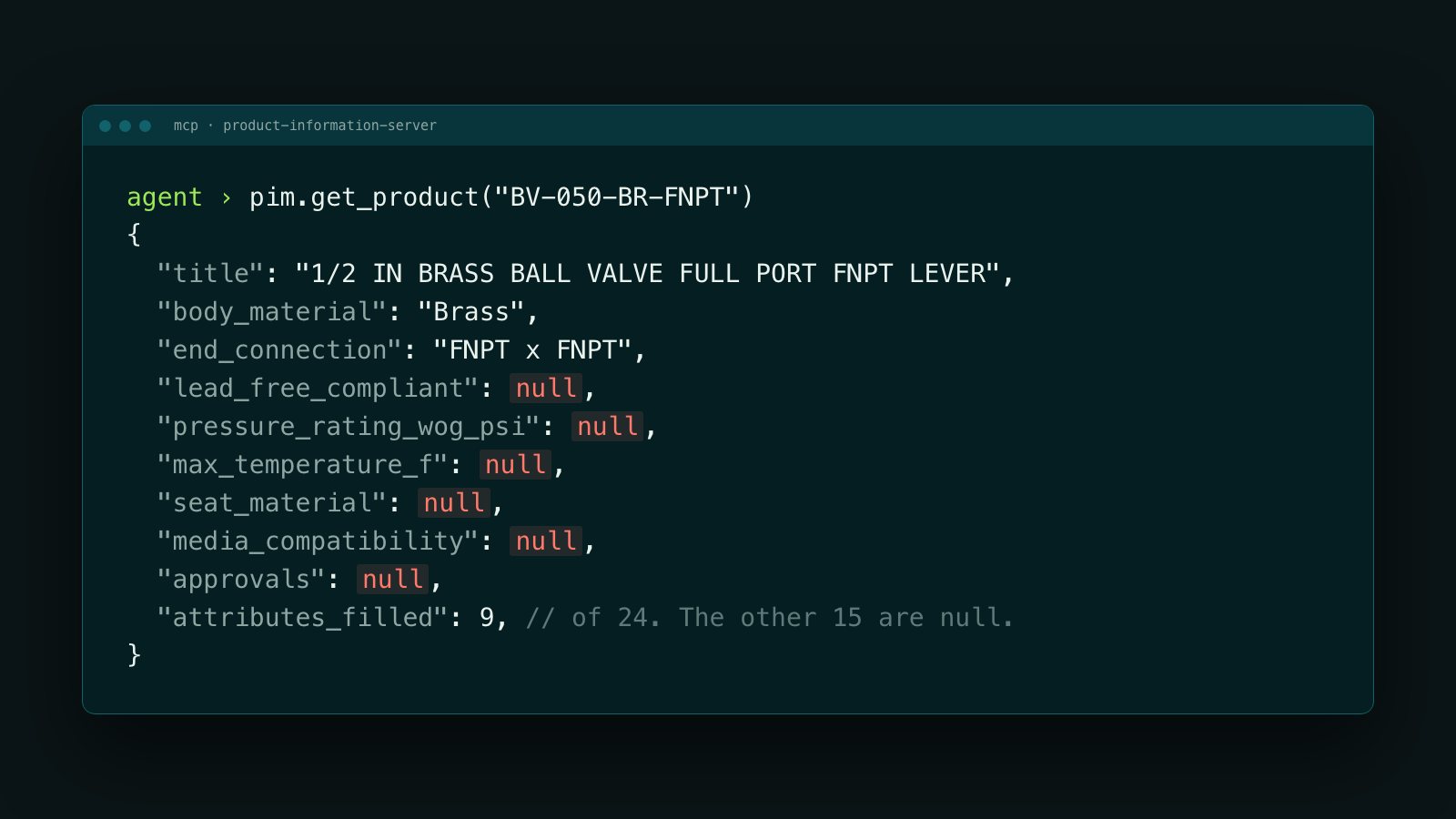
A plumbing contractor asks a procurement agent a simple question at 6:40 on a Tuesday morning: is the half-inch brass ball valve on our usual order lead-free, and is it rated for 600 psi? The agent calls the distributor’s PIM through its MCP server. The response comes back in under a second. It is well formed, fully permissioned, and missing the two facts the contractor asked about.
That is the state of play after Gartner’s Magic Quadrant for Product Information Management Solutions (12 October 2026). By our count of the vendor write-ups, 11 of the 16 evaluated vendors have shipped, piloted or roadmapped a Model Context Protocol server. Our 2026 PIM Magic Quadrant hub covers the placements. This post covers the door they just installed, and what is on the other side of it.
The short version: MCP improves access, not completeness. An agent that walks through the door reads whatever is in the room. An empty field is still empty.
Who has an MCP server
Status below is our reading of Gartner’s vendor write-ups, as of the report’s August 2026 placements.
| Vendor | Quadrant | MCP status | Other AI named in the report |
|---|---|---|---|
| Akeneo | Leader | Shipped / invested | Agentic Ziggy |
| Inriver | Leader | Shipped / invested | Inspire agents, Signals and Projects |
| Salesforce (Informatica) | Leader | Shipped / invested | CLAIRE, Product Experience Agent |
| Stibo Systems | Leader | Shipped / invested | AgentWorkx (roadmap) |
| Syndigo | Leader | Not mentioned | Synapse agentic AI platform |
| Salsify | Challenger | Pilot | SalsifyIQ, Angie |
| Bluestone PIM | Visionary | Shipped / invested | AI Analyst |
| Pimcore | Visionary | Not mentioned | Copilot, SDK for AI agents |
| Viamedici | Visionary | Shipped / invested | SAM |
| apollon | Niche Player | Roadmap (planned 4Q26) | |
| Base.com | Niche Player | Shipped / invested | |
| Centric Software (Centric PXM) | Niche Player | Shipped / invested | |
| Equadis | Niche Player | Not mentioned | AI Content Engine |
| insightsoftware (Agility PIM) | Niche Player | Roadmap | |
| Pimberly | Niche Player | Not mentioned | Pimbles |
| Plytix | Niche Player | Not mentioned |
Eight shipped or invested, one pilot, two on the roadmap, five not mentioned. "Not mentioned" is not "behind": Syndigo and Pimcore are both building agent tooling through other routes. The direction is the same across the board. Gartner’s market overview expects MCP and AI assistants may become the primary way people and agents work with a PIM.
A worked example: one valve, one call
Here is a realistic response from a PIM MCP server when an agent calls a get_product tool for a common distributor SKU. The category, ball valves, carries 24 attributes in this distributor’s data model.
{
  "sku": "BV-050-BR-FNPT",
  "brand": "(manufacturer)",
  "mfr_part_number": "BV50FF",
  "title": "1/2 IN BRASS BALL VALVE FULL PORT FNPT LEVER",
  "category": "Valves > Ball Valves",
  "completeness_pct": 38,
  "attributes": {
    "nominal_pipe_size": "1/2 in",
    "body_material": "Brass",
    "end_connection": "FNPT x FNPT",
    "port_type": "Full Port",
    "handle_type": "Lever",
    "ball_material": "Chrome-plated brass",
    "operation": "Manual, quarter turn",
    "number_of_ways": "2-way",
    "finish": "Natural",
    "lead_free_compliant": null,
    "nsf_ansi_61_372_certified": null,
    "pressure_rating_wog_psi": null,
    "pressure_rating_steam_psi": null,
    "max_temperature_f": null,
    "seat_material": null,
    "stem_packing_material": null,
    "handle_material": null,
    "flow_coefficient_cv": null,
    "media_compatibility": null,
    "approvals": null,
    "overall_length_in": null,
    "weight_lb": null,
    "country_of_origin": null,
    "warranty_years": null
  }
}
Nine of 24 filled. The nine are what you can read off the title. The fifteen nulls are what lives in the manufacturer’s spec sheet and certification documents.
What the agent can answer from this record:
- It is a half-inch, two-way, full-port brass valve with female threads on both ends.
- It has a lever handle and a chrome-plated ball.
What it cannot answer:
- Whether it is lead-free and certified for drinking water, which decides whether it can go into a potable line at all.
- The pressure rating the contractor asked about, or its steam and temperature limits.
- Whether the seat material will hold up with the media in the line.
- Length and weight for fit and freight.
A careful agent says "I can’t confirm that" and stops. A less careful one infers from the title. Most will do the efficient thing and check another distributor whose record answers the question. None of those outcomes is fixed by better access. The server did its job perfectly. It returned what was stored.
This is not an edge case. In our own index of top distributors, the median distributor product page carries 11 attributes, and only 8 of 73 storefronts publish product structured data at all. The records behind the new MCP doors look a lot like the one above.
Gartner’s three open questions get harder with nulls
Gartner flags token costs, security and role-based permissions as unresolved for MCP and AI assistants in PIM. Each one gets sharper when the record is thin.
Token cost. A complete record answers in one call. An incomplete one sends the agent hunting: a second tool call for documents, a web search, a retry against a different SKU. Every extra hop is tokens spent compensating for a field nobody filled.
Security. Exposing the repository to agents widens who and what can reach it. That is a fair trade for a record worth reading. It is a worse trade when what you are exposing is mostly nulls.
Permissions. Read access is the easy part. The real question is write access. If an agent can fill pressure_rating_wog_psi through MCP, where did the number come from? An agent with write permission and no source document is guessing with an API key. Gartner notes that several vendors’ AI today is recommendation-based, with a person reviewing and applying each suggestion. That is a sensible guardrail, and it routes the work straight back to your team.
We get into the difference between an assistant that helps a person and a system that owns the outcome in AI agents in PIM: assist versus own. The short form is that detection and routing are useful, and they are not completion.
What makes the door worth opening
Gartner’s own market overview says agentic commerce needs product data structured and rich enough for AI agents to interpret and act on. MCP is the transport for that. The richness has to be there before the agent arrives.
For the valve, that means someone (or something) opens the manufacturer’s submittal sheet and NSF listing, extracts the 15 missing values, normalizes units, and writes them back with a source attached to each one. Then the MCP response is worth the round trip. The guide to structuring product data for AI agents covers what "complete" should look like per category.
Doing that by hand runs 30 to 45 minutes per SKU. It is the same work that the 17 features in Gartner’s PIM definition leave to the team, which we broke down in no feature in the PIM definition does the work.
Anglera is not a PIM and is not in the report. It is the layer that does that extraction alongside whichever PIM you run, and writes the completed, cited record back into it. In one enterprise distribution pilot that meant 100,000+ SKUs enriched with 800,000+ attribute-level source citations, so every value an agent later reads through MCP can be traced to a document.
Pick the PIM with the MCP roadmap you like. Then make sure there is something worth reading behind it. Your PIM stores the data. Anglera does the work. To see what an agent sees on one of your product pages today, run it through the AI readability tool.