
The 2026 PIM Magic Quadrant is also a map of consolidation. Here’s what it means at renewal.
Salesforce owns Informatica, Syndigo owns 1WorldSync, Centric owns Contentserv. What PIM consolidation means for your roadmap, migrations and renewal.
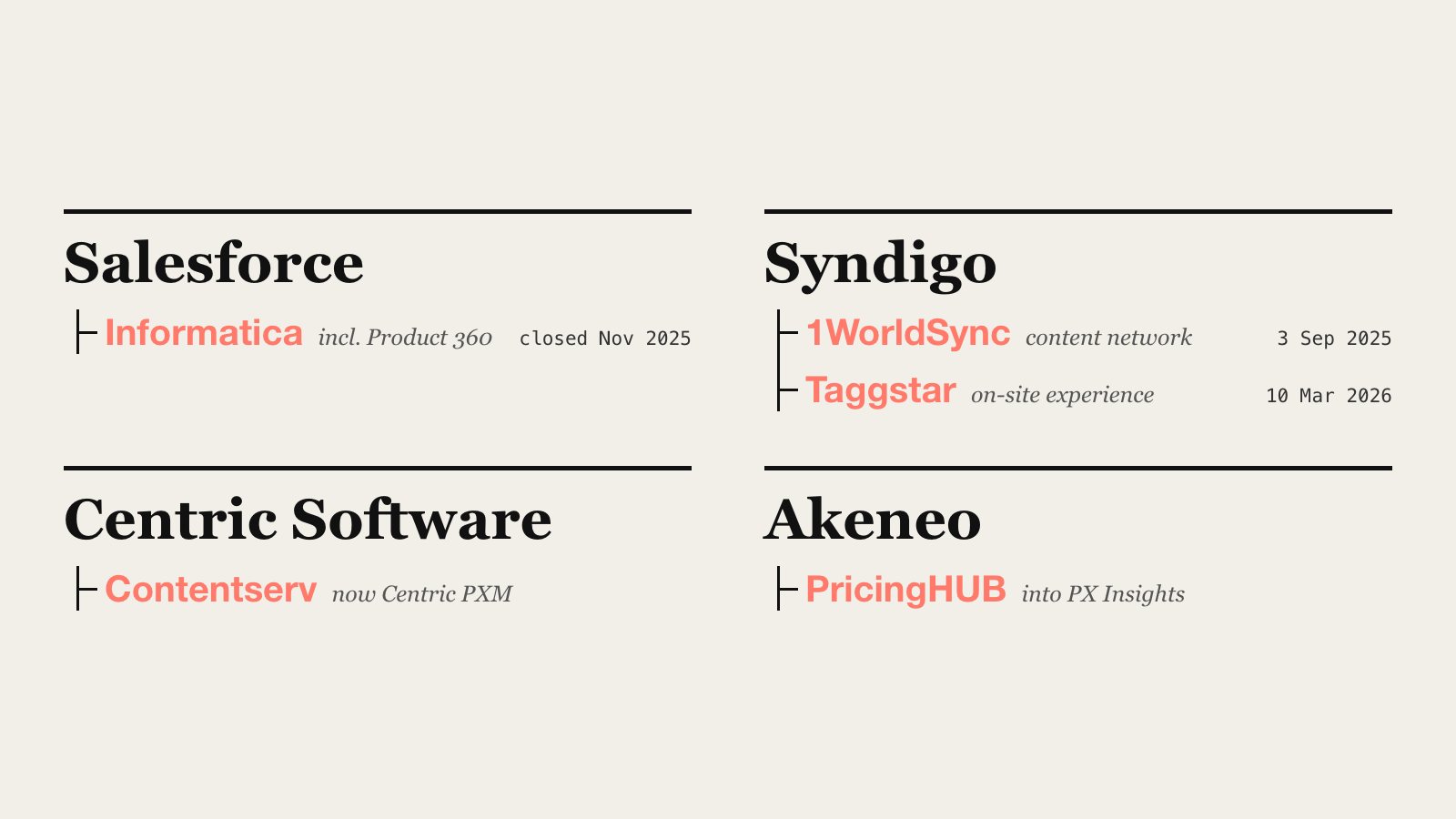
If you signed an Informatica Product 360 contract in 2024, your next renewal gets negotiated with Salesforce. If you syndicate through 1WorldSync, your account now rolls up to Syndigo. If you bought Contentserv, the invoice says Centric Software.
None of that shows up in the dot positions of Gartner’s new PIM Magic Quadrant, published 12 October 2026. But three of the five Leaders arrive with an acquisition attached, and one Niche Player is a renamed acquisition. Read sideways, the quadrant is a map of who bought whom.
Our verdict: consolidation is a real buying risk, and it lands on your roadmap and your renewal far more than on your data. It changes who owns the storage and the pipes. It does not change who fills the records. Plan for both. (Anglera isn’t a PIM and isn’t in the report; we write finished records back into the systems it evaluates.)
The deals behind the dots
Salesforce and Informatica. Salesforce closed its acquisition of Informatica in November 2025, and Informatica Product 360 came with it. A Leader in PIM now sits inside a CRM and commerce company. Gartner’s write-up sketches the roadmap: deeper Salesforce Commerce Cloud integration, an MCP server, and a data and AI governance agent. Every item makes sense for Salesforce. Whether it makes sense for you depends on how much of your stack already runs on Salesforce. We cover where enrichment fits next to Informatica Product 360 separately.
Syndigo, 1WorldSync and Taggstar. Syndigo bought 1WorldSync on 3 September 2025 and Taggstar on 10 March 2026. The first puts two large product content networks under one owner. The second reaches toward shopper-facing, on-site experience. Gartner flags that the 1WorldSync applications still need to be integrated or decommissioned. That is the sentence to bring to your next account review with Syndigo or 1WorldSync.
Centric PXM. Centric Software’s PXM is the former Contentserv, now inside a company best known for PLM. The gravitational pull there runs upstream, toward design and development data. If you are evaluating it, our Contentserv comparison still applies to the product under its new name.
Akeneo and PricingHUB. Akeneo’s PX Insights now includes dynamic pricing insights via its PricingHUB acquisition. A smaller deal, same direction: the PIM reaching into adjacent commercial data.
What consolidation does to a buyer
Three effects, in roughly the order you feel them.
The roadmap bends toward the parent. An acquired product gets investment where it strengthens the acquirer’s core. For Product 360, the stated direction is Commerce Cloud. For Centric PXM, it sits next to PLM. That isn’t sinister; it’s how corporate development works. But if your commerce runs on something else, your feature requests now compete with the parent’s integration priorities.
Acquired apps get merged or retired. Gartner says as much about 1WorldSync. When two product lines overlap, one becomes the migration path and the other gets an end-of-life date. Migrations cost your team real hours: remapping attributes, retesting feeds, recertifying channels. That cost rarely appears on the vendor’s TCO slide, which is why we argue the real total cost of a PIM is the work around it.
Renewal leverage shifts. Fewer independent vendors means fewer credible alternatives when the contract comes up. It also means bundles. The acquirer has new modules to attach: pricing insights, governance agents, on-site social proof. Some are worth buying. Few are worth buying because they showed up in the bundle.
The renewal table
| Deal | Date | What it signals | What to ask at renewal |
|---|---|---|---|
| Salesforce acquires Informatica (incl. Product 360) | Closed Nov 2025 | PIM inside a CRM and commerce company; roadmap points to Commerce Cloud, MCP and a governance agent | What is committed for non-Salesforce storefronts, ERPs and marketplaces? Is Product 360 priced and supported as a standalone PIM? |
| Syndigo acquires 1WorldSync | 3 Sept 2025 | Two content networks under one owner; Gartner flags app integration or decommissioning | Which app am I on, what is its support horizon, and who pays for migration? |
| Syndigo acquires Taggstar | 10 Mar 2026 | Push from content toward shopper-facing on-site experience | Is it bundled into my renewal? Can I decline it without a price change? |
| Contentserv becomes Centric PXM | Now part of Centric Software | PIM inside a PLM company; roadmap pulls upstream | Is PXM investment tied to Centric PLM adoption? Do standalone PIM customers get equal priority? |
| Akeneo adds PricingHUB | In PX Insights for 2026 | PIM reaching into pricing analytics | Is pricing insight a separate SKU? Does it change core PIM pricing at renewal? |
Put these next to the standard questions in our PIM RFP checklist. Get the answers in writing, and ask for price protection and exit terms while you still have alternatives.
What consolidation doesn’t change
Look at what actually moved in each deal. Repositories changed owners. Data pools and syndication networks changed owners. Commerce connectors, a pricing feed, a social-proof widget. None of these transactions came with people who fill product records.
That is the structural point under the whole Magic Quadrant. Gartner defines PIM as software that enables teams to centralize, enrich and validate product content. Enables. After every acquisition on this list, the same small team still opens the supplier PDF, finds the voltage rating or the material composition, and types it into a field. The cabinet changed owners. The person filling the drawers didn’t.
Gartner also observes that improving product information at the source, before syndication, is becoming a critical competitive advantage. Consolidation reshuffles the syndication end of the chain. It leaves the source end exactly where it was: with you.
Make the work portable
If your storage layer might change hands mid-contract, the riskiest place to anchor your enrichment process is inside one vendor’s module. Enrichment built as platform-specific workflows, prompt libraries or marketplace add-ons gets rebuilt when the platform migrates or the app is retired.
An enrichment layer that sits beside the PIM and writes back into it travels with you. Anglera reads supplier documents, extracts values with a citation per value, scores each record against your standards, and writes the result into the PIM you run, Informatica Product 360 included. If that PIM becomes something else in three years, you repoint the write-back. The values, the sources and the citations come along.
A quick worked example. Say you receive an end-of-life notice for an acquired syndication app your team relies on.
- Before: attribute completion lives in that app’s workflows and the team’s heads. Migration means rebuilding the workflows and re-researching the gaps they used to cover.
- After: completed records sit in your PIM with source citations attached. Migration is a feed-mapping problem, not a content problem.
The scale matters here. Researching and filling one record by hand runs 30 to 45 minutes. In one anonymized enterprise-distribution pilot, Anglera enriched more than 100,000 SKUs with over 800,000 attribute-level source citations, including 10,000 SKUs in a single overnight run. Setup takes about two weeks and can start from a flat file, so it isn’t another multi-year integration riding on a vendor’s roadmap.
Where this leaves your shortlist
Consolidation isn’t a reason to avoid any vendor in the report. Every one of them is a reasonable system of record, and every one is a system we write into. It is a reason to separate two decisions that usually get bundled: where your product data lives, and who completes it.
Your vendor may change its name, its parent or its roadmap. Your PIM stores the data. Anglera does the work, and the work goes wherever your data goes. See how it works.