
PIM vs product data enrichment: what is the difference?
A PIM stores, governs and publishes product data. Enrichment is the work of finding, extracting and validating the attribute values that fill it.

A PIM is the software that stores, structures, governs and publishes your product data. A product data enrichment service is the work, or the provider doing it, that finds, extracts, normalizes and validates the attribute values that go into the PIM's fields. The PIM gives you the fields, the completeness rules and the approval workflow. Someone still has to open the spec sheet and type 316 stainless into body_material, and that someone is your team, an outsourced service, or an enrichment layer.
That split is the whole answer. The rest of this post shows where the line sits in real PIM documentation, what lands on your side of it, and how the different kinds of enrichment provider handle that work.
What a PIM does: taxonomy, attributes, digital assets, syndication
Read the documentation of the major PIM vendors and you see a data model, governance and distribution. You rarely see a source of values.
Take Akeneo. Its catalog structure docs define a family as "a template for products": a set of attributes shared by every product in it. Attributes come in typed formats (text, simple and multi-select, number, measurement, price, image, file and others), and categories sit in trees with an unlimited number of levels. Each family declares which attributes are required for each channel.
Those requirements drive completeness. Akeneo's completeness guide says it is defined by a family, a locale and a channel, and a product hits 100% when all its required attributes have a value. Completeness counts filled fields. It cannot tell you whether the value is right.
On the way out, Akeneo Activation maps a PIM family to a retailer or marketplace's attribute requirements, one catalog per family per channel. That is syndication: reshaping data you already have for each destination.
Pimcore covers the same ground in its own way. Its data management page lists more than 25 data types, ETL-style data onboarding with matching and cleansing, a workflow engine, and AI-assisted auto-tagging through Pimcore Copilot. Built In's overview of PIM sums up the category as centralization, enrichment workflows, governance and distribution.
Does a PIM enrich product data or just store it?
It hosts enrichment. People, and increasingly AI features, do it inside the PIM.
Akeneo's collaboration workflows make this explicit: products move through workflow steps and are assigned to users. Contributors in enrichment steps add or edit data, and reviewers approve or reject it. Built In describes the same thing as workflows "for teams to add and improve their product data."
Pimcore's glossary entry on enrichment calls it "the step from raw record to sellable product record" and adds marketing copy, images, units, classification codes and translations on top of thin ERP data. It describes workflows that route tasks to roles, completeness scores that show progress, and agentic AI that generates product copy and enriches classifications, with human approval where it matters.
So the honest answer to "PIM product enrichment" is that the PIM supplies the structure and the queue. It generally does not go and find the values for you. When you evaluate a PIM's AI features, ask one question: what does it read? Writing a description from attributes you already hold is one job. Pulling max_operating_pressure out of a manufacturer's 40-page submittal PDF and citing the page is a different one. We wrote more on that distinction in your PIM added an AI button.
What the PIM leaves to your team, in one worked example
For illustration, a distributor sets up a Ball Valves family. The e-commerce channel requires body_material, end_connection, port_size, pressure_rating_psi and certifications.
The ERP export gives the PIM a SKU, a price and a short description like 1/2 BV SS NPT 1000WOG. The PIM can now show that the product is incomplete, assign it to a contributor and block it from publishing. Everything else is enrichment work:
- Find the source. Locate the manufacturer's spec sheet or submittal for that exact part number, not a sibling size.
- Extract.
SSdoes not tell you304versus316. Only the document does. - Normalize. Turn
1000WOGinto a number inpressure_rating_psiand keep the WOG basis, rather than leaving a string in a numeric field. - Validate. Check that
port_sizeagrees with the description and that the certification listed actually applies to this variant. - Resolve conflicts. When the catalog page and the PDF disagree, decide which wins and record why.
Run the arithmetic on stated assumptions: 8,000 valves times 5 attributes at 3 minutes per value is 2,000 hours, before the next family or the next channel adds requirements. That is the work a PIM stores but does not do.
| Job | PIM | Enrichment |
|---|---|---|
| Define families, attributes, category trees | Yes | Uses them as the target |
| Track completeness per channel and locale | Yes | Raises it |
| Route tasks and approvals | Yes | Feeds the review queue |
| Find and read source documents | No | Yes |
| Extract, normalize and validate values | Limited (rules, imports) | Yes |
| Map and syndicate to retailers | Yes, often via add-on | No |
PIM vs product data enrichment service: the four kinds of provider
If your team will not do the enrichment, someone else does. Providers fall into four groups, and they differ mainly in where the values come from.
BPO and offshore data entry. People work through your spreadsheet against manufacturer sites and PDFs. It is flexible and handles messy sources, but it is usually scoped as a project. When a channel adds a required attribute next quarter, you are scoping another one.
AI writing tools. These generate titles, descriptions and bullets from the data you give them. They are useful for copy. They are the wrong tool for spec attributes, because a model writing from a thin record can produce a fluent value that no source supports.
Content providers and syndicated catalogs. Services like Open Icecat collect content from brands and turn it into structured product datasheets syndicated to retailers and marketplaces. Coverage is strong where the brands participate. Your long-tail and private-label SKUs, plus your own taxonomy and field names, still need work.
Enrichment layers. Software plus process that sits between your sources and your system of record. It reads spec sheets, catalogs, imagery, manufacturer sites and ERP fields, extracts values against your attribute schema, scores them and writes them back to whatever holds your data. This is where Anglera sits: your PIM stores the data, Anglera does the work. Each value is extracted from a real source document and quality-scored, and conflicts are flagged for review instead of guessed. Because it is a maintained practice rather than a one-off project, a new required attribute can be backfilled across the catalog when a channel asks for it. Implementation typically takes around 30 days and can start from a flat CSV or ERP export.
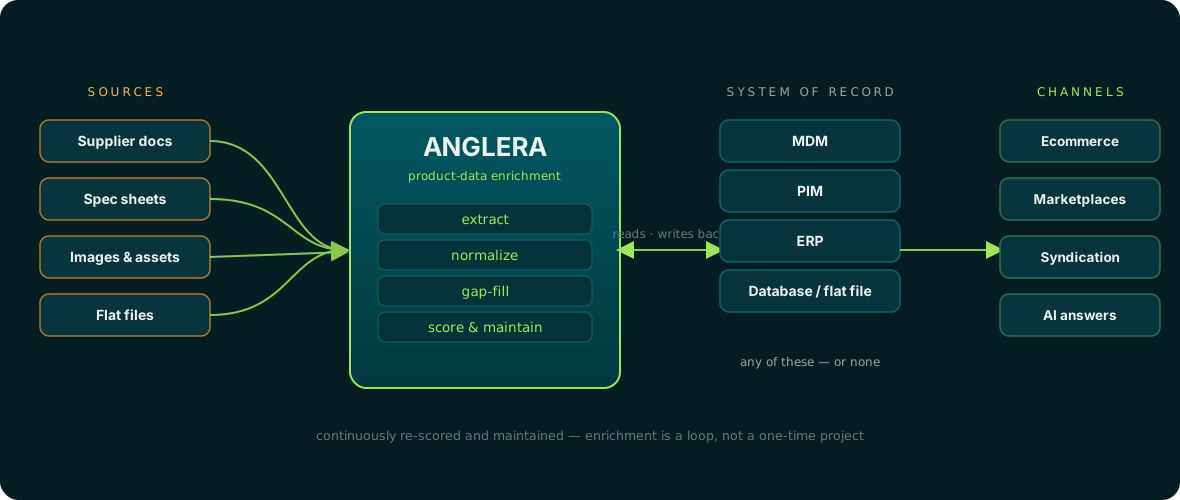
For a side-by-side of tools in that last group, see our roundup of product data enrichment platforms.
How to decide which one you need
Start from the bottleneck, not the category.
If product data lives in a dozen spreadsheets, nobody owns the master record, and you syndicate to many channels, you need a system of record first. Our PIM software guide covers the options.
If you already have a PIM and completeness has been stuck at the same number for two quarters, a second PIM will not move it. You need values, so you need enrichment.
Many mid-size distributors and manufacturers end up needing both, in whichever order matches their bottleneck. Whichever provider you look at, ask four things:
- Where does each value come from, and can I see the source per field?
- What happens when two sources disagree?
- When a retailer adds a required attribute, how fast can it be backfilled across existing SKUs?
- Does it write to my PIM, ERP or a flat file without a migration?
A PIM decides what complete looks like and who approves it. Enrichment decides whether the values behind that score are real. Anglera handles the second job for whatever system you already run, writing source-backed, reviewed values into the fields your PIM has been waiting on.