
Everyone Buys the Same Product Record. The Moat Starts Where the Pool Ends.
Data pools give every distributor the same product record. The differentiation, and the returns problem, live in the SKUs the pool never touched.
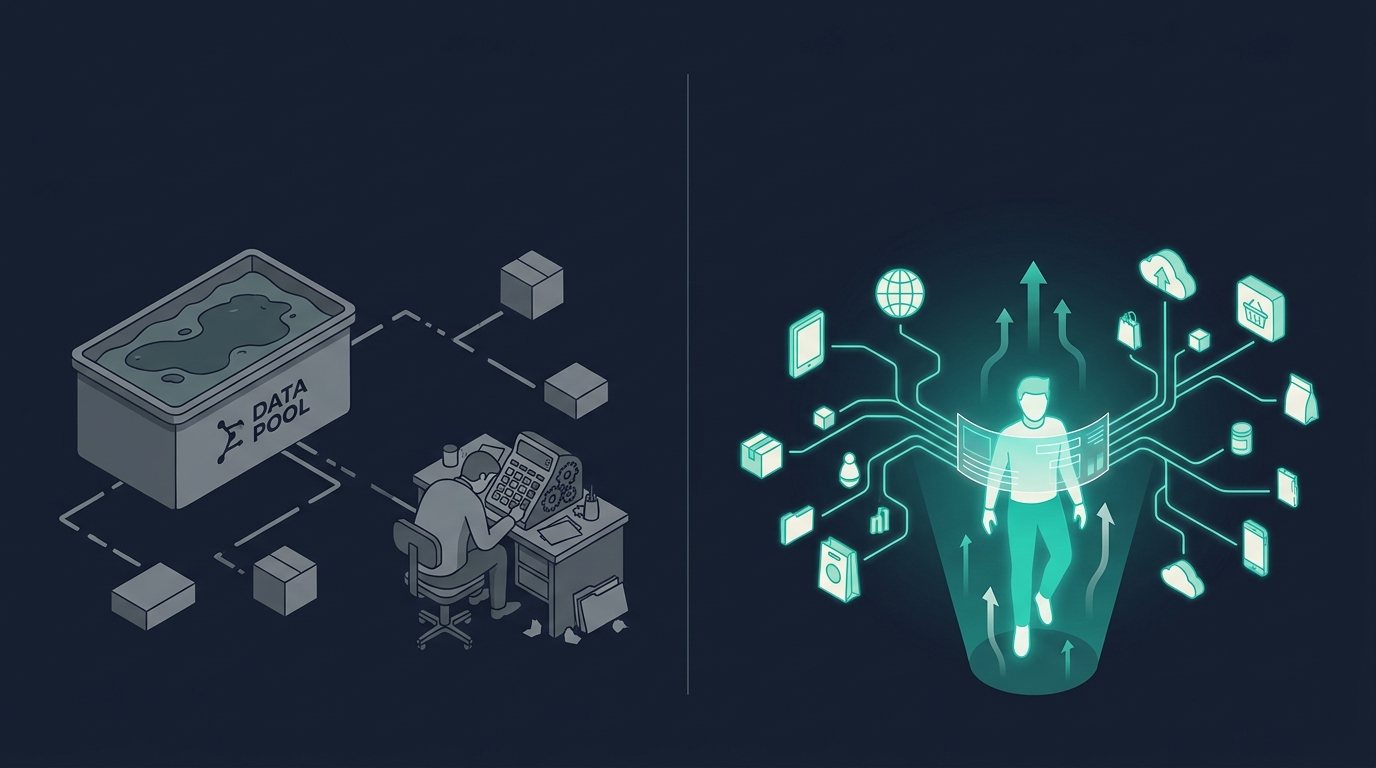
Every distributor buying syndicated content from the same pool ends up publishing the same product record as every competitor buying from that pool. That was fine when having any structured data at all was the differentiator. It is not fine now, because the pool has become table stakes, not an edge — and the SKUs it never finishes are where the P&L damage is actually happening.
The pool was built to solve a 2012 problem
Distribution Strategy Group has been writing about product data for over a decade, and the throughline is consistent: syndication is plumbing, get the pipe built, and the content will flow. Their 2012 piece on "good product data" called structured data "oxygen" for catalogs — a fair description for an era when most distributors had no digital catalog worth the name.
Fourteen years later, the oxygen is ambient. Every serious distributor in a category is connected to the same handful of pools. That's precisely the problem. When the input is shared, the output converges. Two distributors selling the same fastener, pump, or safety glove from the same manufacturer, both pulling from the same syndicated feed, publish nearly identical product detail pages — same title, same bullet points, same three stock photos. Industrial Distribution has flagged this directly: product content is a "hidden differentiator" precisely because most distributors treat the manufacturer or pool feed as the finished product rather than the starting material.
Distribution Strategy Group's 2022 syndication tutorial gets partway there — it distinguishes a "standard" syndication model (passive conduit) from an "advanced" one (enrichment, broader SKU coverage, better descriptions) and notes that most manufacturer source data is a mess: "75% of these leading manufacturers do not have individual product pages," and "90% of manufacturers have less than half of their published U.S. price list searchable." That's the right diagnosis. But the piece still frames enrichment as a feature of the syndicator, a thing you shop for in a vendor RFP, rather than what it actually is: a permanent operating function that sits downstream of the pool, on the distributor's side of the fence, running continuously.
What the pool actually contains, and what it doesn't
Pools like GDSN carry real structure — thousands of standardized attributes moving through certified data pools. But two things about that architecture matter more than the attribute count. First, interoperability between pools is worse than most operators assume — by some estimates, only about a third of data pools actually exchange data with each other, which is why the same SKU can show up complete in one distributor's feed and threadbare in another's. Second, and more importantly: pricing, promotional content, rich commerce attributes, and anything specific to how a distributor's customers actually search and filter are largely outside what the pool syndicates in the first place. The pool was designed for compliance and sync between trading partners, not for winning a search result or closing a spec-based B2B buying decision.
That gap is exactly where distributor differentiation now has to live. B2B buyers increasingly say spec-based filtering is their primary way of finding the right product in a digital catalog — MPN-first identity, classification, tolerances, materials, compatibility. That's not what most syndicated feeds carry deep enough to filter on. It's also not evenly distributed: in Anglera's Top Distributors 2026 index, which measured the Digital Readiness Index across 200+ distributors on 14 live-site signals, the split between distributors with genuinely complete, spec-filterable catalogs and those running on syndicated pass-through was stark enough to separate entire operating archetypes, not just individual scores.
Returns are the invoice for the gap
Distribution Strategy Group's 2020 piece on product returns argues, correctly, that distributors chase the wrong metric — return processing efficiency — instead of the upstream cause, and that "returns are more often attributed to user error than a fault with the product." We'd push that one step further: user error is frequently a symptom of a product page that didn't tell the customer enough to buy the right SKU the first time.
The external numbers back this up, and they're not small. Recent reporting on returns puts 43% of consumers as having returned a product in the past year because pre-purchase information was wrong, and 71% because the item didn't match the listing. Separate research on marketplace and retail catalogs finds that 66% of shoppers have abandoned a purchase over missing or inaccurate product information, and 40% of returns trace to incorrect product data. None of that is exotic — it's the same attribute gap the pool leaves open, showing up on the income statement as reverse logistics cost instead of a data-quality line item nobody's watching.
Why the 2023 cleanup is already gone
Here's the part the trade press consistently underweights, including Distribution Strategy Group's 2019 data-synchronization ROI paper, which frames sync as a project with a business case and a payback period. Catalogs are not static. Manufacturers revise specs, add SKUs, discontinue others, and change packaging counts continuously — and the pool re-syncs whatever the manufacturer sent, complete or not. A distributor that ran a thorough enrichment project in 2023 has, by 2026, absorbed three years of new SKUs the project never touched and spec changes the pool never flagged. Attribute completeness doesn't hold a line; it decays back toward whatever the pool delivers by default, because the pool was never built to hold the line for you.
That's the argument for treating enrichment as an operation, not a project: a standing function that watches fill rate and attribute drift the way a distributor watches inventory turns, not a vendor engagement that ends when the invoice clears.
The moat, concretely
"Completed SKUs" isn't a slogan, it's an audit you can run today: pull your catalog, check what percentage of live PDPs have every attribute a buyer would filter on, and compare it to what the pool actually supplied versus what somebody had to add. The gap between those two numbers is the moat, or the absence of one.
This is the layer Anglera works in. Your PIM stores the data; Anglera does the ongoing work of completing SKUs, normalizing attributes, and enriching specs the pool never carried — typically live in a few weeks, starting from whatever flat file or feed you already have, no rip-and-replace. The pool gets you to parity. Closing the gap after it is the actual job.