
United Natural Foods: The Distributor Behind Whole Foods
United Natural Foods fused two 1970s co-ops into a $31.8B grocery distributor, then wired its growth to one customer, Whole Foods, through 2032.
Part of Distributor Playbooks — strategy teardowns of every company on the MDM Top Distributors lists. New to the 2026 lists.
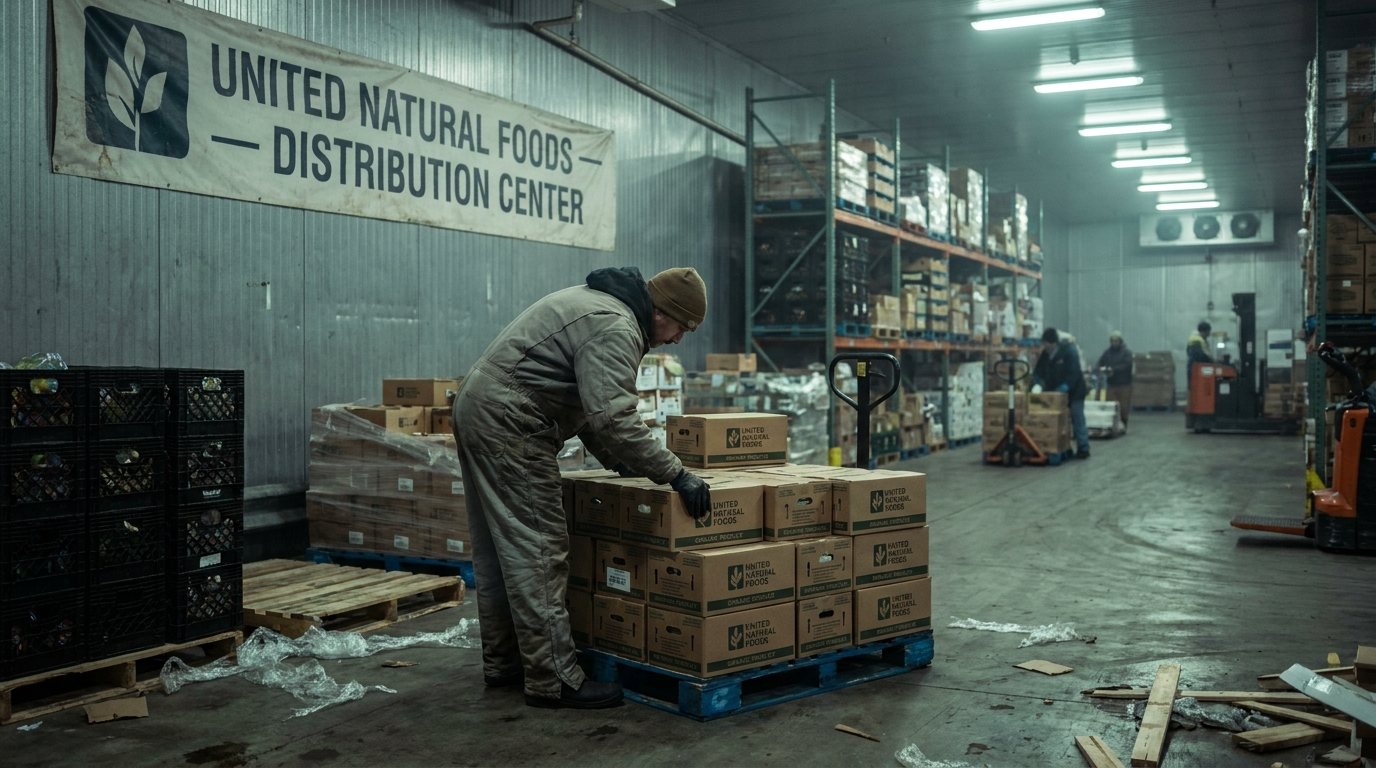
United Natural Foods lands on MDM's 2026 Top Distributors Food & Beverage list at $31.8 billion in revenue, a number that puts it behind only Sysco, Performance Food Group and US Foods among the country's grocery haulers. But UNFI did not start as a full-line grocery giant. It started as two counterculture warehouses on opposite coasts, and the way it got from there to here explains both its scale and its most unusual risk.
Two co-ops, one merger
In 1976, Michael Funk started Mountain People's Warehouse out of a barn in Auburn, California, stocking the bulk bins of natural food co-ops. A year later, on the other coast, Norman Cloutier launched Cornucopia Natural Foods in Connecticut and Rhode Island to do the same for New England's health-food stores. Neither company set out to build a national distribution network. They were regional plumbing for a niche the mainstream grocery trade did not yet take seriously.
The two operations merged in 1996 to form United Natural Foods, immediately creating a bi-coastal distributor with reach no single natural-foods warehouse could match, and the combined company went public on Nasdaq that same year to fund a buying spree of smaller regional distributors. That pattern, roll up the fragmented natural-foods supply chain one warehouse at a time, defined UNFI for the next two decades, according to Wikipedia's summary of the company's history and the company's own About page. By the late 1990s, a small Austin chain called Whole Foods Market had become UNFI's anchor customer, riding the same organic-food wave upmarket into the mainstream.
The bet that doubled the company overnight
The defining move came in 2018, when UNFI agreed to buy Supervalu, a struggling conventional grocery wholesaler and retailer, for $2.9 billion. It was a strange marriage on paper: a specialty natural-foods distributor absorbing a company built on fast-turning conventional groceries and legacy retail banners like Cub Foods. Grocery Dive's coverage at the time noted that UNFI was buying a company still finding its footing in wholesale, betting it could out-execute where Supervalu's own management hadn't.
The deal closed that October, and it reset what UNFI was. Combined, the two companies ran more than 60 distribution centers, carried roughly 250,000 SKUs and served over 45,000 customers, per Grocery Dive's report on the deal's completion. UNFI stopped being the country's biggest organic specialist and became something closer to a universal grocery utility, stocking everything from kombucha to canned soup for independent grocers, regional chains and national retailers like Kroger, Target and Costco. The natural-foods roots never disappeared, but the center of gravity shifted to full-line conventional distribution almost overnight.
Betting the company on one customer, on purpose
Here is the insight that does not show up on UNFI's About page: this company has built its entire modern growth strategy around deepening, not diversifying away from, one customer relationship. Whole Foods Market, now owned by Amazon, has been UNFI's largest account since the 1990s, and reporting on the company's SEC filings has put that single customer at somewhere between 18% and 25% of net sales depending on the year, easily the largest concentration in the distributor's book. Most companies would treat that as a vulnerability to hedge. UNFI has instead leaned in. In 2024 it extended its primary distribution agreement with Whole Foods all the way to May 2032, an eight-year extension announced well ahead of the prior deal's 2027 expiration, according to the company's own press release and Grocery Dive's coverage of the extension. The stock jumped nearly 5% on the news. Locking in a customer that large, that far out, is a statement that UNFI sees itself less as one vendor among several and more as Whole Foods' outsourced supply chain department.
That posture paid off for years. Then in June 2025 it showed its cost. A cyberattack forced UNFI to shut down its entire ordering and distribution network, and because Whole Foods and dozens of other retailers route so much volume through UNFI's systems, shelves across the country went empty within days. CNN's coverage of the incident and Cybersecurity Dive's reporting on the earnings impact both traced a straight line from one company's network outage to a national supply disruption, with UNFI telling the SEC the incident would measurably dent quarterly sales and raise costs. CEO Sandy Douglas's response was candid rather than defensive: a distributor at this scale, he said, has to be "both high capability and humble when it relates to cybersecurity."
That is the real strategic tension in UNFI's story. The same concentration that makes the Whole Foods relationship a growth engine also makes UNFI a single point of failure for a meaningful slice of the American grocery supply chain. Diversify the customer base and you dilute the moat that makes you indispensable to your biggest partner. Deepen the dependency and one bad week in IT becomes a national news story about empty produce aisles. UNFI has chosen depth, and by fiscal 2025 it was still hitting its free cash flow targets despite the disruption, which suggests the bet is holding, at least for now.
A distributor built twice
UNFI has essentially been built twice: once by two regional co-op warehouses merging to cover a coast-to-coast niche, and again by absorbing Supervalu to become full-line grocery infrastructure. Both rebuilds were driven by the same instinct, that scale and breadth beat specialization in a business where margin comes from moving cases efficiently, not from any single hot product line.
Every company in this series wins or loses on unglamorous infrastructure: the branches, the fleets, the catalogs, and, for a company whose network outage can empty a nation's produce aisles, the data pipes that keep the whole system talking to itself.