
How B2B buyers use ChatGPT to research suppliers, and what they find
B2B buyers ask ChatGPT to frame a category, build a supplier shortlist and compare vendors; the engine runs web searches and cites pages with specific facts.

B2B buyers use ChatGPT to frame a category, build a shortlist of suppliers, compare vendors head to head, and check claims, then validate the shortlist on supplier websites, review sites and demo videos. Behind each answer, ChatGPT rewrites the buyer's question into several web searches and cites the pages that answer those searches with specific, checkable facts, so the supplier pages that carry real part numbers, specs and availability are the ones that end up in the answer.
What the surveys say about B2B buyers using generative AI for supplier research
The numbers vary by who was asked, so read each with its sample in mind.
- Forrester. In its Buyers' Journey Survey 2025, Forrester reports that 94% of business buyers use AI in their buying process, up from 89% a year earlier, and that twice as many buyers named generative AI or conversational search a meaningful source as named any other source, ahead of vendor websites, product experts and sales. The same post says 61% use private AI tools provided by their employer, which means a lot of this research happens behind a firewall you will never see in analytics.
- Forrester, earlier wave. The 2024 survey found 95% of B2B buyers planned to use generative AI in at least one area of a future purchase, and over half said it led them to evaluate additional or alternative vendors.
- Gartner. A survey of 646 buyers run August to September 2025 found 45% used AI during a recent purchase and 67% prefer a rep-free experience.
- G2. Its March 2026 survey of 1,076 B2B decision-makers found 51% of software buyers now start research in an AI chatbot more often than in Google, ChatGPT is the preferred chatbot for 62%, and 69% say a chatbot surfaced information that led them to a different vendor than expected. The same report found 64% encounter AI inaccuracies a few times a month or more often.
- Google with National Research Group. A survey of 2,063 senior U.S. business leaders found nearly three-quarters finish their buying journey in 12 weeks or less and 58% of recent buyers also switched vendors in the same six months, with buyers evaluating vendors through Google Search, AI tools, social media and peer recommendations rather than relying on sales reps.
- Bain. From qualitative research, Bain reports that buyers at small and medium-size businesses have started building vendor short lists inside LLMs, then use websites, review platforms and YouTube demos to validate what the model suggested.
A caveat for distributors and manufacturers: G2's panel is software buyers, and the Google sample covered buyers of technology, software, web services or retail purchases. Nobody we found has published a large survey of MRO, electrical or industrial parts buyers specifically. The direction is consistent, though, and the mechanism below does not depend on industry.
How one buyer prompt becomes several searches
When a buyer asks a sourcing question, the engine does not look the prompt up whole. OpenAI's developer docs describe reasoning models that run web searches as part of their chain of thought, analyze results, and decide whether to keep searching, with separate actions for searching, opening a page and finding text inside a page. The response carries a list of every URL consulted, and the docs note the number of sources is often greater than the number cited. Google calls the same idea query fan-out: AI Mode is breaking down your question into subtopics and issuing a multitude of queries on the user's behalf, and Deep Search can issue hundreds of searches.
For illustration, take a maintenance buyer who types: "Who can ship a 2-inch 316 stainless full-port ball valve, 1000 WOG, NPT, to a plant near Houston this week?" A plausible fan-out looks like this:
2 inch 316 stainless full port ball valve 1000 WOG NPTto find candidate parts and MPNs[manufacturer] [MPN] spec sheetto confirm pressure rating, seat material and threadindustrial valve distributor Houston stockto find who sells it locally[MPN] in stock lead timeto check availability[distributor A] vs [distributor B] valvesto compare the shortlist
Each of those is a separate retrieval. A distributor page can win search 3 and lose search 2 and 4 because the product page says "Ball Valve, SS, 2in" with no MPN, no WOG rating and no stock signal. The engine then cites the manufacturer, a competitor or a marketplace for those facts, and the buyer's shortlist forms around whoever answered the specific searches.
If the term is new, our glossary entry on generative engine optimization covers the vocabulary.
What buyers actually find when ChatGPT researches suppliers
Three things show up in the answers, and each traces to how retrieval works.
Mostly third-party pages. Bain cites ScrunchAI data across roughly 500 million citations showing 89% of unbranded prompts are fulfilled by third-party sources. For a manufacturer, the distributor catalogs that carry your parts are third-party sources. For a distributor, manufacturer spec pages and marketplaces are. Whoever publishes the cleanest version of the part's facts gets the citation, regardless of who makes it.
Specific facts beat category copy. A fan-out search like [MPN] spec sheet is answered by a page that contains that MPN and those specs in text an engine can parse. A "We carry a full line of valves" category page answers nothing in that list.
Wrong answers that buyers then check. G2's 64% inaccuracy figure is the buyer's side of the same problem. When the engine cannot find a clear value for thread type or voltage on your page, it fills the gap from someone else's page, and if that page is stale the buyer gets a wrong spec attached to your name. Buyers then validate on supplier sites, which is the second chance for a page with complete data.
What a citable product record carries
The pages that get lifted carry the same layers an agent or answer engine reads in order. Each layer answers one question the fan-out searches ask.
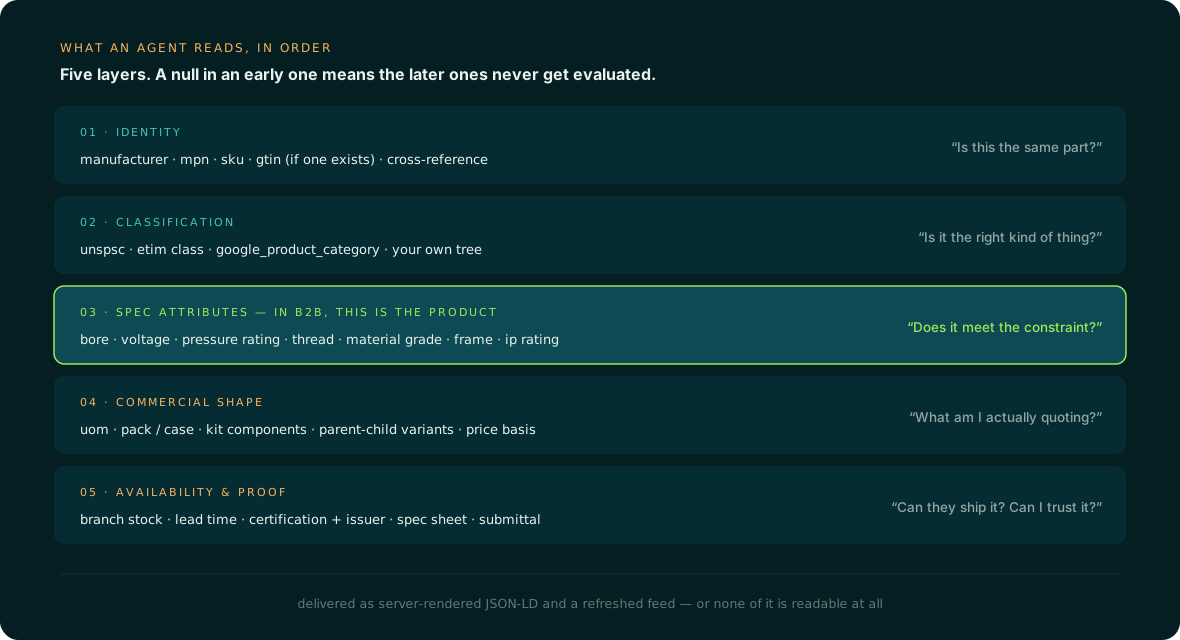
The delivery detail matters. Google's merchant listing documentation recommends the most specific GTIN type that applies, an MPN to identify the product for its manufacturer, and at most one brand name, and warns that dynamically generated markup can make Shopping crawls less frequent and less reliable, a problem Google flags for fast-changing content like price and availability. If your specs only appear after a client-side script runs, assume some crawlers miss them. Our post on how to structure product data for AI agents walks through the field map layer by layer.
The hard part is filling the layers, not rendering them. A typical distributor record has the MPN and a truncated ERP description; the pressure_rating, thread_type and seat_material values sit in a manufacturer PDF. For illustration, a 40,000-SKU catalog at 15 minutes per SKU to find and key those values by hand is 10,000 hours, and the values drift every time a manufacturer revises a sheet. This is where the "who does the work" question gets real. Your PIM or ERP stores the attributes; Anglera does the work of extracting them from spec sheets, catalogs and manufacturer sites, normalizing units, scoring each value against its source, and flagging conflicts for review. It runs on top of whatever system you already have, or a flat export, and how Anglera works shows the pipeline.
Where supplier pages drop out of the answer
Four patterns account for many of these losses:
- No MPN or cross-reference on the page. The fan-out search for the part number cannot match you.
- Specs inside a PDF only. The engine may open it, or may cite whoever put the same values in HTML.
- Inconsistent units.
1000 WOGon one SKU,1000 psion its sibling, and nothing on the third makes the family look unreliable. - Availability hidden behind login. Fine for pricing, but a public "in stock at Houston branch" or lead-time signal answers search 4.
Deciding where to start on AI supplier research visibility
Run five or ten of your buyers' real questions through ChatGPT and Gemini and look at which URLs get cited for each part of the answer. Where a competitor or marketplace is cited for a spec you sell, that is an attribute gap on your page, not a content gap on your blog. Prioritize the categories where buyers search by spec (fittings, valves, motors, fasteners, electrical) and fill identity and spec layers first; commercial and availability layers come next. The guide to getting products cited by AI search lays out the audit step by step, and the distributor guide to answer engine optimization covers the site-level work.
The buyers' engines are already reading your product pages and deciding whether they answer the question. Anglera fills the attributes those searches look for, sourced from real documents and kept current as manufacturers revise them, typically live in 30 days or less from a CSV or ERP export. Your PIM keeps storing the data; the pages just stop having gaps where the answer should be.