
Carter-Jones Lumber: The Holdout in a Rolled-Up Industry
Carter-Jones Lumber ranks BM #13 on MDM's 2026 Top Distributors list. Still family-run after 94 years, it buys yards and keeps their names on the sign.
Part of Distributor Playbooks — strategy teardowns of every company on the MDM Top Distributors lists. New to the 2026 lists.
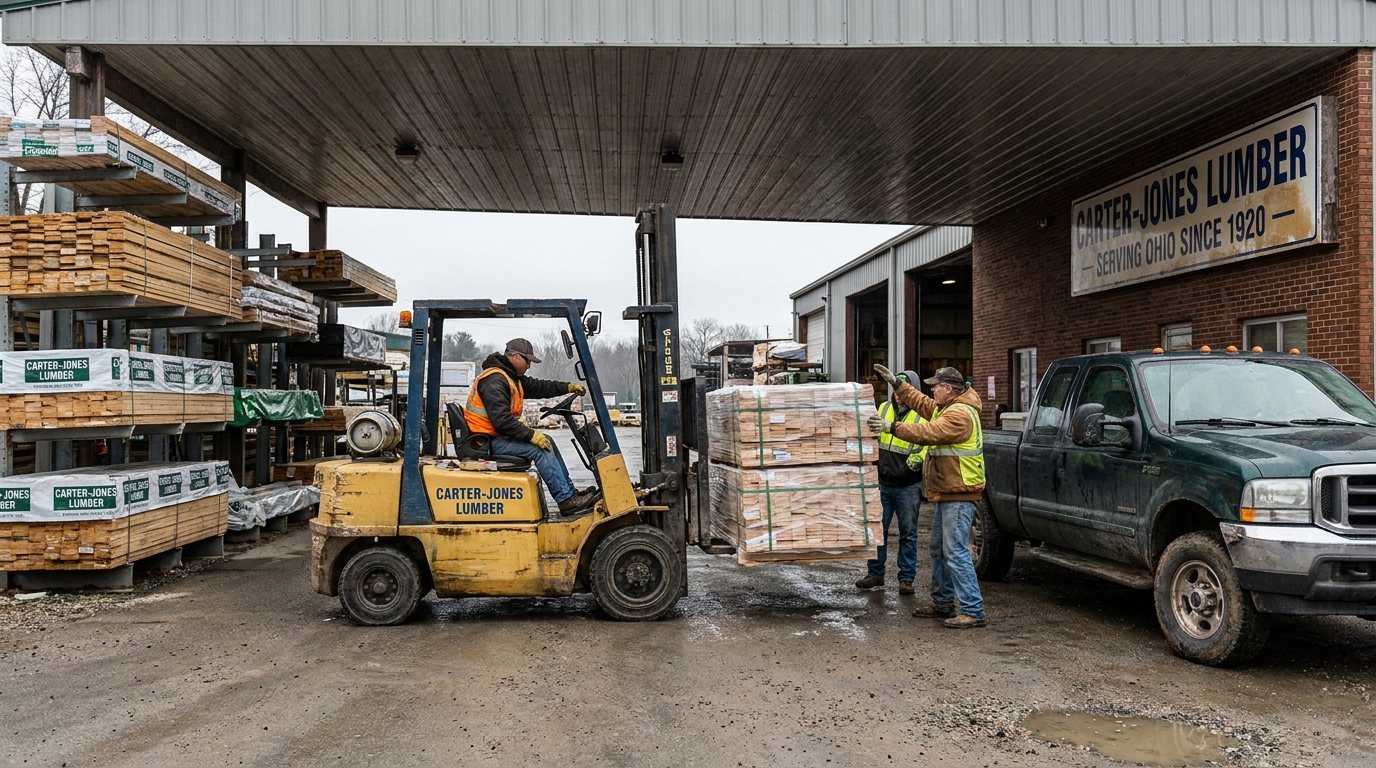
Carter-Jones Lumber lands at BM #13 on MDM's 2026 Top Distributors list with $2.7 billion in revenue, in a building materials sector where the top nine names are increasingly the same handful of private-equity-backed and now publicly traded roll-ups. The company most people know by its retail name, Carter Lumber, is still owned by the family that founded it in 1932. That alone makes it worth a closer look at how it competes.
A lumberyard bought off a foreclosure notice
The founding story is Depression-era and specific. Warren E. Carter arrived in Akron, Ohio in 1927 to visit a brother working at Goodyear, and on the drive around town he stopped at a lumberyard on North Case Avenue in Kent owned by a man named Clyde Gough, who offered him a foreman's job at $22 a month. Five years later, with the bank having foreclosed on Gough's yard, Carter and a co-worker named T. Neil Jones pooled their savings and bought the assets out of foreclosure. The Carter-Jones Lumber Company opened in 1932, at the bottom of the Depression, with Carter and his family living above the store and taking a paycheck only when there was cash left over at the end of the week, according to Zippia's company history and KPC News. Carter died in 2000 at 101; the business he and Jones started is now run by his grandchildren's generation, with Neil Sackett as president and CEO.
That original legal name is why MDM's list still shows Carter-Jones Lumber even though the stores have carried the Carter Lumber name for decades. It is a small detail, but it is the kind of thing that tells you the company has never felt pressure to clean up its cap table or its branding for an outside audience, because there has never been an outside audience to please.
"Run the whole company like one store"
Carter Lumber's own account of its operating philosophy, reported by Smart Business Magazine, traces straight back to the founder. Sackett has described W.E. Carter's core belief this way: if you run the whole company like one store, your customers are better served, no matter how many locations you operate. In the late 1990s, as the chain grew past the size where every manager could still know Carter personally, the company found itself losing that discipline and losing sales to it. The fix was not a rebrand or a private equity recapitalization. It was a deliberate return to basics: on-site contractor sales reps, point-of-sale systems that gave every branch manager the same visibility Carter himself used to have from the counter, and a training program built around courtesy and speed for contractor customers who treat their time as billable. The campaign, built around the tagline "The Yard at Carter Lumber," reportedly delivered a 6 percent sales lift. It is a mundane-sounding fix, and that is the point: the lever was operational discipline, not financial engineering.
Buying yards and leaving the sign alone
The real strategic tension in this profile, and the thing worth naming directly, is how Carter Lumber grows against the backdrop of what is happening to the rest of its sector. Building materials distribution has consolidated hard over the past five years. SRS Distribution was built by private equity and then sold to Home Depot. QXO, run by Brad Jacobs, is explicitly executing a roll-up strategy across the space. Builders FirstSource itself grew through more than 20 mergers. Nearly every large peer on the MDM list is either PE-owned, publicly traded, or both, and the standard playbook is to acquire, integrate, and eventually fold the acquired name into the parent brand.
Carter Lumber acquires too. In October 2024 it bought Townsend Building Supply, a six-location, family-owned dealer in the Florida Panhandle and southern Alabama founded in 1944, according to LBM Journal. In 2025 it added Harvey Lumber, and in May 2026 it acquired Gaster Lumber and Hardware, a three-location, family-run supplier serving Savannah, Georgia since 1985, per LBM Journal's coverage and Hardware Retailing. What is different is what happens next. Carter Lumber's Family of Companies page lists Holmes Lumber, Kempsville Building, Kight Home Center, and Townsend Building Supply as active brands alongside Carter Lumber itself, each still operating under its own local name and, in Townsend's case, with a stated commitment to invest in the acquired yards rather than absorb them. It is acquisition as a federation, not a rollup: buy a well-run local yard, keep the relationships and the sign that customers already trust, and add scale in the back office. That is a slower, less legible growth story than QXO's public roadshow, and it is also a model almost nobody else at this scale in building materials is running.
Where that leaves it
The tradeoff is real. A federated multi-brand structure is harder to run efficiently than a single integrated system, and Carter Lumber's public reporting is thin by design, since there are no shareholders to brief. What the MDM number shows is that the model scales anyway: 190-plus locations across 15 states and $2.7 billion in revenue, growing by greenfield openings, reinvestment in existing markets, and acquisitions concentrated in the South, per LBM Journal's reporting on the company's growth strategy. Ninety-four years after a foreclosure sale in Kent, Ohio, the company is still privately held, still adding yards, and still betting that a customer trusts the name on the sign more than the name on the parent company.
Every distributor on MDM's list runs on the same unglamorous infrastructure underneath the branch count and the revenue figure: the catalogs, the yards, the trucks, and the data that ties them together. This series looks at how the largest ones built that machinery, one company at a time.