
How McCoy's Building Supply Stayed Family-Owned in a Rolled-Up Trade
McCoy's Building Supply ranks BM #19 on MDM's 2026 Top Distributors list. How a fourth-generation Texas family kept it after Home Depot nearly ended it.
Part of Distributor Playbooks — strategy teardowns of every company on the MDM Top Distributors lists. New to the 2026 lists.
McCoy's Building Supply lands at BM #19 on MDM's 2026 Top Distributors list, the annual ranking from Modern Distribution Management of North America's largest wholesale distributors, with $1.2 billion in revenue across 85 stores in Texas, Oklahoma and New Mexico. That number alone doesn't explain much. What makes McCoy's worth studying is who still owns it: the same family that started it in Galveston in 1927, four generations later, in a sector where nearly every peer of comparable size has been bought by private equity or a public roll-up.
A roofing crew that became a lumberyard
Frank McCoy started as a contract roofer, moving the business from Houston to Galveston in 1927. It was his son Emmett who turned it into something else. After World War II, Emmett saw homeowners wanting to buy materials and do the work themselves, and in the 1940s he launched McCoy Supply Company to sell roofing and building materials directly to the public. He kept the roofing crews running alongside the new retail arm until 1964, when he dropped contract roofing entirely, added lumber, and turned the operation into what became McCoy's Building Supply Centers.
The company's founding test came in 1961, when Hurricane Carla tore through the Texas Gulf Coast. Materials suppliers across the region raised prices on desperate homeowners. Emmett didn't. That decision, according to Family Business Magazine, built the community trust that carried McCoy's through the rebuilding boom and pushed the company past $1 million in annual sales for the first time. It's a small episode, but it set a pattern the company still points to: hold the line on price discipline as a long-game asset, not a short-term lever.
The near-death nobody puts on the About page
By the mid-1970s, Emmett's three sons, Michael, Brian and Dennis, had joined the business and were driving an expansion that eventually topped 100 locations. Then, in 1985, Dennis McCoy died in a plane crash at 28, flying to a store location. Mike and Brian, the surviving brothers, restructured leadership around the loss and kept building.
The real threat came a decade later. When Home Depot and Lowe's pushed into Texas in the mid-1990s, McCoy's lost roughly half its revenue within two years and had to close 29 of its 110 stores. For a regional lumberyard chain built on relationships and delivery trucks, big-box retail with national buying power was close to an extinction event. McCoy's survived it, but the strain reshaped the company. In 2000, Mike McCoy wanted to sell. The family split: Brian's branch bought the operating company in 2001 and leased facilities back from the extended family, while Mike retired after three decades running the business. It is the kind of internal fracture most "family legacy" narratives smooth over, but it's the hinge on which the modern McCoy's turns. What survived on the other side wasn't a united family conglomerate. It was one branch of the family, committed to running the company as an operator rather than a portfolio asset, at the exact moment competitors with deeper pockets were arriving in force.
Why this matters more now than it did then
That distinction is the piece's unique insight. Building materials distribution in North America has consolidated hard over the past fifteen years. Builders FirstSource and BMC merged into a public giant. US LBM rolled up dozens of regional yards under a private-equity sponsor before going public. Foundation Building Materials, SRS Distribution and a long list of others have changed hands between PE firms multiple times. Against that backdrop, an $1.2 billion, 85-store chain that is still privately held by descendants of the founder, with no PE sponsor and no public filing requirement, is the outlier, not the norm.
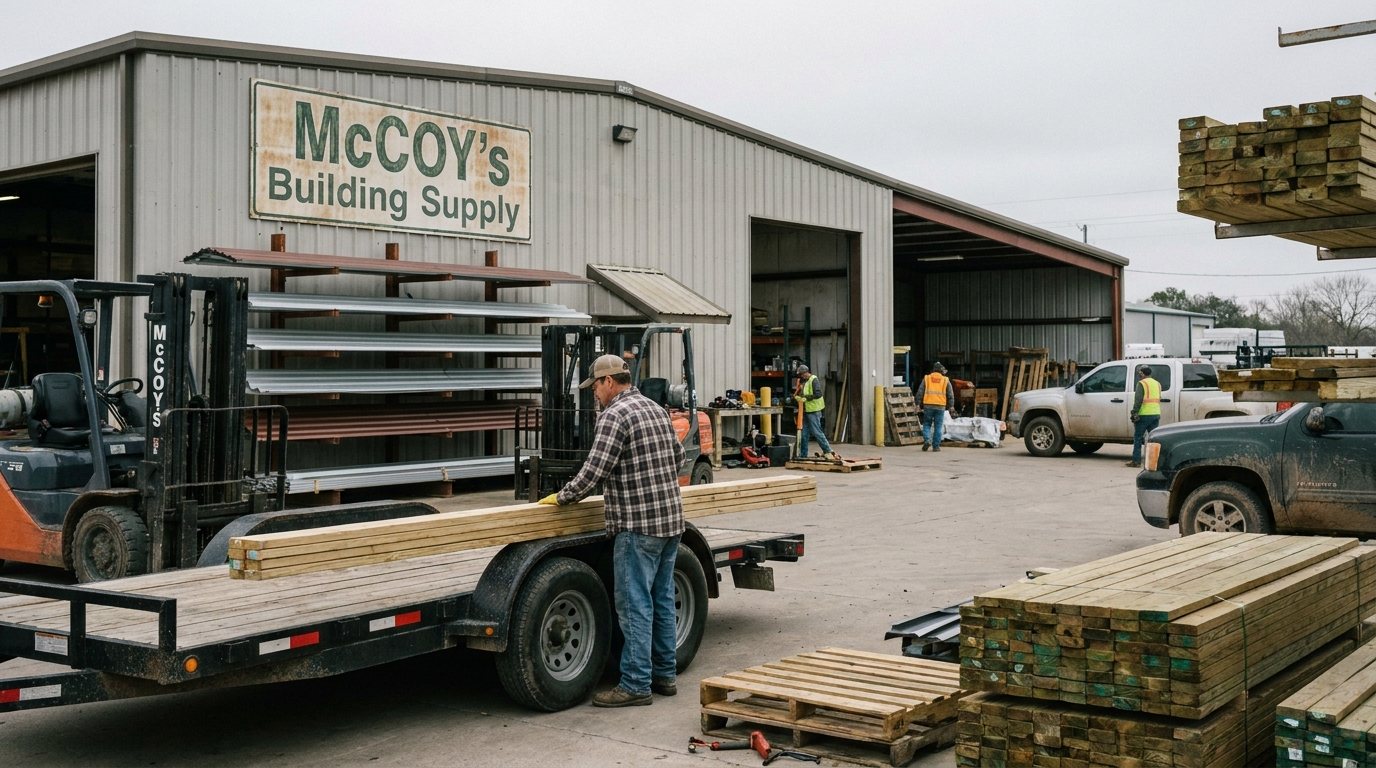
McCoy's paid for that independence with a slower, in-house-everything model rather than acquisition-fueled scale. The company runs its own commercial credit program alongside a Synchrony-backed private-label card, rather than outsourcing contractor financing. It operates its own delivery fleet, a detail the company still markets in its green-and-yellow trucks, and by 2000 had already grown that fleet past 300 vehicles to guarantee same-day jobsite delivery. It built two millworks facilities and two distribution centers rather than relying purely on vendor drop-ship. And it diversified into farm and ranch equipment, a category adjacency that gives McCoy's a customer base independent of new-home construction cycles, useful insulation when residential building slows.
The generational handoff, and the current bet
Brian McCoy stepped down as CEO in 2022 after roughly two decades in the role, becoming board chairman. His daughter, Meagan McCoy Jones, became the company's first woman president and CEO, the fourth generation to lead it. Under her, McCoy's has kept expanding rather than consolidating defensively: a new store opened in New Caney, Texas in spring 2026, and the company closed the Rio Truss acquisition in December 2024, adding structural component manufacturing in the Rio Grande Valley, per the company's press release and trade coverage in LBM Journal. It also closed a store in Plainview in early 2026, a reminder that staying private doesn't mean staying static.
The bet embedded in all of it is that a family that has already turned down a sale once, survived a big-box invasion, and split apart and reformed around a single operating branch, is better positioned to make patient, decades-long capital calls than a sponsor working a five-to-seven-year hold. Whether that holds as the next generation takes the wheel is the open question worth watching.
Distribution is won in unglamorous places: the branch that stays open through a storm, the truck that shows up same-day, the catalog kept current enough that a contractor never has to call twice. McCoy's has spent a century proving that ownership structure is one more variable a distributor gets to choose.