
Charbone: The Hydrogen Startup That Became a Gas Distributor
Charbone set out to make clean hydrogen in Quebec. A global helium shock turned it into a welding-gas distributor on MDM's 2026 Top Distributors list.
Part of Distributor Playbooks — strategy teardowns of every company on the MDM Top Distributors lists. New to the 2026 lists.
Charbone Corporation shows up in the Gases & Welding Supplies column of MDM's 2026 Top Distributors report, the closest thing the channel has to a scoreboard. It sits there next to companies with decades of branch networks and fleets of thousands of cylinders. Charbone has neither. It has an electrolyzer plant in Sorel-Tracy, Quebec, five helium trailers, and a business plan that was, until about eighteen months ago, entirely about a different molecule.
A hydrogen company that hadn't sold hydrogen yet
Charbone was incorporated in 2018 as a green-hydrogen developer, betting that Quebec's cheap, low-carbon hydroelectric power made it an unusually good place to run electrolyzers and produce ultra-high-purity (UHP) hydrogen without shipping it across a continent first. The company listed on the TSX Venture Exchange in May 2022 under the ticker CH, later adding an OTCQB line (CHHYF) and a Frankfurt listing, and spent the years that followed building its flagship modular plant at Sorel-Tracy. That plant didn't reach commercial production until December 2025, per the company's own updates — nearly four years after the public listing. For most of its life as a public company, Charbone was a construction story, not a distribution story.
The pivot the name change made official
In March 2025, shareholders approved dropping "Hydrogen" from the corporate name. The change became effective in June 2026, and the company has been explicit about why: it wanted the name to match a business that had grown past single-molecule production into what it calls a full-stack industrial gases platform, spanning hydrogen, helium, oxygen, nitrogen and argon across production, purification, compression, storage and distribution, according to Industrial Distribution. The rebrand wasn't cosmetic. It tracked a real operating shift: while Sorel-Tracy was still commissioning, Charbone launched an Industrial Gases Distribution Division built on gas it doesn't make itself, contracting supply from third-party producers and reselling it into welding, metal processing, manufacturing and lab accounts across Quebec and Ontario.
Riding someone else's shortage
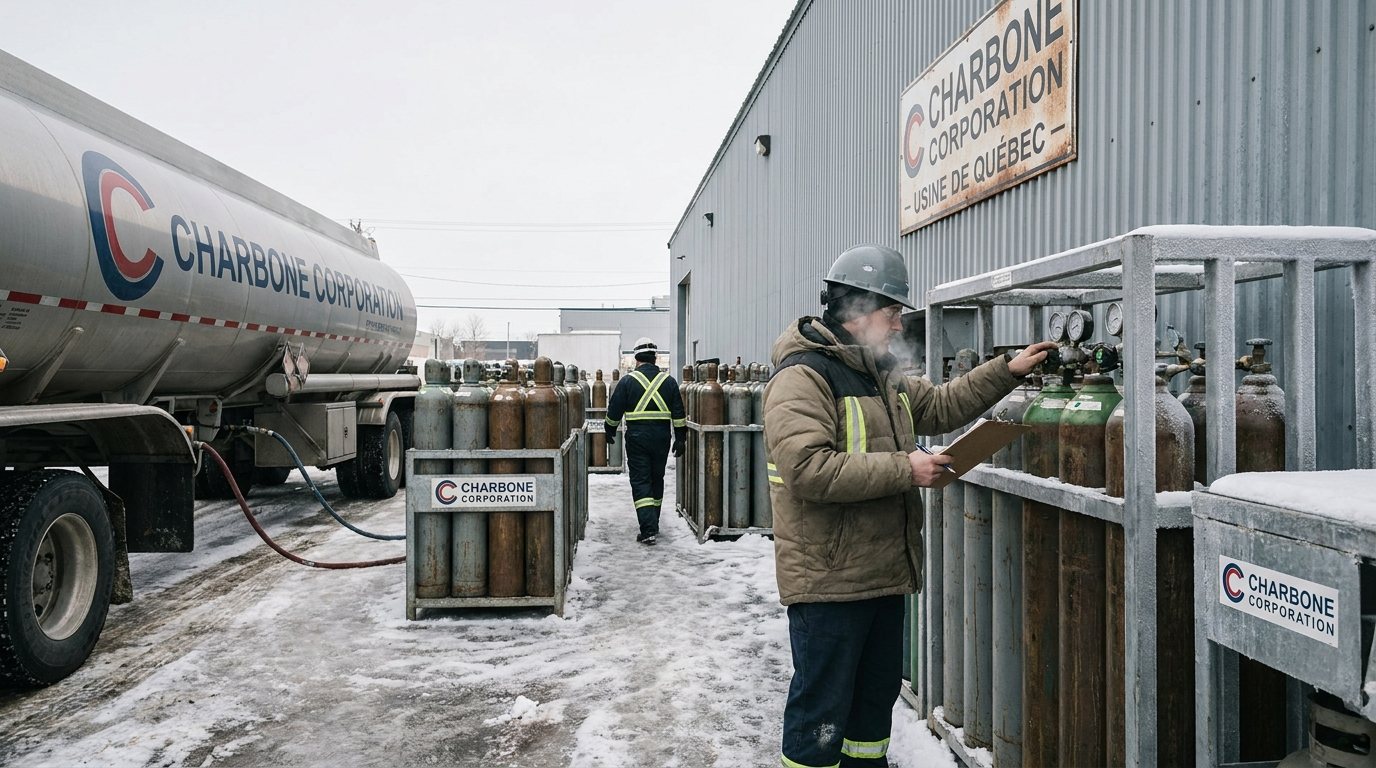
The timing lines up with a genuine supply shock. Disruptions tied to Qatar's Ras Laffan complex, historically the source of roughly a third of the world's helium, combined with shipping constraints through the Strait of Hormuz to squeeze North American helium markets through 2025 and into 2026, per reporting summarized by Indian Chemical News. Major industrial gas suppliers, optimized for volume contracts with the largest accounts, rationed supply. Charbone's read on the moment was that customers locked out of primary allocations are often contractually free to source from a secondary supplier, and it built a delivery fleet to catch that overflow: one dedicated helium trailer in the fourth quarter of 2025, five by mid-2026, with capacity to add five more within months. In one stretch the company added 22 new helium customers across Quebec spanning welding, metal processing, advanced manufacturing and lab services, and CEO Dave Gagnon called it confirmation of "our diversification strategy" in a company release distributed via NewMediaWire.
The insight: a distributor built backwards
Most names on MDM's gases list earned their spot by scaling a production-and-fill network over decades, then layering distribution on top. Charbone did it in the opposite order. It spent years and most of its capital on a single production asset that wasn't shipping product, then used the distribution arm, gas it sources rather than makes, as the fast path to revenue and market presence while the production side caught up. That's an unusual sequence for a "top distributor" entrant: the plant came first and the customer base came second, but the customer base showed up before the plant was contributing meaningfully to what gets sold. Charbone is, in effect, renting its way into distribution relationships it hopes its own hubs will eventually supply.
The company frames its target customer as the mid-tier industrial account that the majors have stopped prioritizing: welding shops, regional manufacturers, labs, and specialty technical services that a global supplier optimized for hyperscale contracts is structurally less interested in serving well, according to the strategic rationale laid out in coverage from StockTitan. That's a real underserved segment. It's also the segment every regional gas distributor already claims.
The tension worth naming
The numbers keep this in perspective. First-quarter 2026 revenue came in around C$245,000, a large percentage jump off a near-zero prior-year base rather than evidence of scale, and the company posted a net loss of roughly C$2.7 million for 2025, an improvement year over year but still a company funding growth through private placements and a secured convertible loan rather than operating cash flow, per the StockTitan summary. Charbone's helium business also depends on supply agreements with producers it doesn't control, which is exactly the fragility that created its opening in the first place. The bet is that by the time competitors' allocations normalize, Charbone's own hubs, six to eight planned across North America by 2027, will have converted borrowed supply relationships into owned production. Until then, the company is selling other people's molecules to build the customer list its plants are meant to eventually serve.
It's a distribution strategy assembled under pressure rather than designed from a blank sheet, and whether that sequence holds up depends on execution nobody outside Charbone can verify yet. What's clear is that a shortage in someone else's supply chain is the reason a hydrogen-production startup now shows up on a welding-gas distributor list at all.
This series exists because distribution runs on the unglamorous stuff, catalogs, branches, fleets, and the data behind all three, and Charbone's entry is a reminder that sometimes the fastest way onto that list is to fill a gap the incumbents left open.