
Industrial Piping Specialists: PVF Without a Parent Company
Industrial Piping Specialists ranks #6 in PVF on MDM's 2026 Top Distributors list. Here's how a private, Tulsa-founded oilfield distributor stayed independent.
Part of Distributor Playbooks — strategy teardowns of every company on the MDM Top Distributors lists. New to the 2026 lists.
Industrial Piping Specialists lands at #6 in pipe, valves and fittings on MDM's 2026 Top Distributors list, the annual ranking from Modern Distribution Management that sizes up North America's largest wholesale distributors across 20 product categories. IPS didn't get there through an IPO or a private-equity roll-up. It got there from a single Tulsa facility opened in 1986, still privately held, still running the same oilfield-energy playbook four decades later.
The unglamorous math of PVF
Pipe, valves and fittings is not a category that rewards a thin catalog. A distributor either has the right flange, in the right pressure class, in the right material grade, sitting on a shelf when a well pad or a midstream job needs it today, or the customer calls someone else. IPS's own materials describe the founding logic plainly: reduce the customer's total cost from spec to delivery, which in PVF means carrying inventory depth most competitors won't bother to stock, then doing the cutting and machining in-house so a distributor doesn't have to become a second phone call.
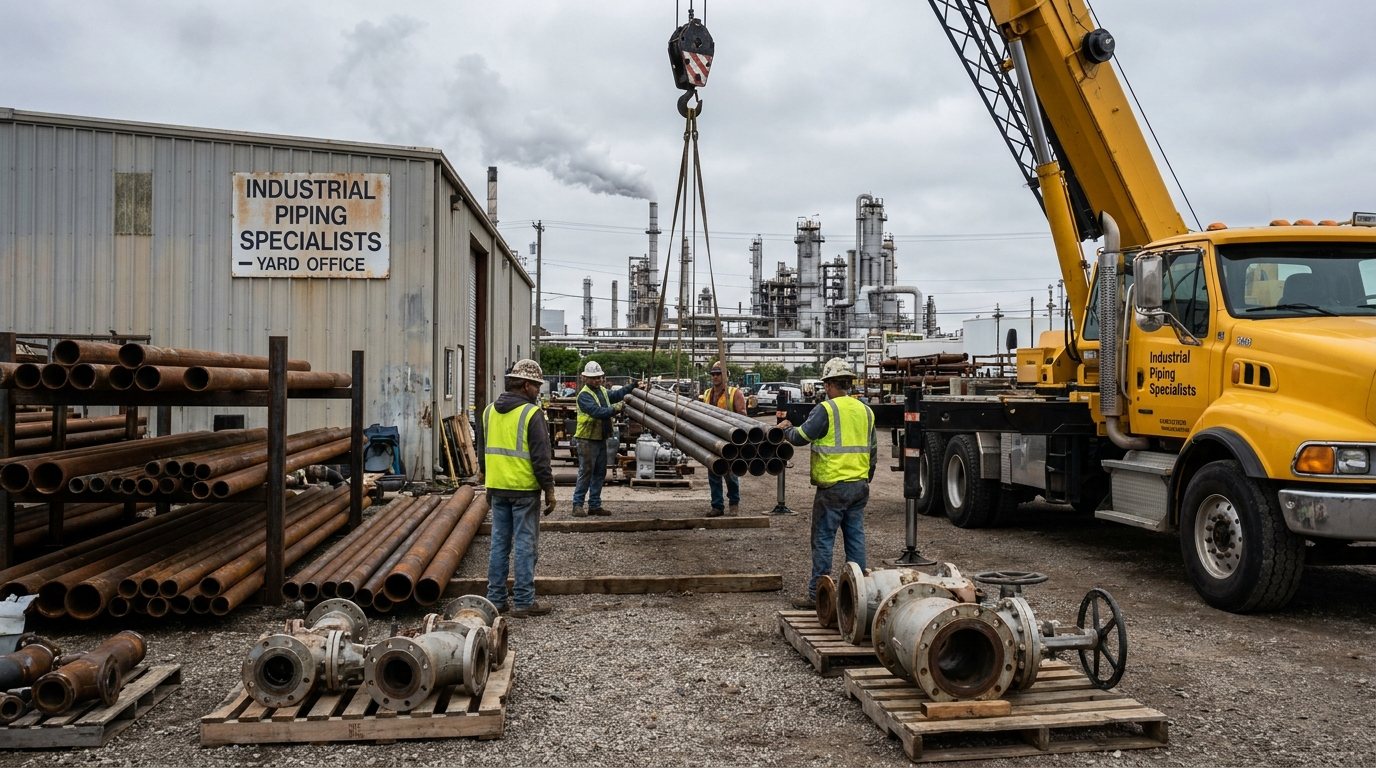
That's the business IPS built. According to the company's site, it now runs 16 distribution facilities across nine states, stocking pipe, valves, fittings and flanges for upstream, midstream and downstream energy work alongside general construction. Layered on top of the stocking function is a real fabrication shop: cutting, beveling, threading, mitering, plasma five-axis profiling, boring, grooving and CNC machining, done to ASTM, ASME and API specs rather than farmed out. Vendors on the line card include Bonney Forge, KF Valves, Tenaris, Vallourec and Warren Valve — mill-grade names that put IPS in the same supply chain as the majors, just without the balance sheet.
The insight: everyone around them sold out, IPS didn't
Here's the part that doesn't show up on the About page. PVF distribution is one of the more consolidated corners of industrial distribution, and the consolidation has a specific shape: either go public backed by a strategic parent, or go public backed by a financial sponsor.
DistributionNOW, the PVF giant that trades as DNOW, exists today because National Oilwell Varco spun it off onto the NYSE in May 2014, handing NOV shareholders one DNOW share for every four NOV shares they held. MRC Global, the other name that dominates PVF rankings, took a different but equally financial-engineering path: Goldman Sachs took a private stake in McJunkin Red Man starting in 2007, and the combined company IPO'd on the NYSE in 2012 as MRC Global, with Goldman as the exiting sponsor. Ferguson, the third name that shows up at the top of most PVF lists, is a multibillion-dollar public company with a market cap most industrial distributors will never approach.
Against that field, a company still privately held since its 1986 incorporation, with no spinoff, no sponsor exit and no public filing history, cracking the top six on revenue is the strategic tell of this profile. IPS competes in a category where the largest players answer to a stock price or a fund's return timeline, and it does so as a company that answers to neither. That's not a small thing in a business this cyclical. Oilfield PVF demand swings hard with rig counts and commodity prices, and a private balance sheet can hold inventory through a downturn on a decision timeline a quarterly earnings call doesn't allow.
Betting the model on one commodity cycle
The trade-off is real, and worth naming rather than glossing over. IPS's vertical focus is upstream, midstream and downstream energy. That focus is the source of its expertise and its inventory precision, but it also means the company's fortunes move with drilling activity and pipeline capex more directly than a diversified MRO distributor's would. A public competitor like DNOW can lean on scale and capital markets access to ride out a slow patch in oil and gas. A private, regionally concentrated distributor rides the same cycle with a smaller cushion, and its 201-to-500-person workforce (per the company's LinkedIn listing) is a fraction of the headcount its public rivals carry into a downturn.
That's the bet IPS has been making since 1986: stay narrow, stay private, stay close to the wellhead, and let inventory depth and in-house processing do the differentiation that scale would otherwise buy. Forty years and a top-six national ranking in its category suggest the bet has held up through more than one commodity cycle already.
Where the branch network actually sits
The nine-state footprint isn't arbitrary. It clusters around the basins and corridors where upstream and midstream work concentrates, extending as far as a Loveland, Colorado location serving Rocky Mountain energy customers, per a regional business directory listing. That's the branch-density logic every PVF distributor runs on: a truck that can make a same-day delivery from a stocked local branch beats a national distribution center every time a rig needs a fitting by end of shift. IPS just runs that logic without a public parent telling it how fast to grow.
Distribution rankings like MDM's measure revenue, but the more durable story underneath the number is usually about what a company chose not to become. IPS chose to stay a private, regionally dense, process-integrated pipe house instead of an acquisition target or an IPO story, and that choice is as much a part of its 2026 ranking as any single branch or vendor relationship.