
Mansfield Energy: The Gas Station Franchise That Never Sold
Mansfield Energy made the 2026 MDM Lubricants and Fuels list still family-run, sixty-nine years after starting as a Cities Service franchise in Georgia.
Part of Distributor Playbooks — strategy teardowns of every company on the MDM Top Distributors lists. New to the 2026 lists.
Mansfield Energy shows up on Modern Distribution Management's 2026 Top Distributors report in the Lubricants & Fuels category, one of a handful of fuel and lubricant suppliers MDM tracks each year across North America's largest distribution companies. It is also, sixty-nine years after its founding, still owned by the family whose name is on the building. In a downstream fuel sector that has spent two decades getting bought, rolled up, and taken private by strategic and financial buyers alike, that alone is worth pausing on.
A Cities Service Franchise, Not a Startup
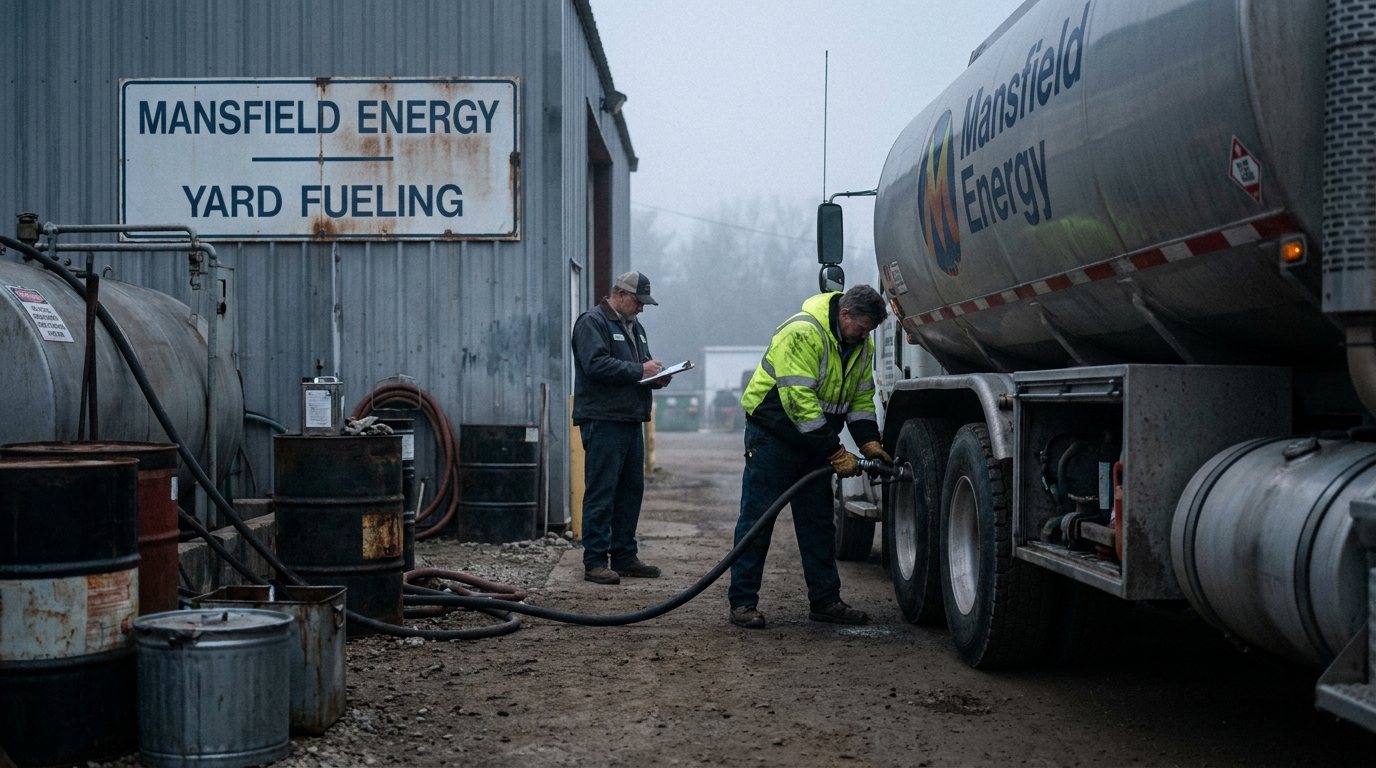
Mansfield did not begin as a growth story. In 1957, John and Winnie Mansfield bought a Cities Service Oil Company franchise in Gainesville, Georgia, inheriting a small customer list, some basic equipment, and a modest stock of consigned heating oil, according to the company's own history page. It was a local heating-oil operation serving a farm town, the kind of business that either stays small forever or finds a second act. Mansfield found the second act by shifting its customer base from households to commercial trucking fleets and industrial plants, trading unpredictable seasonal residential demand for steadier, year-round commercial volume. That pivot, from home heating oil to fleet fuel, is the hinge the rest of the company's growth swings on.
The Company Inside the Company
Here is the detail that does not show up in the marketing copy: Mansfield Service Partners, the lubricants and fluids division that is the reason Mansfield lands on MDM's Lubricants & Fuels list, is older than Mansfield Energy Corp itself. MSP traces its own founding to 1932, starting as a single Houston gas station, per its company history. Mansfield acquired it and folded it in as a semi-autonomous operating brand rather than dissolving it into the parent name. Today MSP runs its own fleets out of the Gulf Coast, the Rocky Mountains, and the Mid-Continent, holds a Shell Prestige Distributor designation for lubricants, and extends its reach further through what it calls a network of Associate Distributors, according to its website. The parent company is younger than the subsidiary that carries its lubricants business. That is not how most roll-ups work; usually the biggest name absorbs the older ones. Mansfield let a 25-year-older company keep operating under its own identity because the brand and the customer relationships were worth more intact than merged.
An Independent Network, Not a Private Fleet
The operating model that makes Mansfield unusual is called the DeliveryONE Network, which Mansfield describes as the largest independent fuel distribution network in the country, moving over 3 billion gallons of fuel and related products annually to more than 8,000 customers across every U.S. state and all ten Canadian provinces. Most large fuel distributors compete on the size of their owned fleet: more trucks, more drivers, more terminals. Mansfield's network instead stitches together independent haulers and regional operators under one coordination layer, letting the company claim national reach without owning every truck that carries its fuel. It is closer to a logistics platform than a trucking company, and it is the kind of asset-light structure that lets a family-held business compete for national fleet accounts against much better-capitalized, publicly traded rivals without matching them dollar for dollar in rolling stock.
Growth by Acquisition, Carefully
Mansfield's expansion since the 1990s has come mostly through bolt-on acquisitions rather than organic branch-building: O'Rourke Petroleum in Houston, R.W. Earhart Company in Ohio, the oil and lubricants division of Hi-Grade, and FuelTrac in Baton Rouge, all absorbed in the 2017-2018 window according to the company's own account. Mansfield also built out capability through partnership rather than pure acquisition, forming Team Logistics as a joint venture with Lincoln Energy Solutions in 2018, and creating Mansfield Clean Energy Partners with Clean Energy Fuels back in 2013 to get into natural gas and alternative fuels before that was a mainstream distributor bet. The pattern across three decades is consistent: buy the regional relationships, keep the acquired brand's local credibility where it helps, and use joint ventures to enter adjacent categories instead of building every capability from scratch.
Second Generation Running It, Third Generation Learning It
Michael Mansfield, the current CEO, is the second generation of family leadership and has been in the business for roughly 40 years, according to the company's leadership page, taking it from a 25-employee regional outfit to an organization of around 880 people. His son, Michael Mansfield Jr., is now Chief Operating Officer, having joined in 2013 after a stint trading oil liquids at Noble Group, and sits over operations, supply, transportation, and technology. That is a third generation already running the parts of the business, technology and logistics, that will determine whether the DeliveryONE model keeps scaling. It is a quiet bet against the sector's dominant trend: while distributors of Mansfield's size are frequently the target of private equity consolidation, this one is preparing to hand the wheel to family again rather than to a buyer.
The Honest Tension
Staying private and family-run has an upside MDM's rankings do not capture: patience. Mansfield can hold onto a joint venture like Clean Energy Partners for over a decade without a quarterly earnings call demanding it prove out. But the same structure caps how fast it can move against PE-backed competitors that can raise acquisition capital in weeks rather than fund deals off the balance sheet. Mansfield has bet that logistics network breadth and long-held customer relationships outrun raw acquisition speed. Six decades in, the bet is still open, and still working.
Distribution rewards the companies that get the unglamorous layer right: the catalog, the branch, the truck route, the data behind all three. Mansfield Energy's version of that discipline is a network built on relationships old enough to have outlived the oil company whose franchise started it.