
Tricon Energy: The Chemical Trader Betting on Full Ownership
Tricon Energy made the 2026 MDM Top Distributors lists in Plastics and Lubricants & Fuels. Here's the take-title trading model behind its $14B climb.
Part of Distributor Playbooks — strategy teardowns of every company on the MDM Top Distributors lists. New to the 2026 lists.
Tricon Energy lands on two of Modern Distribution Management's 2026 Top Distributors lists, Plastics and Lubricants & Fuels, with $14.0 billion in revenue per MDM's report. That places a Houston commodities house founded by a Barcelona-born trader with four employees and a phone line ahead of most household-name industrial distributors on the same list. The story of how it got there runs through a decision most of its peers made in the opposite direction.
The four-person start
Ignacio Torras founded Tricon in Houston in 1996, trading liquid caustic soda and acetone with a handful of colleagues. The company opened its first overseas office in Korea in 1999, in the middle of the Asian financial crisis, then added Shanghai and Istanbul in 2004. It crossed one million metric tons handled in 2002 and $1 billion in sales in 2006, the same year it launched Tricon Plastics. Tricon Dry Chemicals followed in 2008, and Liquid Fuels and Raw Materials units arrived between 2015 and 2017, per the company's own history page. By 2024 the firm was moving roughly 24 million tons of chemicals a year out of more than 28 offices in over 100 countries, according to Forbes. ICIS now ranks Tricon the second-largest chemical distributor in the world, behind only Germany's Brenntag.
The insight: Tricon buys the risk everyone else sells off
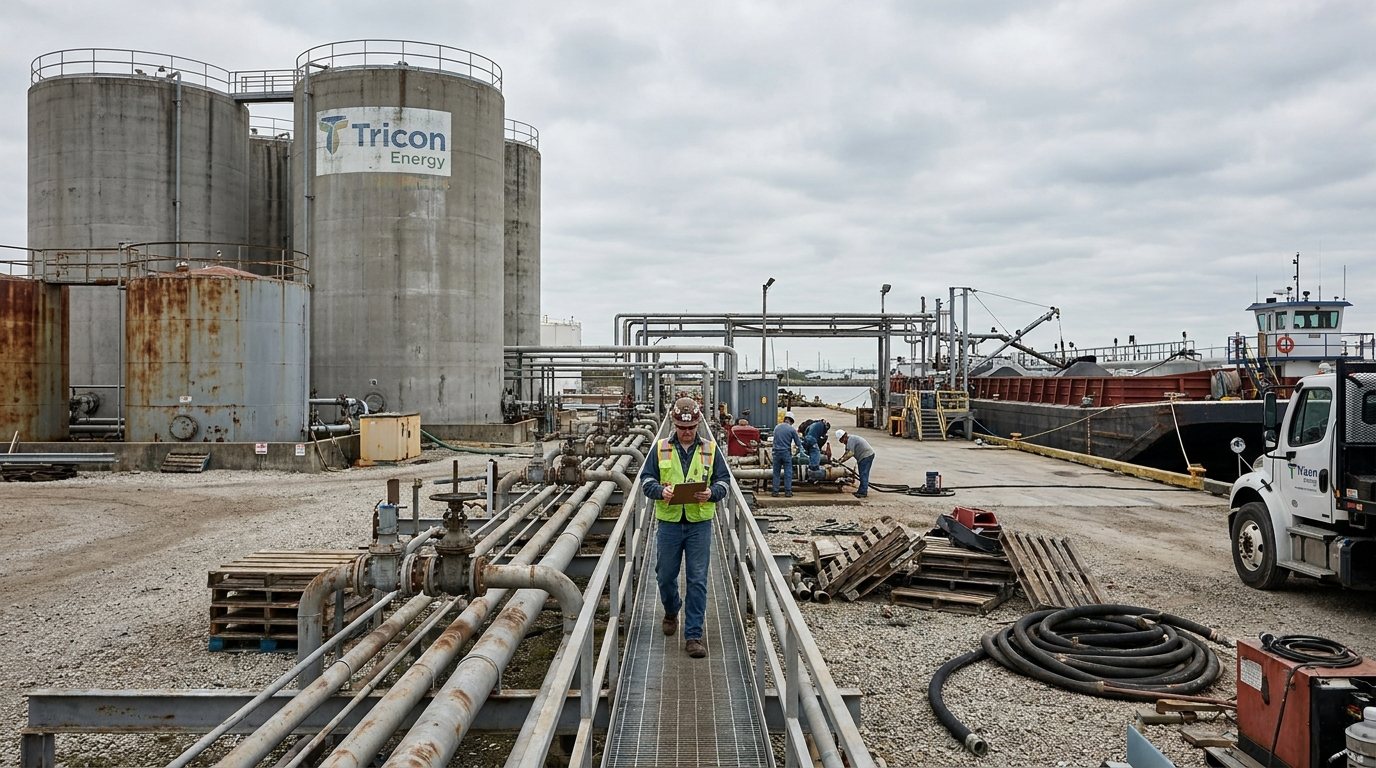
Chemical distribution has spent two decades drifting toward asset-light brokerage: take a fee, move title fast, keep inventory and price exposure off the balance sheet. Tricon runs the opposite playbook. Torras describes it to Forbes as the "Walmart of chemicals": the company buys commodity volumes outright, five thousand tons of polyethylene resin at a time, warehouses them in Houston or another hub, and carries the price and inventory risk itself before breaking the lot into smaller shipments, three hundred tons to Algeria, five hundred to Nigeria, sold to manufacturers who could never place an order at bulk scale.
That is a real bet, not a slogan. Taking physical possession means Tricon eats commodity price swings, storage costs, and shipping risk that a pure broker would pass through. The payoff is a role brokers cannot fill: Tricon becomes the buffer between volatile bulk commodity markets and manufacturers who need reliable, right-sized supply regardless of what polyethylene or xylene did that week. It is also why the company needs serious balance sheet muscle. Tricon operates on roughly $2.7 billion in credit lines from banks including Societe Generale and Mitsui Marubeni, per Forbes, capital that funds inventory most of its lean, fee-based competitors never touch.
Buying when the cycle turns down
That credit capacity does double duty as an acquisition engine, and Tricon has used it specifically during industry downturns rather than waiting for better conditions. Q-Logistics and Mexican polymer distributor Polymat joined in 2023, giving Tricon three terminal shipment centers and five-plus warehouses across Mexico, per the company's announcement. eXsource followed in 2024. In Africa, Tricon took an initial strategic stake in West African International Group in March 2025, then converted it to a full acquisition roughly a year later, a two-step structure the company's own release frames as validating the regional partnership before committing fully, per Tricon's announcement. Torras told Forbes that larger rival Brenntag "sees us in the rear view mirror" and is closing the gap. Buying distribution assets while competitors retrench is a strategy with an obvious trade-off: it works only if the balance sheet can absorb a downturn that runs longer or deeper than planned, and Tricon's entire model leans on the credit lines holding up through that stretch.
Staying private in a sector that keeps consolidating into public roll-ups
The other quiet tension in Tricon's story is ownership structure. Brenntag, Univar, and most of the scaled chemical distributors are public companies or private-equity roll-ups answering to shareholders on quarterly cycles. Tricon, at $14 billion in revenue, remains privately held and founder-controlled, which is precisely what lets it fund inventory-heavy, countercyclical acquisitions on bank credit rather than managing to a stock price. Torras landed on the 2026 Forbes World Billionaires List with a $1.5 billion net worth, and the company was Forbes' highest-ranking newcomer on its 2025 Top Private Companies list at No. 35. Staying private at that scale, in a sector where nearly every serious competitor has gone public or been rolled up, is itself a strategic choice, one that trades access to public capital markets for the freedom to run a physical, capital-intensive trading book on its own timeline.
Tricon also uses that trading flexibility defensively. When new tariffs hit specific import lanes, such as duties on Korean benzene, the company has substituted duty-free alternatives like acetone or styrene monomer that serve similar manufacturing purposes, insulating customers from a policy shock a pure broker would simply pass along, per Forbes.
Internally, Torras leans on a blunt operating mantra employees call W2MTC, work two more hours than the competition, and frames the business in cyclical terms: day follows night, and the trader who prepares for the turn is the one still standing when it comes. For a company that has grown from four people trading caustic soda to a $14 billion operation spanning 28 offices, the discipline behind that line is doing more work than the slogan lets on.
Distribution rewards the companies willing to hold the inventory, run the warehouse, and own the risk that others structure their way around, and Tricon Energy's rise is a reminder that the unglamorous middle of a supply chain, the tank farm, the credit line, the terminal in Veracruz, is where competitive advantage actually gets built.