
Johnstone Supply: HVACR's #2 Runs on Owners, Not Employees
Johnstone Supply ranks HVACR #2 on MDM's 2026 Top Distributors list. Its real edge is an owner-operator model few rivals in the vertical have copied.
Part of Distributor Playbooks — strategy teardowns of every company on the MDM Top Distributors lists. New to the 2026 lists.
Johnstone Supply lands at #2 on Modern Distribution Management's 2026 Top Distributors list for HVACR, with $4.5 billion-plus in fiscal 2025 revenue, behind only Watsco. What separates it from almost every other distributor at that scale is who actually owns the branches: not a corporate parent, but 60 individual operators running the network store by store.
A cooperative that never fully stopped being one
Most distributors that hit $4.5 billion have consolidated into a single operating company with regional managers reporting up a chain. Johnstone never did that. Roughly 350 of its approximately 470 locations are independently owned by local operators, with the remaining company-owned stores filling in territories where no independent buyer stepped up. That split is not a historical accident left over from a slower-growing era. It is the deliberate architecture the company still runs on.
The arrangement traces to 1981, when founder John Shank converted the business into a member cooperative. Shank had opened the original store in Portland, Oregon in 1953 and spent the next three decades building out a product catalog contractors trusted more than any single manufacturer's line card. At launch, the co-op had 32 member-owners sharing warehousing, purchasing, and marketing while each ran their own store and kept the upside of running it well, according to Johnstone's own history page. That structure compounded for forty years: member locations grew, distribution centers were added, and the catalog kept expanding, all without the center ever taking direct ownership of the stores doing the selling.
The 2021 bet: sell the co-op to keep the model
In September 2021, Johnstone's members voted to convert the cooperative into a Delaware LLC backed by capital from Redwood Capital Investments, a deal formally closed that November, per the Business Wire announcement of the conversion agreement. On paper this looks like the standard move in a decade when HVACR distribution has been aggressively rolled up by private equity and public consolidators. In practice, the deal did something unusual: it brought in outside capital while preserving the owner-operator layer that made the co-op work. Johnstone Supply LLC still serves 60 individual Johnstone Business Owners rather than running a flat corporate hierarchy, and those owners still control day-to-day operations of their stores.
That is the strategic tension worth naming plainly. Redwood's capital gives Johnstone the balance sheet to fund distribution centers, acquisitions, and shared infrastructure at a scale no member cooperative could self-finance. But every dollar of that capital has to be deployed without breaking the incentive structure that made local owners outperform salaried branch managers in the first place. Get the balance wrong in either direction, too much central control or too little coordination, and the model that built the company erodes. Four years in, the acquisition pace suggests they are still finding real estate to add rather than territory to consolidate: the company picked up Dunphey-Smith Supply's two New Jersey locations in February 2026, a bolt-on that added Garden State coverage rather than folding an existing owner's territory into corporate hands, per MDM's coverage of the deal.
Why owner-operators still win on the counter
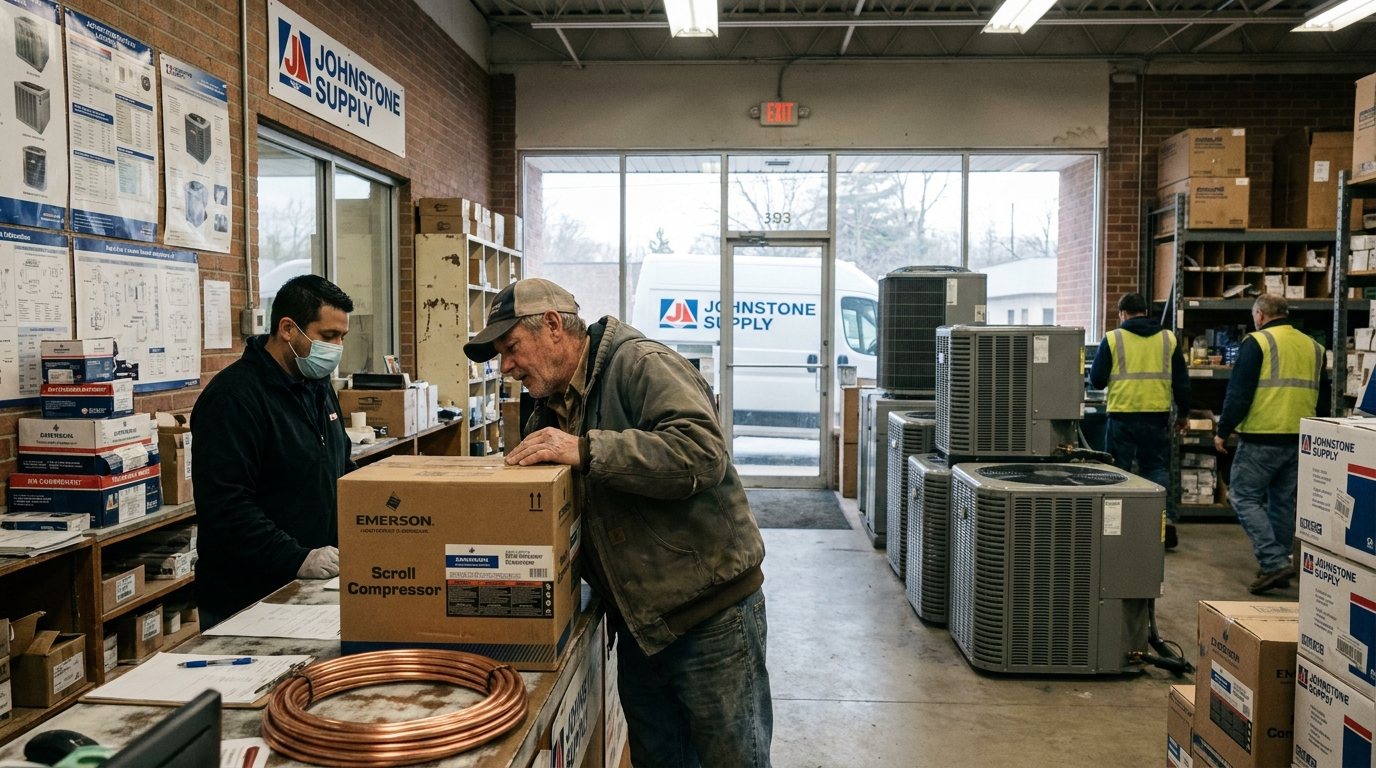
The mechanism matters because HVACR distribution is a relationship business fought branch by branch. A contractor walking into a Johnstone counter at 6 a.m. for a compressor is usually dealing with someone who has equity in that specific store's performance, not a manager rotating through a territory on a two-year assignment. That alignment shows up in how deep individual Business Owners invest in their local markets: training, inventory depth on the parts contractors actually break, and relationships with the service techs who decide which counter gets the call at 6 a.m. next time.
Training is the clearest example of that local investment compounding into a network advantage. Johnstone's Orion Group built a 3,000-square-foot live-fire training facility in 2023 so technicians could work hands-on with residential unitary equipment, VRF systems, and high-efficiency boilers rather than learning off spec sheets, a differentiator HVACR Trends covered as part of a broader pattern across the network. Multiply that by 60 owners each running NATE-certified programs suited to their own market's mix of residential, commercial, and refrigeration work, and Johnstone effectively fields dozens of specialized training operations instead of one standardized curriculum handed down from Portland.
The scoreboard against Watsco
Watsco holds #1 in HVACR at $7.2 billion, built largely through direct ownership and an aggressive digital-commerce push. Johnstone's $4.5 billion-plus puts it a clear second, but the two companies are running different bets on the same problem: how do you make a distribution network feel local at national scale. Watsco leans on centralized systems and acquired-and-integrated branches. Johnstone leans on capitalized independence, funding shared infrastructure while leaving ownership, and the incentive to actually build a market, in the hands of the person behind the counter.
Neither approach is obviously right. But Johnstone's 2021 conversion is a rare example of a distributor taking private equity capital and using it to reinforce a model other consolidators spend that same capital erasing. That is the bet worth watching as the next round of HVACR roll-ups plays out.
Distribution rewards the companies that get the boring infrastructure right: catalogs deep enough to trust, branches close enough to matter, and the people running them incentivized to keep both that way. This profile is part of Anglera's Distributor Playbooks series.