
Total Safety Supplies & Solutions: A Distributor Set Free
Ranked #17 in Safety on MDM's 2026 Top Distributors list, Total Safety Supplies & Solutions just became its own company after 43 years inside a services parent.
Part of Distributor Playbooks — strategy teardowns of every company on the MDM Top Distributors lists. New to the 2026 lists.
Total Safety Supplies & Solutions lands at #17 on the Safety list in MDM's 2026 Top Distributors report, the annual ranking from Modern Distribution Management. What makes the placement notable is timing: the company earned it in the same year it stopped being a division and became, for the first time in its 43-year history, a standalone business.
A distribution arm bolted onto a services company
Total Safety Supplies & Solutions (TSSS) traces to 1983 in Fairfield, California, built to move PPE, fall protection gear, and MRO consumables into utility, transportation, refining, and industrial-services accounts. For decades that business lived as one piece of a larger parent, Total Safety U.S., a company whose core identity was rental and service: gas detection equipment, fire watch, confined-space monitoring, inspection crews sent to refineries and pipelines. TSSS was the warehouse-and-catalog half of that operation, distribution bolted onto a services-and-rental engine.
That structure is common enough in industrial safety. What is less common is unwinding it. On June 5, 2026, Mill Point Capital signed a definitive agreement to acquire the Supplies & Solutions division outright, and the deal closed in July, per Distribution Strategy Group's coverage. Total Safety U.S. keeps the services and rental fleet. TSSS becomes its own company, with its own balance sheet, for the first time since Reagan's first term.
The unbundling is the story
Here is the observation worth naming plainly: most safety distributors on the MDM list were built as pure-play distribution businesses from day one, buying and reselling PPE and consumables at scale. TSSS was not. It spent four decades as the transactional half of a hybrid model, subsidizing and being subsidized by a services business with a completely different cost structure, asset base, and sales motion. Distribution runs on inventory turns and fill rates. Rental and inspection services run on technician headcount and asset utilization. Bundling the two under one roof made sense when the parent was chasing wallet share across a refinery's entire safety spend. It makes less sense to a buyer who wants a clean, valuable distribution platform to scale.
That is effectively what happened. Total Safety's CEO Brad Clark framed the split as letting the remaining services business "increase our focus on providing quality safety and compliance services," which is the polite version of saying the two businesses were pulling in different directions and both would be worth more apart. TSSS President Sean Nacey, who becomes CEO on close, put it from the other side: Mill Point's "domain knowledge of value-add distribution" and "operational resources" were the fit his half of the business needed and wasn't getting as a division.
The distribution mechanics it kept
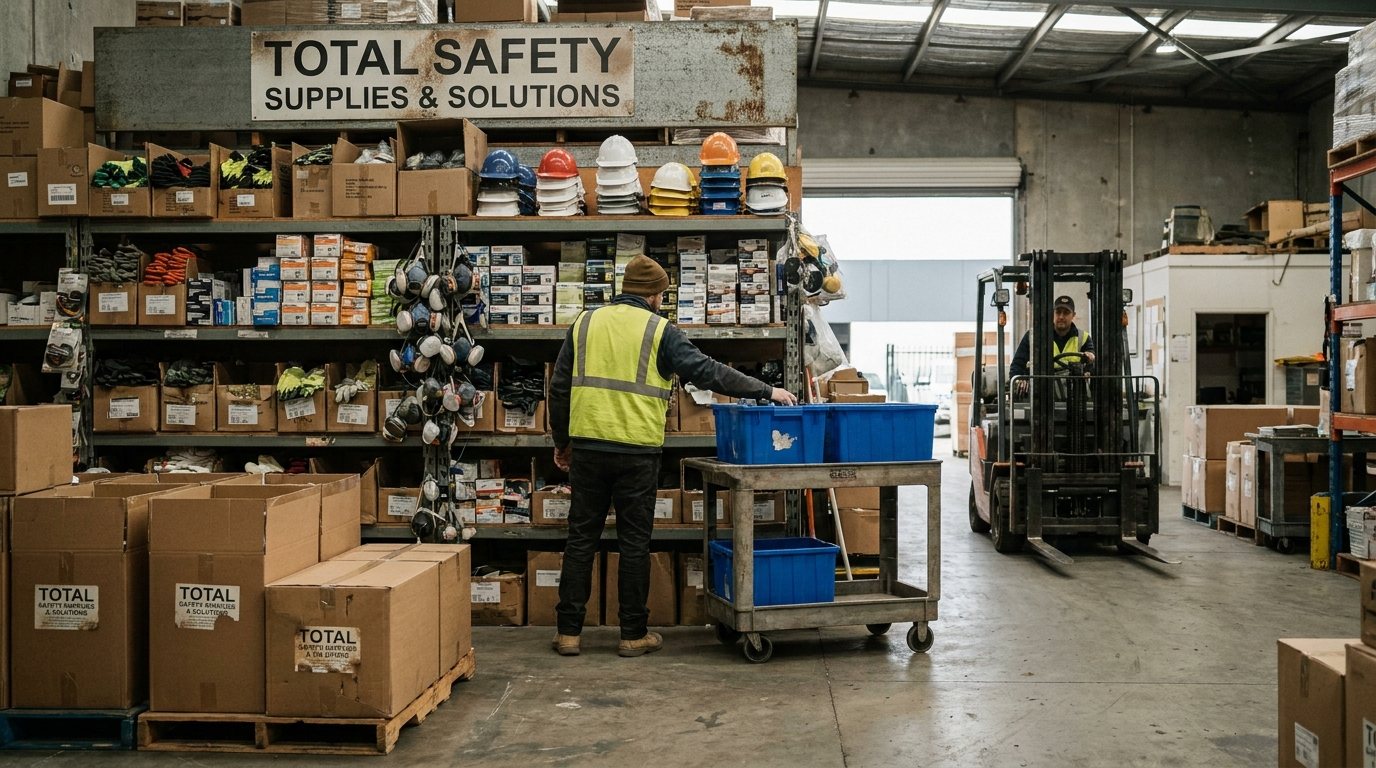
Whatever else changes under new ownership, the physical network is what MDM ranked. TSSS runs 13 distribution centers, 20 on-site customer stores embedded inside client facilities, and more than 850 vendor-managed inventory and vending installations, according to MDM's company profile. That VMI and vending density is the real moat in industrial PPE: a refinery or utility crew that has to requisition gloves and respirators through a central purchasing system will burn hours a week doing it, so a distributor that puts a stocked machine or a dedicated on-site store inside the plant gate wins the reorder before the customer ever opens a browser. Grainger and Airgas compete on the same logic at far larger scale; TSSS's bet is that a leaner, more customer-embedded version of it, focused on utility, transportation, and refining accounts specifically, is defensible against generalists.
SKU counts vary by source and by which slice of the catalog is being measured. The acquisition announcements cite more than 65,000 MRO, safety, and PPE products across the combined catalog; MDM's own writeup separately describes a safety-and-equipment assortment of over 130,000 SKUs of PPE, tools, and consumables. Either figure puts TSSS well into the range of a serious category-depth player rather than a niche PPE reseller.
What the carve-out signals
For Mill Point Capital, a New York private equity firm focused on lower-middle-market industrials, this was its 20th corporate carve-out, a repeatable playbook of buying business units out of larger parents and running them standalone. Mill Point founder Michael Duran called TSSS "a high-quality distribution platform with deeply embedded customer relationships," language that reads like every PE press release until you notice what it is actually praising: not growth rate, not margin, but the stickiness of the VMI and vending relationships built up over four decades inside a bigger company's shadow. The plan from here, per Mill Point, is to expand wallet share, broaden the geographic footprint, and build out digital commerce, the standard moves for a newly independent platform with a fresh capital sponsor and no more services division to share overhead with.
That last part is the trade-off worth watching. TSSS now has to build or buy the back-office functions, brand identity, and digital capability that came for free as part of a larger parent. A company that spent 43 years as someone else's distribution arm is, this year, finding out what it costs to run its own.
Every company on this list runs on the parts of the business nobody sees on the label: the catalog data, the branch network, the reorder logic, the inventory that makes distribution work. This series looks at how they built it.