
Are AI-generated product attributes accurate enough to publish?
Yes, when each AI-generated attribute traces to a source document and passes schema, conflict, and confidence checks. Untraced values need human review.

AI-generated product attributes are accurate enough to publish when each value is traced to a source document and has passed schema, unit, and conflict checks; values a model inferred without a source are drafts that need human review. Accuracy depends far more on grounding and validation than on which model you use: material: 304 stainless steel lifted from the manufacturer's spec sheet and matched to your pick-list is publishable, while the same value guessed from a product title is not.
Why AI-generated product attributes go wrong
Language models fail in a specific way. NIST's Generative AI Profile (NIST AI 600-1) names it confabulation: confidently stated but false content, the thing people call hallucination. In a catalog it rarely looks absurd. It looks plausible:
- A
voltageof120Von a fixture that ships in 120-277V, because 120V is the common case. - A
thread_sizeof1/2" NPTcopied from a sibling SKU in the same series. color: Blackon a part whose photo shows a dark bronze finish.
Each passes a casual read. The fix is to separate two jobs often lumped together as "AI enrichment":
- Extraction. The model reads a spec sheet, catalog page, label image, or ERP field and pulls out a value that is written there. The value can be checked against the source.
- Generation. The model writes a value that is not in any document it was given, based on what similar products usually have. Nothing can check it except a person.
Extraction errors are catchable by machines; generation errors mostly need people. A publish policy that treats them alike either lets guesses through or buries reviewers.
What Amazon has published about AI-generated product details
When it launched generative listing tools, Amazon said sellers were accepting suggested attributes nearly 80% of the time with minimal edits, and that it always encourages sellers to review generated product details before submitting them. A later update says more than 900,000 selling partners have used the tools and accept AI-generated content with little to no edits about 90% of the time, with sellers able to review, customize, or decline suggestions.
Two things follow. First, acceptance rate is not accuracy rate. A seller clicking accept on a color suggestion has not necessarily checked it against a spec sheet, and at distributor scale nobody knows every value by heart. Second, the design keeps a human approval step in the loop by default.
Amazon's science team describes the other half: checking values already in the catalog. Its write-up on using LLMs to improve product listings uses how often a value appears across products in a category as a signal of correctness, builds a candidate list of standard values, and prompts the model to match that list's granularity (for example, stainless steel versus 440 stainless steel) and to flag erroneous or nonsensical entries. That is validation against a controlled vocabulary, which any catalog team can copy.
How to validate AI-generated product data before it goes live
A workable validation stack has five layers, each catching a different failure.
| Layer | What it checks | What it catches |
|---|---|---|
| Source traceability | Every value carries the document, page, and snippet it came from | Values with no evidence (generation posing as extraction) |
| Schema, pick-list, units | Type, allowed values, unit of measure, ranges, check digits | Blk instead of Black, 25 mm in an inches field, bad GTINs |
| Cross-source conflicts | Spec sheet vs. image vs. ERP vs. manufacturer site | Sources that disagree about the same attribute |
| Confidence routing | A threshold per attribute decides auto-publish vs. review | Low-evidence values reaching the storefront |
| Sampling audits | A random sample of published values re-checked by a person | Drift and systematic errors the checks miss |
Source traceability is the base layer. Store the source file or URL, page, and exact text span next to each value, so a reviewer confirms in seconds instead of redoing the research.
Schema, pick-list, and unit checks are deterministic and cheap. Enforce types, map free text to allowed values, normalize units, reject out-of-range numbers. For GTINs, Google's product data specification asks for valid GTINs with a correct check digit and says not to guess.
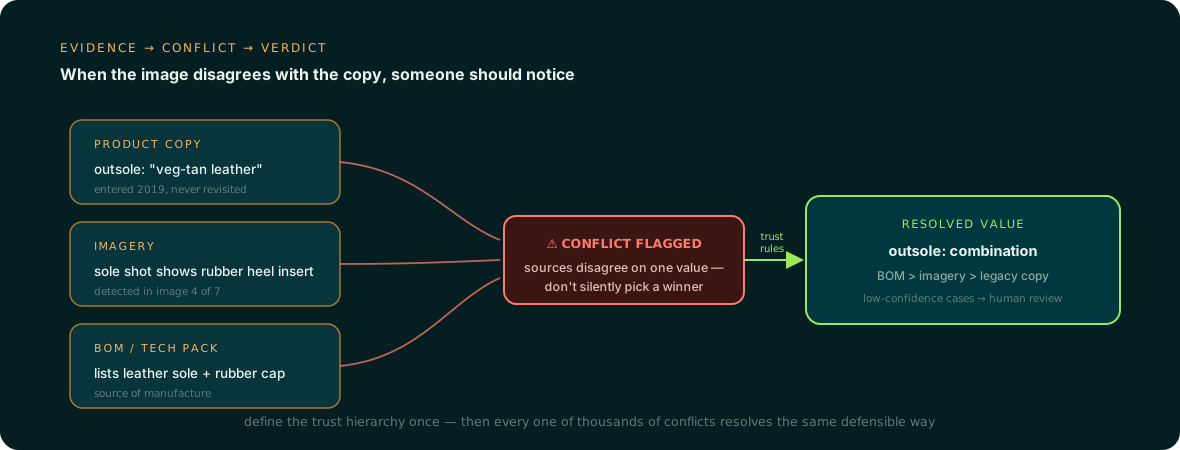
Cross-source conflict detection catches errors that pass every format check. When the copy, the imagery, and the bill of materials describe the same attribute differently, the system should flag it and resolve by a declared trust hierarchy (for example, manufacturer spec sheet over marketing copy over model inference), not quietly pick one.
Confidence thresholds decide routing. Set them per attribute: a wrong finish is a return, a wrong pressure_rating is a safety issue. Safety and regulatory attributes should require a source match and often a human sign-off regardless of score.
Sampling audits keep the whole thing honest after launch. Re-check a random sample of published values against sources each week and track error rate by attribute and supplier. Our guide on how to measure product data quality covers the metrics, and fill rate vs. accuracy explains why a full field is not the same as a correct one.
A worked example: backfilling one attribute across a catalog
For illustration, assume a 20,000-SKU electrical catalog needs ip_rating backfilled. These are assumptions, not industry figures.
- 14,000 SKUs have a spec sheet that states the rating. Extraction pulls it with a source snippet; schema checks confirm it matches the
IPplus two-character pattern. These publish after a sampling audit. - 4,000 SKUs have conflicting evidence, say the datasheet says
IP65and the manufacturer's web page saysIP66. Those route to review with both snippets shown side by side. - 2,000 SKUs have no document that states a rating. The model could guess from siblings in the series. Do not publish those guesses; leave the field empty or request data from the supplier.
If a reviewer clears a traced conflict in one minute, the 4,000 conflicts are about 67 hours. Researching 20,000 SKUs from scratch at 10 minutes each would be about 3,333 hours. The saving comes from routing, not from trusting the model more.
What Google Merchant Center and GS1 expect of the data
Channels judge the data, not how it was produced. Google says products may be disapproved when submitted data does not match your website or the product data specification, and disapproved products do not show in Shopping ads or free listings. The same page says products get limited performance when the submitted GTIN is not associated with the submitted brand. An AI-filled brand that disagrees with the brand tied to the GTIN is exactly that mismatch. Requirements change, so confirm current rules in Merchant Center before you build checks around them.
GS1 US takes a similar line. It calls hallucinations a real risk, says AI-generated content needs to be reviewed for authenticity, and points to a ground source of truth for correcting errors. For identifiers and brand-owner data, that source is the GS1 registry and the manufacturer, not a model.
How the NIST AI risk management framework maps to catalog validation
The NIST AI RMF is voluntary and organized around Govern, Map, Measure, and Manage. Its generative AI profile includes actions that line up with the stack above: compare output against known ground truth using both human and automated evaluation (MP-2.3-001), deploy fact-checking when information comes from multiple or unknown sources (MP-2.3-003), avoid extrapolating performance from narrow, anecdotal assessments (MS-2.5-001), and review and verify sources and citations during ongoing monitoring (MS-2.5-003). In catalog terms: trace every value, check it against sources, and keep measuring after go-live. The same discipline applies if you want product data that AI agents can read and trust.
Who does the validation work
Most teams already have a PIM, ERP, or syndication platform that stores attributes and enforces some schema rules. The gap is upstream: finding documents, extracting values, reconciling conflicts, and staying current as suppliers revise spec sheets. Offshore data entry handles volume but often leaves no source trail. Description-writing tools produce fluent text but are not built to cite a page for each value.
Anglera sits in that gap. Your PIM stores the data; Anglera does the work. It extracts values from real source documents, scores each one, flags conflicts for review rather than inventing a value, and can backfill a new attribute across a catalog, working alongside whatever PIM, ERP, or flat file you have. You can see the flow in how Anglera works, or compare approaches in our roundup of AI product content enrichment software.
The short version for a publish decision: if a value has a source and passes the checks, ship it and audit a sample; if it does not, it is a question for a person or a supplier. Anglera is built to make the first group as large as possible and to make the second group fast to clear, with implementation planned around 30 days from a CSV or ERP export.
Hero photograph by Jason Leung on Unsplash