
A flexible data model is not a compliance strategy
Seven of 16 vendors in Gartner’s 2026 PIM Magic Quadrant cite digital product passport work. What a DPP record needs, where each value lives, who fills it.
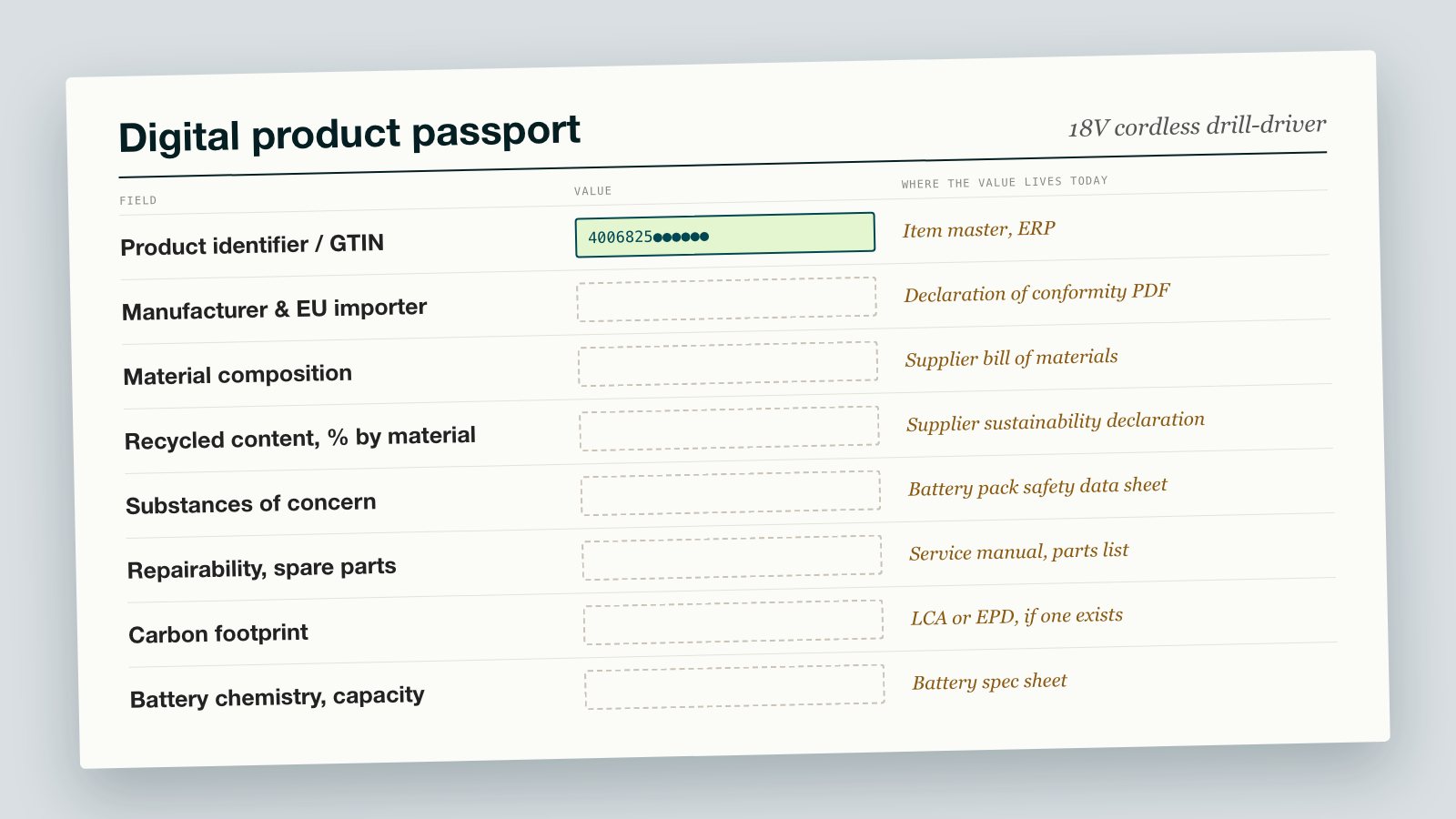
Seven of the sixteen vendors in Gartner’s new Magic Quadrant for Product Information Management Solutions (12 October 2026) mention digital product passport work. That sounds like a category getting ready for EU regulation. Gartner’s own market overview is more measured: vendor readiness is uneven, and for many vendors the main answer to regulation is a flexible data model.
Translate that and it means you design the regulatory structure, and you maintain it. A flexible data model is an empty form with more boxes. The boxes are useful. Somebody still has to find what goes in them, for every SKU, and be able to prove where each value came from.
Our 2026 PIM Magic Quadrant hub covers the whole report. This post follows the regulatory thread and works one product through it. Anglera isn’t a PIM and isn’t in the report; we write into the PIMs that are.
What the seven are offering
By our count from the vendor write-ups, the passport mentions look like this:
- apollon, through a partnership with Narravero
- Bluestone PIM, with a DPP app
- Centric Software, with a DPP module in Centric PXM
- Pimcore, with DPP support and an EU battery passport on its roadmap
- Pimberly, with DPP on its roadmap
- Syndigo, with DPP accelerators
- Viamedici, with Sustain360
A partnership, a module, an accelerator and a roadmap item are different levels of commitment, and a buyer should know which one is on the table. But all of them share a premise with the flexible-model answer: the PIM provides the place for passport data. The data has to arrive from somewhere else.
That matches how Gartner defines the category. In Gartner’s framing, PIM enables teams to centralize, enrich and validate product content, and regulatory compliance tools are one of its optional features. None of the seventeen features is “complete the record,” and a passport is a record that has to be complete.
The regulation, briefly
The Ecodesign for Sustainable Products Regulation (ESPR) entered into force in 2024. It establishes the digital product passport as a framework, then phases in actual requirements product group by product group through delegated acts. The fields that become mandatory for one group won’t match another, and for most groups the final list doesn’t exist yet. Separately, the EU Battery Regulation introduces a battery passport from February 2027 for certain battery categories.
That phasing is why “flexible” appeals to vendors. Nobody can ship a finished template for a delegated act that hasn’t been adopted. Fair enough. It also means every buyer will extend their model as each act lands, and then fill the new fields.
Worked example: one cordless drill
Take an 18V cordless drill-driver sold through a European distributor. The table is illustrative, the kind of information ESPR passports are expected to carry, not the final field list for any product group. The middle column is where the value actually lives today. The right column is who has to go get it.
| Passport field | Where the value actually lives | Who fills it |
|---|---|---|
| Product identifier, model number, GTIN | Item master, ERP, packaging | Your team (you have this) |
| Manufacturer and EU importer details | Declaration of conformity PDF | Your team, from the DoC |
| Material composition by component | Supplier bill of materials or full material declaration, if the supplier will share it | Supplier compliance contact, then your team |
| Recycled content, % by material | Supplier sustainability declaration, often brand-level rather than per model | Supplier, chased by your team |
| Substances of concern | Safety data sheet for the battery pack, REACH and RoHS declarations | Your team, reading SDS sections |
| Repairability, spare parts availability | Service manual, exploded parts diagram, spare parts list, warranty terms | After-sales team or supplier service desk |
| Disassembly and end-of-life instructions | Service manual, WEEE documentation | Your team, from the manual |
| Carbon footprint | Lifecycle assessment or EPD, where one exists at all | Supplier sustainability team |
| Battery chemistry, capacity, removability | Battery spec sheet, test report | Your team, from the spec sheet |
| Supporting compliance documents | DoC, CE test reports | Your team, linked per SKU |
Count the rows where the answer is “the PIM.” There are none. The PIM is the destination, and every option in the report can hold these values. Holding them was never the hard part.
Three things show up the moment you try to fill this for real.
The values live in documents, not feeds. Almost nothing in the middle column arrives as a structured field in a supplier file. It arrives as a PDF: an SDS, a declaration, a service manual. Somebody reads it. For a distributor carrying hundreds of suppliers’ lines, that’s hundreds of document formats, a problem we take up in the distributor’s reading of the Magic Quadrant.
One product, two regimes. The drill is a product under ESPR. Its battery pack also falls under the Battery Regulation, with its own labeling and documentation rules. The record has to hold both, and they change on different schedules.
The answer moves. A supplier changes a cell supplier, swaps a housing plastic, or reissues an SDS. The value that was correct in March is wrong in September. That’s the regulatory version of data decay, and a stale passport value costs more than a stale product description.
Our manual benchmark for researching and filling a product record by hand is 30 to 45 minutes per SKU, measured on ordinary spec attributes. Multiply by a few thousand SKUs and you have a staffing plan, not a configuration task.
Template or model: what to ask a PIM vendor
Gartner’s distinction is the useful one: a preconfigured template versus a flexible model you build. Templates are better. A template is still a form. Put these in any PIM RFP:
- For my product groups, do you ship a passport template, or do I model it? If you ship one, who updates it when a delegated act is adopted or amended, and is that in the license or a services engagement?
- Is DPP a product module, an accelerator, a partner integration, or roadmap? Get the answer in writing, with a release.
- Can each value carry its source? Not a free-text comment. The document, the page, the version and the capture date.
- What happens when a source document changes? If a supplier sends a new SDS, does anything flag the fields that came from the old one?
- Who fills the fields? Supplier portal, your team, the vendor’s services team, or a partner. Ask for the staffing assumption behind the demo.
The fifth question sets the budget. Every answer except “a system that reads the documents” is a person typing.
Provenance matters more here than anywhere
For marketing copy, a wrong value costs a conversion. For regulatory data, a wrong value is a statement made to an authority and to every customer who scans the data carrier. When a market surveillance authority or a large customer asks where your recycled content figure came from, “someone entered it last spring” is not an answer.
So provenance per value matters more for passport data than for anything else in the catalog. Every field needs a trail back to the document that supports it, and that trail is what tells you which fields to re-check when the document changes.
This is where Anglera sits. Anglera reads the supplier documents you already have (SDS, declarations, spec sheets, service manuals), extracts each value, attaches a citation to the source it came from, and quality-scores it. In one enterprise distribution pilot that came to more than 800,000 attribute-level source citations, with 81% of values extracted directly from a cited source. Your experts set the quality standards once; review is guardrails, not babysitting. Values then write back into whichever PIM holds your model, including every one in this report.
The flexible data model still matters. It’s where the passport lives. It just doesn’t fill itself, and it can’t tell you why a value is true.
Every PIM in the Magic Quadrant can hold a passport. None of them reads the SDS for you. Your PIM stores the data; Anglera does the work of finding each value, citing it and keeping it current when the supplier’s documents change. Here’s how that works, from a flat file to a cited record.