
The 2026 PIM Magic Quadrant, read from a distributor’s desk
Gartner’s 2026 PIM Magic Quadrant read by a B2B distributor: the signals that matter at 50,000 SKUs and 400 suppliers, and the work left after you buy.
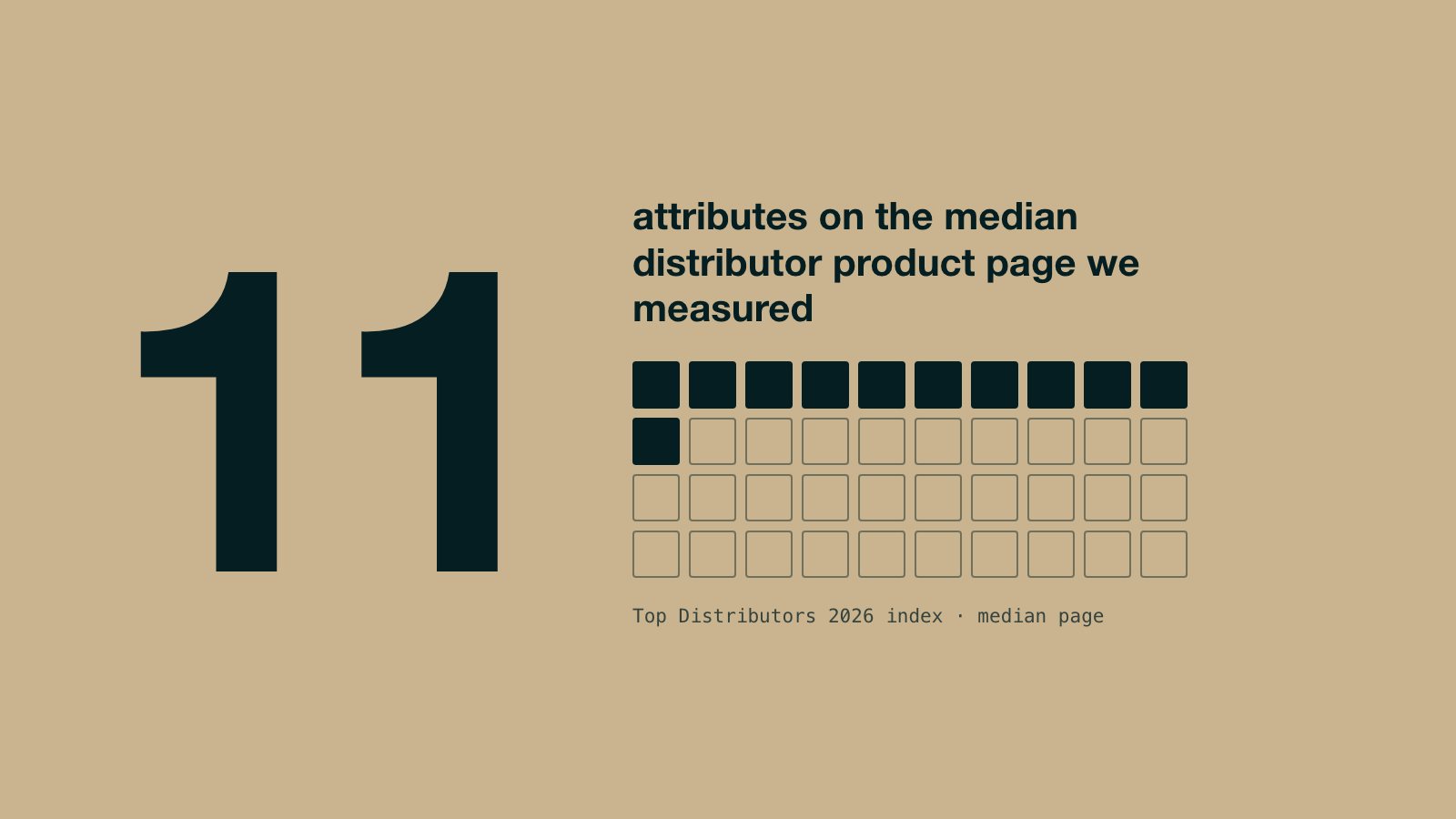
The median distributor product page we measured carries 11 attributes. That number comes from our Top Distributors 2026 index, and it’s the one to keep in mind while reading Gartner’s new Magic Quadrant for Product Information Management Solutions, published 12 October 2026.
Eleven attributes is a part number, a brand, a description, a few dimensions and maybe a weight. In our enrichment work, category templates for spec-driven products run from 15 to 60-plus attributes. The engineer buying a contactor, a pump or a cap screw filters on the ones that are missing.
Here’s the verdict up front. The Magic Quadrant is a decent map of where to store that data. It wasn’t built to tell you who will fill the other fields, and for a distributor that’s the larger line item. Our 2026 PIM Magic Quadrant hub covers the full report; this post reads it as a distributor would.
Why distributors read it differently
A brand manages its own products and owns the source data. A distributor manages tens of thousands of SKUs it didn’t make, from hundreds of suppliers, each sending data in its own shape. The big suppliers send a classified BMEcat or a clean spreadsheet. The long tail sends a PDF catalog, a spec sheet per product family, and a sales rep’s email. EU passport data is heading the same way, for products the distributor didn’t make either, which is why a flexible data model is not a compliance strategy.
The buyers on the other end are spec-driven. They filter by voltage, thread, material and rating. A missing attribute is a missed filter hit, and a missed filter hit is an order that went to whoever had the field filled.
So five signals in the report matter more to a distributor than to most readers.
Five signals worth reading for
1. Supplier onboarding
Gartner lists supplier onboarding portals among the optional PIM features. Akeneo’s Supplier Data Manager lets suppliers upload files, with AI-assisted mapping into your model. Gartner credits Salesforce (Informatica Product 360) with data sourcing, ERP integrations and AI-assisted onboarding that benefit B2B distributors. Gartner cautions that Inriver has no native supplier onboarding module yet; it’s on the roadmap.
2. Industry taxonomies
For a distributor, “industry taxonomy” means ETIM, ECLASS, UNSPSC or a house scheme mapped to them. Gartner gives strengths for industry accelerators and data pools to Salesforce (Informatica), Stibo Systems and Syndigo, and credits Stibo specifically for complex hierarchies and industry taxonomies. On the other side, Gartner cautions six vendors for lacking industry accelerators: Base.com, Inriver, insightsoftware, Pimberly, Plytix, and Pimcore for B2C. Without accelerators, you configure and maintain the taxonomy yourself.
3. Catalog scale
Gartner describes the Leaders as mature and scalable, with broad enterprise coverage. Further down, Gartner notes that Plytix involves some manual onboarding and validation steps at large catalog sizes. At 80,000 SKUs, any manual step per SKU is a headcount decision.
4. B2B hierarchy depth
Distributor catalogs are made of families, variants, kits, accessories, replacement parts and cross-references. Stibo is credited for complex hierarchies. Gartner cautions that Salsify has a limited footprint in complex B2B industrial manufacturing, and that complex industrial data may need more manual setup and mapping there.
5. Distributor-specific experience
Gartner credits insightsoftware’s Agility PIM with extensive distributor and wholesaler experience and a GenAI prompt library for distributor use cases, and cautions about its minimum 36-month contract. Pimberly is described as distributor-centric, with many marketplace connectors and preflight checks.
Read together, those signals make a reasonable shortlist. Our guide to choosing a PIM covers the rest of the evaluation.
The portal problem
Every onboarding feature above shares an assumption: the supplier will type the data in.
Look at it from the supplier’s side. A mid-size manufacturer selling through 40 distributors gets 40 portal invitations, each with its own template, its own required fields and its own name for the same voltage attribute. Large suppliers have a content team and a syndication feed. The long tail, which is most of a distributor’s supplier count, has a sales rep and a folder of PDFs. They won’t fill your portal. Many can’t, because the person who knows the data isn’t the person with the login.
So the data arrives incomplete regardless of the portal. The portal moves the empty field from your spreadsheet to their upload screen, and adds a reminder email.
That’s what our Supply Side report measured from the outside: a median of 11 attributes per distributor product page, 8 of 73 storefronts publishing product structured data, and 36 of 73 refusing a plain web request, which can shut out AI agents doing product research. Those numbers aren’t a verdict on any PIM. They’re what a catalog looks like when it has somewhere to store data and nobody with the hours to fill it.
The report’s own cautions point the same way. Of the 48 cautions across 16 vendors, 18 by our count have a remedy that is effort by the buyer’s own team or tools the buyer has to add: building your own taxonomy, custom integration, manual mapping and onboarding, extra licenses.
What you buy, and what’s left
The middle column is a good evaluation checklist. The right column is the job.
| Distributor need | What to look for in the PIM | The work that remains after you buy it |
|---|---|---|
| Ingest hundreds of supplier formats | Inbound mapping, supplier portal, AI-assisted mapping | Reading the PDFs and spec sheets that never arrive as columns |
| Classify to ETIM, ECLASS or UNSPSC | Industry accelerators, taxonomy support | Assigning every SKU a class and filling that class’s attributes |
| Spec-driven search and filters | Attribute-level model, validation rules, mandatory fields | Finding each missing value per SKU: thread, rating, material |
| Families, variants, kits, replacement parts | Hierarchy depth, relationships, inheritance | Working out which supplier SKUs belong together, and linking them |
| Tens of thousands of SKUs | Bulk operations, performance at volume | Throughput: 30 to 45 minutes per SKU by hand |
| Completeness tracking | Data quality dashboards and scorecards | Closing the gaps the dashboard shows |
| Supplier updates | Workflows, approval routing | Spotting what changed in a reissued spec sheet and re-checking dependent fields |
| Marketplace and channel feeds | Syndication connectors, preflight checks | Supplying the attributes the preflight check says are missing |
Run the math on the throughput row. A 40,000 SKU catalog at 30 to 45 minutes each is 20,000 to 30,000 hours. That’s ten to fifteen people for a year, before a single supplier reissues a datasheet.
Where Anglera fits
Anglera works in the right-hand column. It reads the documents suppliers already sent you (PDFs, spec sheets, flat files, supplier sites), extracts values into your taxonomy’s attributes with a citation per value, quality-scores them, and writes them back into your PIM, whichever quadrant it sits in. The supplier doesn’t have to type anything.
In one enterprise distribution pilot, that meant more than 100,000 SKUs enriched, 2.6 times the contracted scope, with 10,000 SKUs in a single overnight run and 81% of values extracted directly from a cited source. At Cresco Resco, one person working part-time rebuilt more than 23,000 products. Anglera is live in about 30 days, starts from a flat file, and doesn’t need a multi-year integration project.
Pick the PIM that fits your hierarchy, your taxonomy and your scale. Then budget for the right-hand column, because that’s where the year goes. Your PIM stores the data. Anglera does the work. To see where your own catalog starts, grade one of your product pages against what a spec-driven buyer, or an AI agent, needs to find.