
How plumbing and PVF distributors get product content from manufacturers
Plumbing wholesalers get manufacturer content via price files, EDI 832, spec sheets, content providers, and the ASA template, then fill PVF attribute gaps.
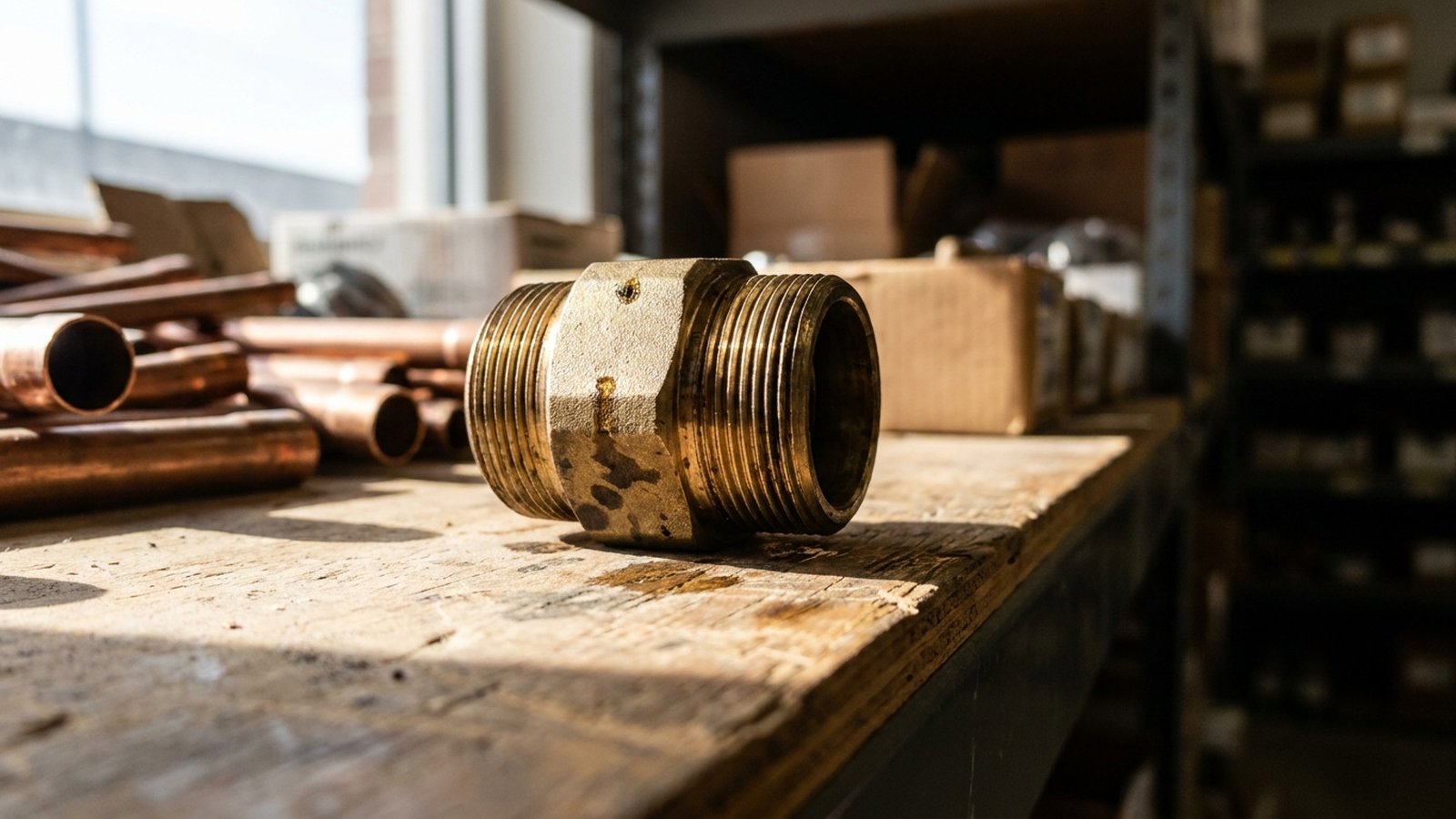
Plumbing and PVF wholesalers get product content from manufacturers through five channels: the manufacturer's own product and price files, EDI 832 catalog transactions, spec-sheet PDFs and portals, third-party content providers and industry catalogs, and, since July 2025, flat-file templates built on ASA's Product Data Standard. None of these reliably delivers the attributes a PVF buyer filters on (size, end connection, pressure class, material, and the standard it is built to), so most distributors still extract those values from spec sheets themselves or pay someone to.
How plumbing wholesalers get product content from manufacturers
Each channel carries a different slice of the record, and it helps to know which slice before you build a process around it.
Manufacturer product and price files. These are spreadsheets keyed on model number, typically carrying description, UPC, list price, and packaging quantities. They are built for purchasing and receiving and rarely carry the technical attributes that drive search on a distributor's site.
EDI 832. The X12 Price/Sales Catalog transaction carries item identification and description, packaging details, and pricing with unit of measure. It keeps the ERP item master in sync with the vendor. Like the price file, it is a commercial feed, not a spec feed. Large wholesalers publish their own expectations here; Ferguson's vendor handbook, for example, covers product data requirements and EDI processes for suppliers.
Spec sheets, submittals, and portals. This is where the engineering data actually lives: connection types, pressure and temperature ratings, materials, certifications. It is published as PDFs, install guides, and portal downloads, one product family at a time.
Content providers and industry catalogs. Several companies aggregate manufacturer data so each distributor does not have to. Harrison Publishing says it lists 3.3 million items from more than 600 manufacturers, with UPC/GTIN, pricing, labor units, and links to spec sheets and SDS, and that listing is free for manufacturers. Distributor Data Solutions says it connects to manufacturer data sources and delivers structured content into a distributor's ERP, PIM, and ecommerce systems. SpecBooks, aimed at quoting and submittals, cites 15 million SKUs from 2,700+ brands.
The ASA Product Data Standard. The American Supply Association released the PDS on July 1, 2025, built with more than 30 manufacturers and distributors. It ships as downloadable .xlsx templates per category plus a Data Dictionary and an Interpretation and Rules Guide, covering full-line plumbing, water heaters, pipe/tubing/fittings/valves, tools, and rough plumbing. ASA deliberately chose a flat-file format over a hierarchical taxonomy so smaller companies can use it, and Kohler was the first manufacturer to adopt it, mapping the template into its PIM for exports. Check the current templates on ASA's site before you map to them; the standard has a governance committee and will be revised.
If you are weighing a content provider against doing more of this yourself, our comparison with Distributor Data Solutions lays out where a shared pool fits and where it stops.
Where PIES and EDI fit in plumbing product data exchange
Plumbing buyers sometimes search for "PIES data" because they have heard it from the auto side of the business. PIES and ACES are automotive aftermarket standards maintained by the Auto Care Association. They are not the plumbing exchange format. In PHCP and PVF, the practical stack today is the manufacturer's price file or EDI 832 for commercial data, spec PDFs for technical data, and the ASA template as the emerging common container for both.
What PVF product data the feeds usually leave out
A PVF item is defined by its specification, not its name. FrontBeacon puts it plainly: two-inch pipe is not an item; two-inch Schedule 40 A53 Grade B black is. The Estes Group describes PVF catalogs as spanning material types, schedules, sizes, pressure classes, end connections, and application requirements.
Those are exactly the fields a price file or 832 tends to bury in a description string like BALL VLV 2 FIP LF BRS 600WOG. For a ball valve, the attributes worth carrying as discrete fields look like this:
| Attribute | Example value | Where to find it |
|---|---|---|
| Nominal size | 2 in | Description, spec sheet |
| End connection | FNPT, solder, press, flanged | Spec sheet, dimension drawing |
| Pressure rating | 600 WOG, Class 150 | Spec sheet, body marking |
| Body material | lead-free brass, CF8M | Spec sheet, submittal |
| Seat material | PTFE | Spec sheet |
| Design standard | ASME B16.34 (steel and alloy valves) | Spec sheet, submittal |
| Potable water / lead-free | lead-free per SDWA, listing ID | Certification listing, spec sheet |
The standards fields matter because they carry meaning. ASME B16.34 sets pressure-temperature ratings, dimensions, materials, testing, and marking for flanged, threaded, and welding-end valves of steel, nickel-base alloys, and other alloys, so it belongs on a stainless or carbon steel valve record more than on a typical brass one. Under the Safe Drinking Water Act, "lead free" means a weighted average of 0.25% lead across wetted surfaces of pipes, fittings, and fixtures. Claro's ball-valve attribute library makes the operational point: potable-water and gas listings are often granted only for certain sizes or end connections, so they have to be recorded per variant, not per family.
For a deeper field list by category, see our guide to plumbing product attributes.
Filling the PVF gap across thousands of commodity SKUs
The arithmetic is what stalls most projects. For illustration: a distributor carrying 25,000 PVF SKUs that needs six attributes filled per item, at two minutes per attribute from a spec sheet, is looking at 5,000 hours of work. That is before the first vendor revises a sheet.
The approach that holds up has four steps:
- Start from what you have. Export the item master with vendor part number, UPC, and the raw description. Parse what the description already encodes (size, connection,
LF,WOG) into candidate values, and mark each as parsed, not verified. - Pull the source documents per vendor. Spec sheets and submittals, matched to part numbers. Commodity lines often share one sheet across a size range, so one document can fill dozens of rows.
- Extract to a fixed vocabulary. Decide that end connection is one of
FNPT,MNPT,solder,press,grooved,flanged,socket weld,butt weldand normalize everything to it. Same for pressure units and material names. Map that vocabulary to the ASA template columns if you need to exchange it. - Flag conflicts instead of picking one. When the price file says
600 WOGand the spec sheet says400 WOGfor the 3-inch size, that row goes to a person, with both sources attached.
What goes wrong
Certifications get copied across a family when they apply to only some sizes. Descriptions get trusted over spec sheets because they are easier to parse. A content provider's record is used as-is, so every distributor buying from the same pool shows the same thin page, a pattern we cover in the shared content pool trap. And the work is treated as a one-time cleanup, so it decays as manufacturers revise ratings and add sizes.
Who does the work
A PIM or ERP holds these attributes; it does not read the spec sheet. The options are an internal data team, offshore data entry, a content subscription, or an enrichment service. If you are choosing the system of record first, our roundup of PIMs for plumbing distributors covers that decision.
Your PIM stores the data. Anglera does the work. Anglera extracts PVF attributes from the manufacturer's own spec sheets, catalogs, and sites, normalizes them to your vocabulary, scores each value against its source, and flags conflicts for review rather than guessing. It works with whatever you run, including a flat CSV or ERP export, and a typical implementation is 30 days or less.
If the ASA template, an 832 feed, and a stack of PDFs are all landing on the same team, that is the work Anglera is built to take on as a maintained practice, so new attributes can be backfilled across the catalog when a buyer or a code change asks for them. See how it applies to plumbing and PVF distributors.