
How to standardize product titles across suppliers
Stop editing supplier titles. Parse them into attributes, normalize units and abbreviations, then generate every title from one formula per category.

To standardize product titles across suppliers, stop editing the titles suppliers send you: parse each supplier's title and spec data into structured attributes (brand, product type, key specs, size or pack), normalize those values to one vocabulary and one unit format, and generate every title from a fixed formula per category. The formula enforces consistency, and you render each channel's length from the same attributes, for example up to 150 characters for Google Merchant Center, 200 for most Amazon categories, and 80 for eBay.
Why rewriting supplier titles never stays fixed
A title is a rendering of attributes, not a field you can own on its own. If one supplier sends LED HIBAY 150W 5000K DIMM UL and another sends High Bay Light, LED, 150 Watt, Dimmable, 5000 Kelvin - UL Listed, a person can rewrite both to look alike. The next price file overwrites one, and the cleanup starts again.
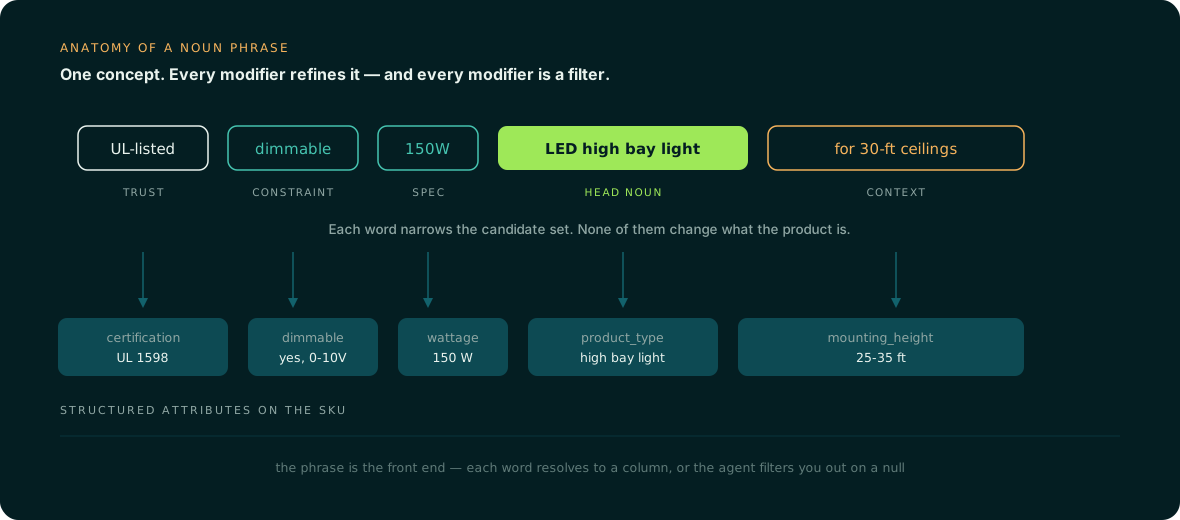
The fix is to move the work one layer down. Once wattage, color temperature, dimming, and certification live in their own columns with controlled values, the title is just a template filled from those columns. Two suppliers then produce the same shaped title by construction. It is also why free-text attributes break BI for the same root reason messy titles do.
A product title naming convention per category
Write one formula per category, not one for the whole catalog. The order should follow how a buyer in that category narrows a search: brand first, then the head noun that says what the thing is, then the specs that decide fit, then pack or size.
Some working formulas for industrial categories:
- High bay lighting:
Brand+wattage+light source+product type+dimmable+color temperature+certification - Fasteners:
product type+grade+finish+thread size x length+pack quantity - Disposable gloves:
Brand+material+product type+powder status+color+thickness+size+pack quantity
GS1 already works this way. In GDSN, the trade item description is built by concatenating Brand, Sub Brand, Functional Name and Variant Description, plus net content (and child quantity for a case), with a 200-character maximum and guidance to avoid abbreviations. That is a title formula published as a data standard. If your suppliers send GDSN data, map those four attributes into your formula rather than copying their description string.
Each slot in the formula should point to exactly one attribute column. If a slot has no column yet, that is your schema gap, not a writing problem. Our guide on how to structure product attributes and values covers how to define those columns and their allowed values.
Product title normalization: before and after
These are hypothetical supplier strings of the kind every distributor receives. The after column is generated from attributes, not hand-written.
| Supplier title (before) | Extracted attributes | Generated title (after) |
|---|---|---|
LED HIBAY 150W 5000K DIMM UL | brand BrandX, wattage 150 W, source LED, type High Bay Light, dimmable yes, CCT 5000 K, cert UL Listed | BrandX 150 W LED High Bay Light, Dimmable, 5000 K, UL Listed |
HHCS 3/8-16X1-1/2 GR5 ZP 50PK | type Hex Head Cap Screw, grade 5, finish Zinc Plated, thread 3/8-16, length 1-1/2 in, pack 50 | Hex Head Cap Screw, Grade 5, Zinc Plated, 3/8-16 x 1-1/2 in, Box of 50 |
NITRILE GLV PF LG 100/BX BLUE 4MIL | brand BrandY, material Nitrile, type Exam Gloves, powder Powder-Free, color Blue, thickness 4 mil, size Large, pack 100 | BrandY Nitrile Exam Gloves, Powder-Free, Blue, 4 mil, Large, Box of 100 |
The after titles carry no all-caps, supplier codes or promotional words. Google's title guidance says not to use capitals for emphasis and not to add price, shipping, or your company name to the title attribute. A generated title cannot drift into those habits because the template has no slot for them.
Normalizing abbreviations and units before they reach the title
Most of the visible mess in supplier titles is two things: private abbreviations and inconsistent units. Fix both at the value level, once, with a mapping table scoped by category.
Abbreviations need a category scope because the same token means different things. SS usually means stainless steel on a fastener but can mean single-sided on tape. A short dictionary per category handles most of it: HHCS to Hex Head Cap Screw, ZP to Zinc Plated, GR5 to Grade 5, PF to Powder-Free, DIMM to Dimmable. Any token the dictionary does not recognize goes to a review queue instead of passing through to the title.
Units need one canonical form. 150W, 150 Watt, 150 watts and 150-watt should all resolve to a numeric value of 150 with a unit of W, stored separately. When you render, pick a single style and apply it everywhere. A defensible default is the NIST convention: a space between the number and the unit symbol even when it is used as an adjective, no plural on the symbol (75 cm, not 75 cms), and no period after it. Marketplaces publish their own style rules on top of this, so confirm the current style guide for each channel before you encode it.
Storing value and unit separately also lets you convert millimetres and inches without breaking filters.
Product title length limits by channel
Generate one master title from the formula, then render shorter variants per channel by dropping the lowest-priority slots from the end. Current published limits, which you should re-check against each portal because they change:
- Google Merchant Center: 1 to 150 characters, and users "usually notice only the first 70 or fewer characters" per Google's title help page. Put brand, product type and the deciding spec in the first 70.
- Amazon: for most categories, titles "may not exceed 200 characters, including spaces," and a word may not appear more than twice, under the requirements effective January 21, 2025. Some categories set lower limits.
- eBay: 80 characters, with eBay advising against all-caps words and asterisks between words.
Because every slot has a priority, truncation is a rule, not a judgment call. For the fastener above, the eBay render keeps type, grade, thread and length and drops the finish only if it must.
Generating titles from structured attributes so they stay consistent
The pipeline has four steps, and the order matters.
- Extract. Pull values from the supplier title, the description, the spec sheet PDF and the manufacturer page. The title is often the least reliable of these; a spec sheet will have the thread pitch the title abbreviated away.
- Normalize. Apply the category's abbreviation dictionary and unit rules. Map brand aliases to one canonical brand.
- Validate. Check each value against the allowed list for its attribute. Flag conflicts, for example a title saying 4000 K while the spec sheet says 5000 K, for a person to resolve rather than letting either one win silently.
- Render. Fill the category formula, then the channel variants.
Teams underestimate step 1 at scale. For illustration, a 20,000-SKU catalog at 10 minutes per SKU to read a spec sheet and key in attributes is about 3,300 hours of work, before any new supplier arrives. This is the "who does the work" question. Your PIM stores the data. Anglera does the work: it extracts attribute values from the supplier's own source documents, scores each value's quality, flags conflicts for review instead of inventing values, and keeps doing that as new supplier files land. It works alongside whatever PIM, ERP or syndication platform you already run, or from a flat CSV export, and typical implementation is 30 days or less.
Titles rendered from your own attributes also stop your pages reading like every other reseller's, the problem behind duplicated manufacturer copy.
Where title standardization goes wrong
- One global formula. A formula that works for gloves puts thread size in the wrong place for screws. Write formulas per category and accept that you will have dozens.
- Normalizing the title string instead of the values. Regex on titles fixes today's file and breaks on the next supplier's pattern.
- No source for the value. If nobody can say which document a wattage came from, nobody can resolve the conflict when a second supplier disagrees.
- Forgetting the product attributes behind variants. Google asks that titles distinguish variants by size or color; that only works if size and color are columns, not words buried in a string.
Where to start this week
Pick the one category with the most suppliers and the worst search complaints. Write its formula, list the attribute columns each slot needs, build its abbreviation and unit table, and regenerate those titles from attributes. Measure how many SKUs had every slot filled; the gaps are your real backlog.
Most of that backlog is extraction and gap-filling, which is the part Anglera handles: source-grounded attribute values your PIM can hold and your formulas can render. Once the attributes are complete and maintained, consistent titles across every supplier are a template, not a project.