
Can you enrich product data without a PIM? Yes. Here is how it works
Yes. Enrichment is work done to product data and a PIM is where it is stored, so you can enrich an ERP export or CSV and load it into ERP, store, or feed.

Yes, you can enrich product data without a PIM: enrichment is the work of extracting, normalizing, and filling attributes, and a PIM is one place to store the result. You can run that work on a flat CSV or ERP item export and write the enriched attributes back into your ERP, your ecommerce platform, or a channel feed, and you only need a PIM once governance across many teams, channels, and locales becomes the bottleneck.
What a PIM does versus what enrichment is
The two blur because vendors describe enrichment as a PIM feature. Akeneo, for example, describes a PIM as a central source of truth that enables "the collection, management, and enrichment of product information", used to centralize product data and distribute catalogs to channels. That is an accurate description of the software. But read closely: the PIM enables enrichment. It gives people fields, completeness rules, and workflow. Someone still has to open the spec sheet, find that the voltage is 120 V and the ingress_protection is IP65, and type or load it.
A vendor-neutral definition is even plainer. Wikipedia defines product information management as the process of managing all the information required to market and sell products through distribution channels, and cites Forrester describing it as a hub between content management, ecommerce, digital asset management, and ERP systems. A hub is plumbing. It does not read PDFs.
So when someone asks for an "Akeneo product enrichment definition", the honest answer is: enrichment is adding the technical, usage, and marketing attributes a buyer needs; a PIM like Akeneo is a workspace that makes that addition governable. Remove the PIM and the work still exists. You just need somewhere else to put the output. We cover the storage side in more depth in PIM vs spreadsheets.
How to enrich product data without a PIM, step by step
The no-PIM route is a loop over a flat file. For a distributor or manufacturer it usually looks like this:
- Export the item master. Pull
item_number,mfr_name,mfr_part_number,short_description,uom, and category from the ERP into a CSV. MPN plus manufacturer is the join key for everything that follows. - Define the target attributes per category. A ball valve needs
body_material,end_connection,pipe_size,pressure_rating_psi,max_temp_f. A work glove needscut_level,palm_coating,size. Write this as a column list per category, with allowed values and units. - Gather sources. Manufacturer spec sheets, catalog PDFs, the manufacturer's product page, supplier onboarding files, and product images.
- Extract and normalize. Pull each value from its source and force it into your format:
1/2 innot.5",316 Stainless SteelnotSS316, one unit per column. - Validate and flag. Check values against the allowed list and plausible ranges, and flag conflicts where two sources disagree rather than picking one silently.
- Load to the destination. Write the columns back to wherever the data lives.
Steps 3 through 5 are the expensive part, and none of them depends on having a PIM. That is why the question of who does that work is separate from the question of which system stores it. We wrote about that split in your PIM stores data, the work remains.
Where enriched data lands when there is no PIM
Without a PIM, the enriched file has three common homes, and many teams use more than one.
The ERP. Many ERPs support user-defined fields or attribute tables on the item record. Writing enriched attributes back there keeps one record per SKU, which matters if your quoting, counter, and ecommerce systems all read from it. The catch is that ERP item masters were built for transactions, not merchandising, so long descriptions, images, and category-specific attribute sets fit awkwardly. See why the ERP item master is not a catalog and the broader PIM vs ERP comparison.
The ecommerce platform. For Shopify, the attribute store is metafields. Shopify says metafields let you extend the platform data model "with your own custom data", and you add a metafield definition first, then values. Shopify also confirms that product metafields are supported in product CSV import and export, with a column header in the form Name (product.metafields.namespace.key), while variant metafields are not supported in that CSV. For a catalog where size or voltage varies by variant, that last line matters: Shopify points you to the variant bulk editor, and an app or the API are the other routes for variant-level attributes. This is the practical answer to "Shopify product information enrichment without a PIM": metafields plus CSV or API, with the variant limitation planned for. Confirm against Shopify's current docs before a large load.
The channel feed. If the goal is Google Shopping, the destination is the feed itself. Google's product data specification lists attributes such as gtin, mpn, brand, material, and color, plus a product_detail attribute with section name, attribute name, and attribute value sub-fields, and up to 100 details per product. A flat enriched file maps onto that directly. Check the live spec for current limits.
A headless CMS can also hold attributes, but it is usually a presentation layer that reads from one of the three systems above, not where enrichment should be recorded.
A worked example: 8,000 SKUs, spreadsheet route
For illustration, take a hypothetical MRO distributor with 8,000 active SKUs across 40 categories, a 12-attribute target per category, and no PIM.
| Stage | What happens | Where it lives |
|---|---|---|
| Export | ERP item master to CSV, 8,000 rows | CSV |
| Enrich | 96,000 attribute cells to fill (8,000 x 12) | Working CSV, one tab per category |
| Review | Flagged conflicts and low-confidence values checked by a product person | Same file, a review_status column |
| Load | Attributes into ERP user-defined fields; same columns pushed to Shopify metafields and the Google feed | ERP, store, feed |
At an assumed 2 minutes per cell for a person reading spec sheets, 96,000 cells is 3,200 hours. That arithmetic is the real reason teams think they need a PIM. The PIM does not change the 3,200 hours. Automating extraction from source documents does.
What goes wrong on the flat-file route
The spreadsheet route works. Its failure modes are predictable:
- Version drift. Two people edit copies of
valves_enriched_v3_FINAL.csvand the load uses the wrong one. - No provenance. Six months later nobody knows whether
pressure_rating_psi = 600came from the manufacturer's PDF or a guess. - Unit and vocabulary creep. Without enforced allowed values,
Brass,brass, andLead-Free Brasscoexist and break facets. - One-way loads. A manufacturer revises a spec, the ERP changes, and the enriched file is never refreshed.
- Variant gaps. On Shopify, attributes that differ per variant fall outside the product CSV.
Each of these is a governance problem, not an enrichment problem. That tells you what a PIM actually buys you.
Signals that you do need a PIM
Stay on the no-PIM route while one team owns product data, you sell through one or two channels, and your ERP or store can hold the attributes you need. Look seriously at a PIM when:
- several teams (purchasing, marketing, ecommerce, regional sales) edit the same product records and need approval workflow;
- you syndicate to many channels, each with its own schema and mapping;
- you localize into multiple languages or markets;
- you manage digital assets at a volume your store's media library cannot organize;
- auditors or customers need a change history per attribute.
None of those signals is "our attributes are empty." Empty attributes are an enrichment gap, and a new PIM will arrive empty too.
Who does the enrichment work
Whether you add a PIM later or never, someone has to turn spec sheets into fields. The options are in-house staff, offshore data-entry teams, generic AI writing tools, or a dedicated enrichment layer. Writing tools generate descriptions; they do not reliably return a verifiable pressure_rating_psi with a source. Offshore teams can, but as a project that ends while the catalog keeps changing.
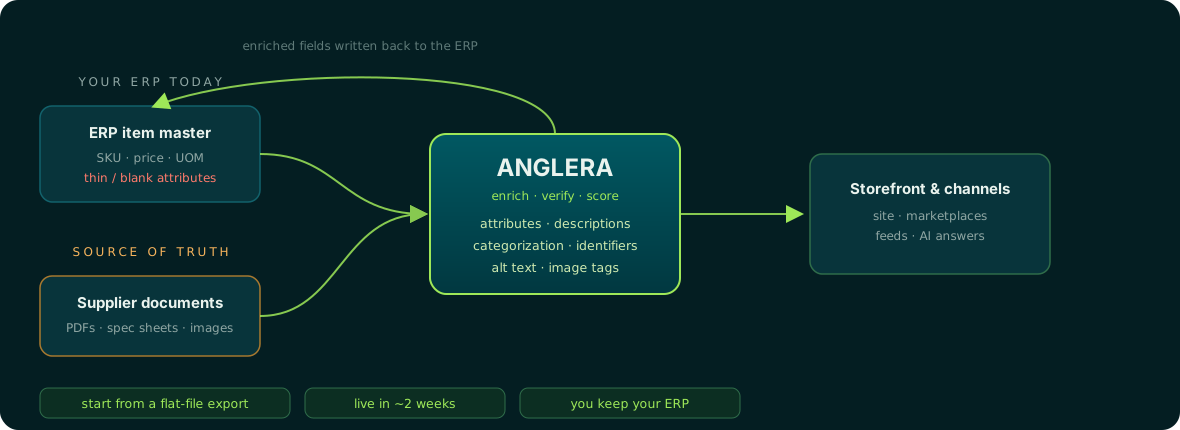
Anglera sits in that gap. It works from a flat CSV or ERP export, extracts values from the actual source documents, scores each one for quality, flags conflicts for review, and writes enriched attributes back to the ERP, your store, a feed, or a PIM if you have one. Implementation typically takes 30 days or less, and it keeps running as products and specs change. Your PIM, if you have one, stores the data. Anglera does the work.
The short version for your team
Enrich now, store where you already store, and add a PIM when coordination across teams and channels becomes the constraint, not before. If you want to see what the flat-file route looks like on your own item master, see how Anglera works: start from an export, get source-backed attributes back into the systems you already run.
Hero photograph by Marmi Sica on Unsplash