
How manufacturers send product data to distributors
Manufacturers send product data to distributors via spreadsheets, EDI 832 catalogs, GS1 GDSN data pools, industry hubs like IDEA, content providers, and APIs.

Manufacturers send product data to distributors through six main channels: spreadsheet templates, EDI 832 price/sales catalogs, GS1 GDSN data pools, industry data hubs such as the IDEA Connector in electrical, syndication and content providers such as DDS, and direct APIs or supplier portals. Many manufacturers use several at once, and each channel carries pricing and identifiers far better than it carries the rich, category-specific attributes a distributor's search filters and ecommerce pages depend on.
That gap is why distributors who receive data through every channel still run enrichment work in-house.
How distributors get product data from manufacturers, channel by channel
Spreadsheets and distributor templates
The distributor sends a vendor-onboarding template (often an Excel file with columns like MFR_PART_NO, UPC, SHORT_DESC, UOM, LIST_PRICE, CASE_QTY), and the manufacturer's product or sales-ops team fills it in.
Templates carry whatever the distributor asks for, which is both the strength and the problem. Every distributor's template is different, so the manufacturer re-keys the same catalog into dozens of layouts, and attribute columns get skipped first because they are the slowest to fill. The Distribution Strategy Group's syndication tutorial puts a number on the downstream cost: building proper content for 10,000 SKUs at five minutes each is roughly 800 hours of distributor effort, repeated for every supplier that sends thin data.
EDI 832 price/sales catalogs
The EDI 832 is the X12 transaction set built for catalogs. Per 1 EDI Source, it carries seller contact details, terms of sale and discounts, item identification and description, packaging details, and pricing by quantity and unit of measure. TrueCommerce adds that it typically includes SKUs and UPCs, minimum order quantities and promotions, and is usually sent periodically, quarterly for example, or when prices change.
The 832 is excellent at what an ERP needs to buy and sell: part number, UPC, UOM, case pack, cost, effective dates. It is weak at descriptive depth. A PID description segment holds text, not a structured voltage, thread_size or ingress_rating. And per 1 EDI Source, updates to item attributes that exclude price are meant to go on a separate transaction, the 888 Item Maintenance, so attribute changes and price changes can travel on different documents.
Some industries extend the 832 for their own needs. The Healthcare Distribution Alliance's 832 guideline uses it to send DSCSA compliance attributes to pharmacies, including GTINs at every packaging level, drug name, dosage form, strength and package size, and that version omits pricing. If you work in a regulated category, check your industry's own implementation guide before assuming what an 832 will contain.
GS1 GDSN data pools
The Global Data Synchronization Network is a publish-and-subscribe network, not a single database. According to GS1's own explanation, suppliers align their data to GS1 standards including GTINs and GLNs, upload it to a GDSN-certified source data pool, and the pool registers basic item information with the GS1 Global Registry. Recipients subscribe to that supplier's items through their own certified pool, and the two pools synchronise continuously. GS1 maintains a list of certified data pools rather than a single operator; Syndigo, for example, describes itself as a GS1-certified GDSN data pool alongside its other syndication.
GDSN is strongest for logistics and identity data: GTIN hierarchies, dimensions, weights, packaging. It is weaker for commercial and merchandising data. SPS Commerce notes that pricing and certain ecommerce attributes can generally not be shared through GDSN.
Industry data hubs: IDEA in electrical
Some verticals built a shared hub. In electrical, IDEA was founded by NEMA and NAED to unify product data flow across the supply chain. Manufacturers load into the IDEA Connector, formerly the Industry Data Warehouse (IDW), and distributors pull from it into their ERPs, catalogs and web stores. IDEA mandated 43 critical fields for all new items from February 1, 2015 and all existing active items from October 1, 2015, measured through its Data Certification Program.
A shared standard raises the floor. It does not set the ceiling: a mandated core set covers what distributors need to transact, while a distributor's faceted search on a breaker or a luminaire usually wants more. If you sell electrical, see how an IDEA feed and an enrichment layer fit together.
Content providers and syndication networks
A third party sits in the middle, takes the manufacturer's data once, and reformats it for each distributor. DDS, for example, says manufacturers can send content through scheduled exports, APIs or automated feeds and that it has 475+ distributor endpoints connected, formatted to each distributor's templates and taxonomy. The Distribution Strategy Group tutorial linked above distinguishes a standard model, where the syndicator mostly reformats, from an advanced one that adds images, specs and harmonised attributes.
The key question with any shared pool is whose data you end up with. If every distributor buys the same normalised content for the same SKU, nobody's product page is better than anyone else's. We cover that dynamic in the shared content pool trap.
Direct APIs and supplier portals
Some manufacturers expose a product API or a dealer portal with downloadable feeds, and large distributors run supplier portals where vendors upload into the distributor's own schema. These can be the freshest channels, but they are only as good as the manufacturer's internal PIM. If the attribute was never captured upstream, an API returns an empty field faster.
What each channel carries well and badly
| Channel | Carries well | Carries thinly |
|---|---|---|
| Spreadsheet template | Whatever the distributor asks for | Attributes, consistency across vendors |
| EDI 832 | Price, UOM, case pack, UPC, terms | Structured specs; non-price changes may move on the 888 |
| GS1 GDSN | GTIN hierarchy, dimensions, weights, packaging | Pricing, many ecommerce attributes |
| Industry hub (IDEA Connector) | Standardised core fields for the vertical | Category-deep specs beyond the mandated set |
| Content provider | Reformatted content at scale | Differentiation, since others get the same data |
| API or portal | Freshness | Anything missing from the manufacturer's own PIM |
Why distributors still end up enriching
Every channel above moves data the manufacturer already has in structured form. They rarely create attributes that only exist in a PDF spec sheet, an installation guide, or a product photo. So a distributor receiving a clean 832 and a GDSN subscription can still find, for example, a material field blank across much of a fastener category, or voltage stored as 120V, 120 V and 120VAC across three suppliers.
For illustration, take a distributor adding 15,000 SKUs a year from 200 suppliers. If 60 percent arrive missing the category attributes their filters need, and filling each takes eight minutes of reading spec sheets, that is 1,200 hours a year, before normalising units and fixing conflicts between feeds.
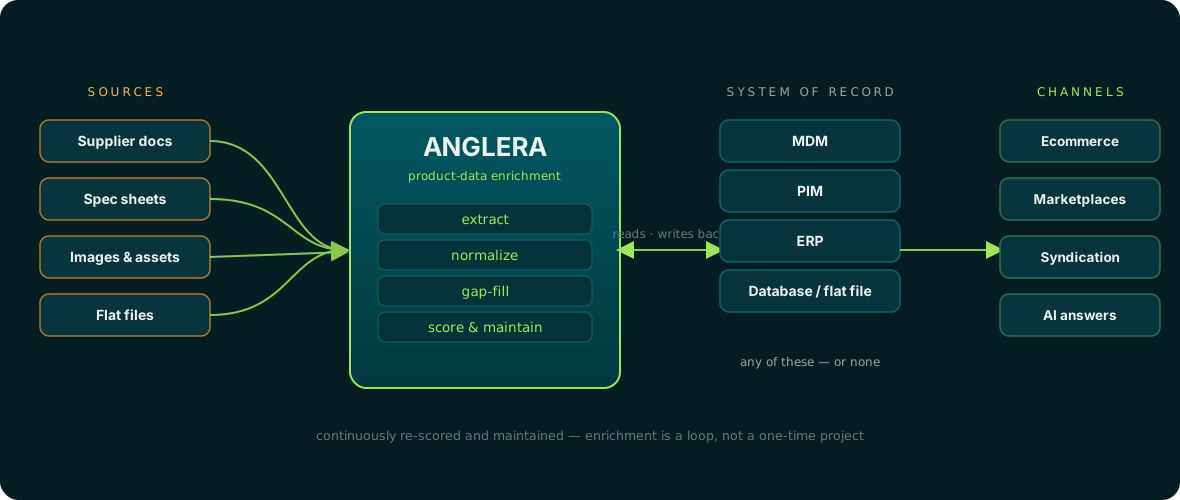
This is the point where the "who does the work" question gets real. Options are an internal data team, offshore data entry, a content provider's pooled data, or an enrichment layer. Anglera is the last of those: your PIM stores the data, Anglera does the work. It reads the actual source documents, extracts and normalises values into your schema, quality-scores each one, and flags conflicts for review instead of guessing. It runs alongside whatever already receives the feeds, whether that is a PIM, ERP, MDM, syndication platform or a flat file, and the process can start from a CSV export, with typical implementation in 30 days or less.
Manufacturer-to-distributor product data syndication: how to decide
If you are a manufacturer, choose channels by where your distributors already listen. Ask each major distributor which hub or pool they subscribe to, whether they take an EDI 832 for price, and what template or portal they use for everything else. Send the structured attributes you have through every one of them, and keep your source documents current, because that is where distributors and their tools will go to fill gaps.
If you are a distributor, treat the feeds as inputs, not the finished record:
- Use EDI 832 and price files as the source of truth for cost, UOM and pack.
- Use GDSN or IDEA for identifiers and logistics data where your vertical supports them.
- Decide which attributes drive your search, filters and AI-answer visibility, and own those yourself.
The last point is the one that compounds. Owning the last mile of your product data means the specs on your pages come from your own maintained process rather than from whatever arrived in the latest file. Our comparison of distributor data solutions lays out how data pools, content providers and enrichment fit together.
Where Anglera fits
Data pools, EDI and hubs get the manufacturer's existing data into your systems, and they are worth keeping. Anglera works with them, filling the attribute gaps they leave by extracting values from spec sheets and manufacturer sites, and keeping those values maintained as products and sources change.