
How much does a PIM cost? License plus implementation
PIM implementation runs about $30,000-$150,000 mid-market, often 50-200% of first-year licence, on top of licences from free to $300,000+ a year.

A PIM implementation typically costs $0 to $5,000 for an entry-level tool and $30,000 to $150,000 for a mid-market project, or roughly 50% to 200% of the first-year licence, on top of annual licences that run from free to $300,000 or more (Hootcore's cost breakdown). Those quotes pay for configuration, integrations, and moving your existing data, but rarely for creating the missing attribute values, and on a large catalog that work can cost more than the software.
How much a PIM implementation costs, by scope tier
Published ranges cluster by catalog size and channel count. Hootcore's bands are a reasonable starting frame:
- Entry: under 10,000 SKUs and one to three channels. Licence from $0 to about $8,400 a year, implementation $0 to $5,000, mostly self-serve.
- Mid-market: 10,000 to 100,000 SKUs and three to eight channels. Licence about $25,000 to $60,000 a year, implementation $30,000 to $150,000.
- Enterprise: 100,000+ SKUs, often multi-country. Licence $75,000 to $300,000+ a year.
UK figures from Bluestone PIM land in the same shape: free to £10k a year under 10,000 SKUs, £10k to £50k+ for 10,000 to 100,000 SKUs, and £50k to £100k+ above that. Polish integrator Macopedia quotes PLN 50,000 to 150,000 for a basic implementation with no integrations and PLN 300,000+ once data import, multiple integrations, and training are in scope.
Timelines move cost more than anything else, because most of the bill is people. Sitation's implementation guide says there is no standard duration and cites one Akeneo rollout finished in 12 weeks and one Salsify launch, connected to JD Edwards, Bynder and SAP Commerce, in four months.
What PIM software costs per year: published prices and reported contracts
Few PIM vendors publish list prices. Here is what the primary and transaction-data sources actually show.
Pimcore publishes its prices. The Pimcore pricing page lists a free Community Edition, Professional at $9,900 per year and Enterprise at $29,900 per year (Professional on-premises, Enterprise on-premises or private cloud), and a managed PaaS edition on custom pricing. Self-hosting means your hosting and developer time sit outside that number.
Akeneo quotes by request. Hootcore cites a G2 listing at about $45,000 a year, a figure Akeneo does not publish itself, and notes separate charges for AI and connectors.
Salsify is also quote-based. Purchase data on Vendr shows a median contract of $52,100 a year, with reported deals ranging from $21,467 to $86,250.
Two pricing mechanics to watch. First, many tools price on SKU count, channels, locales, or modules, so the same platform can double in cost when you add a marketplace or a second language. Second, for on-premises licences, Plytix notes that updates and support can run 15% to 25% of the licence fee per year. If you are still building a shortlist, our ranked PIM software comparison and guide to choosing a PIM cover fit before price.
What the implementation quote covers: consulting hours, integration, migration
An implementation statement of work usually breaks into phases that Sitation describes as discover, design, build and migrate, then launch and adopt. Mapped to line items:
- Data model and workflow design. Families, attribute groups, validation rules, approval steps. Partner consulting hours.
- Integrations. ERP in, ecommerce and marketplaces out, maybe a DAM. Plytix puts custom integrations at $3,000 to $20,000+ each. Macopedia calls integrations the biggest single cost driver, mostly because of how many transformations the data needs between systems.
- Data migration. Plytix lists migration and cleanup at $5,000 to $30,000+, more if your data is messy. Bluestone says migration, onboarding, configuration, and first integrations typically add 20% to 40% to an enterprise first-year budget.
- Training and change. Bluestone suggests budgeting at least 10% to 15% of first-year PIM spend.
Read the migration line carefully. Migration moves the values you have into the new data model. It maps ERP_DESC_2 to short_description and splits a concatenated Size/Color field. It does not go find the voltage, IP_rating, thread_size, or material values that were never in your ERP to begin with.
The line item nobody quotes: getting the data worth storing
A PIM is a well-organised container. When it goes live, the attribute schema for a category like cordless drills might have 30 fields, and your ERP export fills six of them: SKU, MPN, brand, a truncated description, price, and weight. Sitation calls data migration and clean-up often underestimated and often the largest variable, and lists moving unclean data into the new system and having no owner after launch as common mistakes. We wrote about why that gap persists in your PIM stores the data, but the work remains.
That gap gets filled one of four ways: your own merchandising team, an offshore data-entry vendor, a generic AI writing tool, or an enrichment layer that pulls values from spec sheets, manufacturer sites, and catalogs. The cost driver is the same in every case, which is minutes per SKU multiplied by SKU count, plus the new SKUs that arrive every month. AI buttons inside PIMs help with copy, but they generate text from what is already in the record. They do not source a missing amperage value. More on that in your PIM added an AI button.
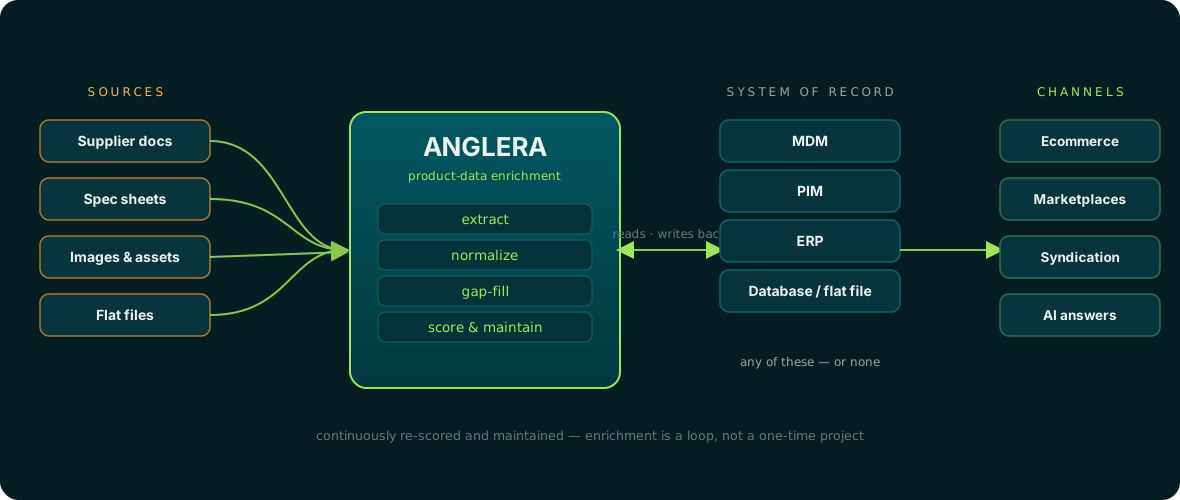
This is the work Anglera does. Your PIM stores the data, and Anglera extracts attribute values from real source documents, quality-scores them, and flags conflicts for review instead of inventing them. It works with whatever system of record you run, or a flat CSV export, and is built to go live in about 30 days. See how it works.
Three-year total cost of ownership, illustrated
Hootcore's TCO method is sound: add three years of licence and support to one-time implementation, migration, integration, customisation, and training, then add three years of internal staff time, which it says frequently exceeds 20% of the total. Here is that method applied to a hypothetical distributor. Every input is an assumption chosen from the ranges above, not a benchmark.
Assumptions: 40,000 SKUs, of which 20,000 need meaningful attribute work; 15 minutes per SKU to research and enter missing values; $35 per hour loaded labour; 4,000 new SKUs a year; a mid-market licence of $50,000 a year; implementation at 100% of first-year licence; two integrations at $15,000 each; training at 10% of first-year spend.
| Line item | Basis | Three-year cost |
|---|---|---|
| Licence | $50,000 x 3 years | $150,000 |
| Implementation partner | 100% of year-one licence | $50,000 |
| Integrations | ERP in, ecommerce out, $15,000 each | $30,000 |
| Training and change | 10% of $130,000 year-one spend | $13,000 |
| Initial attribute backfill | 20,000 SKUs x 15 min = 5,000 hrs x $35 | $175,000 |
| New-SKU enrichment | 4,000 SKUs x 15 min = 1,000 hrs x $35 x 3 | $105,000 |
| Total | $523,000 |
In this illustration the two data lines come to $280,000, more than half the three-year total, and neither typically appears on a vendor quote or a partner SOW. Change the assumptions and the share moves: at 5 minutes per SKU the data lines drop to about $93,000. The point is to put the line in the budget, then decide who does it.
How to get a PIM quote that matches reality
Before you sign, get these numbers in writing or work them out yourself:
- Licence escalators. Price at today's SKU count, channels, and locales, and again at your three-year plan.
- What migration means in the SOW. Mapping and loading existing values, or creating missing ones? Usually the former.
- Attribute fill rate today. Export one category, count populated required attributes against the schema, and multiply the gap by a realistic minutes-per-value figure.
- Ongoing ownership. Who enriches the 300 SKUs that arrive next month, and from which sources?
A PIM licence and implementation are predictable once you scope them. The data inside is the variable, and it is the part that decides whether the investment pays off. Anglera sits next to whichever PIM you choose and does that work from source documents, so you can budget for it as a maintained practice rather than discovering it after go-live.