
Top Hose & Accessories Distributors 2026 Ranked
Eight major hose and fluid-power distributors ranked and scored, with a Digital Readiness Index read on why only two of them carry a measurable catalog score this edition.
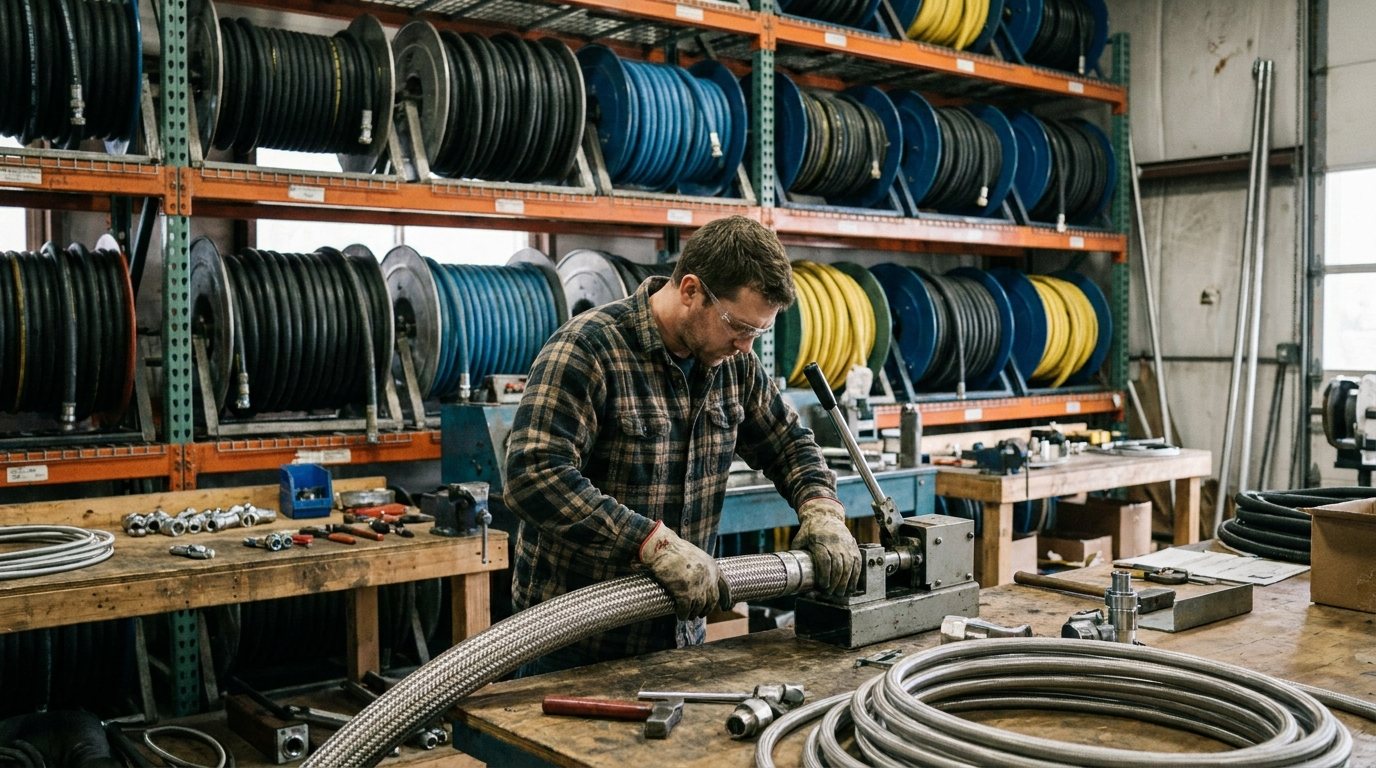
Part of Top Distributors 2026 — the Anglera Index: North America’s largest distributors ranked, classified into six operating archetypes, and scored on the measured Digital Readiness Index.
Of the eight distributors in this cut, only two have a public product catalog measured and scored. The rest build hose assemblies to spec on a service truck, or run their business as a holding company of locally branded units with no unified storefront — though in one case a verification pass found live product pages tucked under one of those local banners. That split, not a leaderboard gap, is the story in Top Distributors 2026 this vertical tells.
The ranking
| Rank | Company | Revenue | Archetype | DRI Score |
|---|---|---|---|---|
| 31 | Motion (Genuine Parts Company) | ~$9.0B (FY2025, segment) | Branch-density / scale-aggregator | 62 |
| 81 | SunSource | $2B+ (FY2025, est.) | PE roll-up / technical-specialist | 52 |
| 103 | Singer Industrial | $593M (FY2025) | PE roll-up / technical-specialist | — |
| 106 | Kimball Midwest | $565M (FY2025) | Program-supplier | — |
| 125 | Bridgestone HosePower | $287M (FY2024, segment, est.) | Technical-specialist / branch-density | — |
| 128 | Motion & Flow Control Products | ~$272M (FY2025, est.) | Technical-specialist / branch-density | — |
| — | Echelon Supply and Service | not disclosed | PE roll-up | — |
| — | LGG Industrial | not disclosed | PE roll-up / branch-density | — |
Only Motion and SunSource carry a measured Digital Readiness Index score. Kimball Midwest and Motion & Flow Control Products simply weren't part of this measurement round. Bridgestone HosePower and LGG Industrial were measured and came back with no public catalog to score — a finding about how each company sells, not a technical failure of extraction. Singer Industrial is this edition's correction: an adversarial verification pass found live public product pages on its locally branded storefronts (Watts Steam Store among them), so its status is now not yet measured (catalog verified live) — no score is published until a rule-compliant sample is taken.
Why fabrication crowds out catalogs here
Hose is a fitted product. A buyer rarely wants "a hose" off a shelf; they want a specific inside diameter, fitting configuration, pressure rating, and cut length assembled to fit a machine that is down right now. That single fact shapes the vertical more than revenue does.
Motion, the GPC subsidiary that anchors the top of this list, is the exception that proves the rule. Its archetype rationale calls out that roughly 80% of its segment revenue runs through MRO sales via a dense North American branch network — a stocked-parts business, not a made-to-order one, which is exactly why it is the only company here running a full public catalog with price and spec on every page. Motion is also the vertical's freshest headline: GPC announced in February 2026 that it will split into two independent public companies, separating Global Automotive (NAPA) from Global Industrial (Motion), targeted to close in Q1 2027. A branch-density model built on parts availability is what that standalone company will take public.
SunSource sits at the other pole: a CD&R-backed platform built by acquisition, most recently closing the purchase of Vytl Controls Group (32 branches, flow-control products for marine, chemical, and downstream energy) on January 30, 2026. SunSource's rationale is explicit that its network was built through deals — Vytl, and before it Ryan Herco Flow Solutions — rather than organic branch growth, which is the pe-rollup archetype in miniature.
The two companies with no catalog to score make the pattern sharper. Bridgestone HosePower's differentiator is a fleet of mobile service trucks that fabricate and install hose assemblies on-site — an engineered-repair service, and its "ALL PRODUCTS" navigation leads to a marketing page describing hose and fitting families with no individual SKUs or part numbers behind it. LGG Industrial is brochureware layered over a base built from ERIKS North America plus bolt-ons (DeeTag, Branham, Rubber Belting & Hose, Mill & Elevator Supply). Singer Industrial describes itself as a portfolio of 45-plus locally branded distribution business units, added most recently by acquiring Wilmington Rubber & Gasket and Fluid Tech Hydraulics in 2025, and while its corporate site is not a unified e-commerce storefront, individual banners like Watts Steam Store do serve public, spec-rich product pages — quote-driven rather than priced, and verified live but not yet sampled. Echelon Supply and Service tells the same consolidation story from a different angle: HCI Equity Partners bolted three separately branded hose distributors onto JGB Enterprises in under fifteen months and dissolved all four names into one platform, with a CFO promoted to President in January 2025 and a debt refinancing from Bluehenge Capital Partners in July 2025 to fund the next stage.
Five of the eight companies here carry a pe-rollup or technical-specialist tag; two of those five have no catalog to measure, and a third's catalog surfaced only under a local banner. That is not a coincidence. A roll-up integrating newly acquired branches under one brand, or a specialist selling engineered fabrication instead of stocked parts, has little reason to build a unified public product database — the thing a Digital Readiness Index measures barely exists as a concept in that model yet.
What the two measured catalogs show
Where a public catalog does exist, the Digital Readiness Index shows two very different shapes of "good enough." Motion scores 62 against SunSource's 52, both above the vertical's median of 62 and close to the index-wide median of 58, but the pillar breakdown tells the real story.
Motion is close to perfect on commerce transparency (20 of 20): every product page it publishes carries price and availability, with a 100% price rate in the sample, no login wall. SunSource's price rate is 40%, pulling its transparency pillar down to 11.6 of 20. On product data depth, Motion also leads, 21.9 versus 18.1 of 35, backed by a median of 34 structured attributes per page against SunSource's 15, and a GTIN identifier rate of 40% versus 0%.
But flip to buyer answerability and the gap nearly closes: Motion scores 8.6 of 25, SunSource 9.4 of 25 — SunSource's descriptive content and imagery edge out Motion's despite Motion's much richer spec tables. And on machine and agent readiness, SunSource actually leads, 13 of 20 against Motion's 11, even though SunSource's sample showed no product structured data (productJsonLd: false) versus Motion's undetermined status. Neither company's robots.txt addresses AI crawlers one way or the other, which under this index's scoring is silence, not a penalty — both are read as open to AI shopping agents by default.
The attribute counts matter most for what a buyer in this category actually needs. A hose or fitting purchase lives or dies on inside diameter, outside diameter, working pressure, burst pressure, fitting thread type and size, temperature rating, and material compatibility — a longer list of pass/fail specs than most industrial categories carry. Motion's median of 34 attributes per page can plausibly carry that list; SunSource's median of 15 likely cannot, and its consistency spread of 24 points (versus Motion's 45) means the shortfall is at least evenly distributed rather than concentrated in a few thin categories. Motion's wider 45-point spread is the less comfortable number: some of its product pages are carrying real depth and others clearly are not, which is a harder thing for a buyer to predict page to page than a uniformly thinner catalog.
Where this goes
The vertical's near-term trajectory is written into the moves already on record: SunSource, LGG, Singer, and Echelon are all still buying, and Motion is heading toward a standalone public listing built on the one model in this group that actually runs a catalog. None of that points toward more companies publishing structured product data soon — a roll-up integrating four brands into one has bigger priorities than a spec table, and a fabrication business selling made-to-order assemblies may never need a SKU-level catalog at all. The interesting question for 2027 isn't whether the rest of this list catches up to Motion's score. It's whether "catalog" stays the right unit of measurement for a category built increasingly on service trucks and bolt-on integration rather than stocked parts.