
Top JanSan, Packaging & Disposables Distributors 2026
Three mergers reshaped JanSan, packaging and disposables distribution in 18 months. See the 2026 ranking, archetypes and Digital Readiness Index scores.
Part of Top Distributors 2026 — the Anglera Index: North America’s largest distributors ranked, classified into six operating archetypes, and scored on the measured Digital Readiness Index.
Three separate mergers changed who owns the top of this vertical in the space of about eighteen months, which makes 2026 a strange year to try to rank it: some of the biggest names on this list didn't exist in their current form a year ago. Layered onto that churn is a Digital Readiness Index spread that runs from 54 to 70 among the seven companies we could measure, with the smallest revenue figure in that group posting the top score. See the full Top Distributors 2026 index for how this cut fits the other nineteen.
The 2026 ranking
| Rank | Company | Revenue | Archetype | Digital Readiness Index |
|---|---|---|---|---|
| 10 | Ferguson | $31.3B (CY2025) | scale-aggregator / branch-density | 58 |
| 13 | Network Distribution | $28B (systemwide, global) (FY2026) | scale-aggregator / program-supplier | not measured (not-in-set) |
| 20 | W.W. Grainger | $17.9B (FY2025) | scale-aggregator | 66 |
| 29 | Imperial Dade | $10B+ (FY2025) | pe-rollup / branch-density | 54 |
| 35 | Fastenal | $8.2B (FY2025) | program-supplier / branch-density | 55 |
| 36 | Uline | $8.1B (est.) (CY2025, est.) | catalog-native / scale-aggregator | 56 |
| 50 | Veritiv | $5.9B (FY2023, dated) | pe-rollup / scale-aggregator | 61 |
| 66 | NFI Industries | $3.6B (FY2025, est.) | Program-supplier / scale-aggregator | not sampled |
| 80 | UFP Industries | $2.00B (FY2025, segment) | scale-aggregator / program-supplier | not measured (not-in-set) |
| 89 | TricorBraun | $1.4B (stale, FY2020 TTM) (FY2020, dated) | scale-aggregator / technical-specialist | 70 |
| 90 | Global Industrial | $1.38B (FY2025) | catalog-native | not measured (not-in-set) |
| — | Aramsco | not disclosed | pe-rollup / branch-density | not measured (not-in-set) |
| — | McMaster-Carr | not disclosed | catalog-native | not measured (no public catalog) |
| — | Pollock Orora | not disclosed | technical-specialist / program-supplier | not measured (not-in-set) |
| — | The Home Depot (Pro) | not disclosed | branch-density / scale-aggregator | not measured (not observable) |
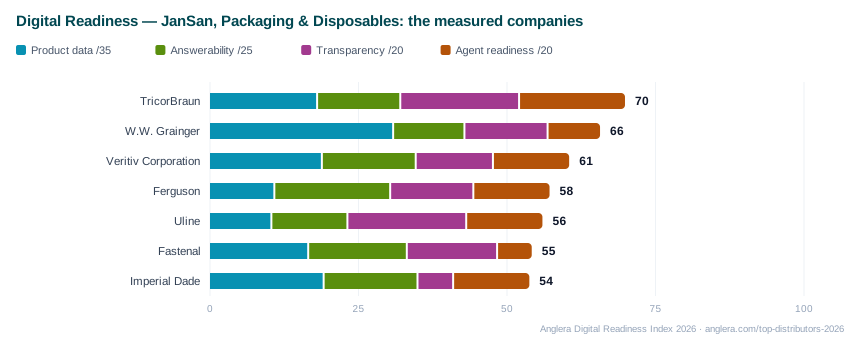
Stacked bars: the four pillars of the Digital Readiness Index — segment lengths are pillar scores, the number is the company's total out of 100.
Who leads, and why the ownership map keeps moving
The consolidation this cycle is not incremental. Imperial Dade completed its merger with BradyPlus on March 12, 2026, combining two PE-sponsored roll-ups into a single JanSan, foodservice and industrial packaging distributor north of $10B in revenue and 13,000-plus employees, financed in part by a $2.8B JPMorgan term loan. That deal caps 97 acquisitions Imperial Dade has done since the Tillis family took control in 2007 under Advent International and Bain Capital, and it folds in BradyPlus's own history as three sequential PE mergers (Brady Industries plus IFS, then Envoy Solutions, then Imperial Dade), each sponsor keeping a board seat rather than cashing out. Network Distribution ran a parallel play, allying with Packaging Distributors of America on March 27, 2026 to push its 75-plus independently owned regional distributors into industrial packaging alongside legacy JanSan and foodservice lines, reporting 850-plus distribution centers across 52 countries and roughly $28B in systemwide revenue (reported as systemwide and global, not a single company's consolidated total, per our data). Full PDA integration is targeted for July 1, 2026.
Veritiv is running the same strategy from the packaging-manufacturing side. Since CD&R took it private in 2023, Veritiv has closed at least six acquisitions, the largest being the roughly $1.2B purchase of Orora Limited's North American packaging arm in December 2024, which brought the Pollock Orora brand and its in-house corrugated manufacturing under the Veritiv roof. Veritiv then sold its Rigid Containers business to TricorBraun in 2025 to sharpen its focus, and TricorBraun installed a new CEO, former FleetPride and Grainger/Zoro executive Kevin Weadick, in May 2025. Three of the largest names in this vertical changed hands or absorbed a competitor within the last eighteen months.
The archetype mix explains why roll-ups dominate here rather than technical specialists. JanSan supplies, packaging materials and disposables are high-volume, comparatively undifferentiated categories where national-account buying power and delivery density matter more than engineering depth, which is exactly what Ferguson's steady tuck-in cadence and Grainger's centralized national-account model are built to sell. The exceptions prove the point: Pollock Orora is classified technical-specialist outright and TricorBraun carries it as a secondary tag, both tied to custom packaging engineering, and Uline and McMaster-Carr sit in the catalog-native camp, self-serve operations built around published stock and next-day delivery rather than a field sales force.
What the Digital Readiness Index found
We measured seven of the fifteen companies in this cut against the Digital Readiness Index methodology: five live product pages, pulled from the middle of five different category listings on each company's own public catalog (Uline's, whose pages block standard clients, was read through a full browser session, disclosed on its scorecard). This vertical's median score of 58 matches the full index's median exactly, but the seven-company range (54 to 70) hides more than it shows.
Grainger's product-data pillar is the standout number in the cut: 31 of 35 points, built on a median of 47 structured attributes per sampled page, roughly triple what any other measured company here returned. For a buyer trying to match a specific mop head, liner gauge or glove size against what's already on a shelf, that depth is the difference between filtering and reading. But Grainger's agent-readiness score, 9 of 20, is the lowest in the group, because its robots directives explicitly block AI crawlers, the one clear block in this cut and the reason its overall score (66) trails TricorBraun despite a stronger catalog.
TricorBraun's 70 is the cut's high score, carried by a maxed-out commerce transparency pillar (20 of 20) and the only agent-readiness score above 18, built on the cut's only confirmed product structured data (JSON-LD) and a robots stance our data records as a partial AI-crawler accommodation rather than silence. Its median attribute count, 14, is unremarkable next to Grainger's, but its consistency spread, the gap between its richest and thinnest sampled page, is just 4, the tightest in the cut: what a buyer finds on one product page they can expect on the next.
Ferguson is the odd result: an overall 58, driven almost entirely by a strong answerability pillar (19.5 of 25) and full marks on public pricing, but a median attribute count of 0 and a product-data pillar of just 11, second-lowest here after Uline's 10.5. A page can show a clean photo, prose and a price and still withhold the structured spec table a buyer needs to filter by size or material, or that an agent needs to match the SKU elsewhere — exactly what the product-data pillar catches. Imperial Dade shows the inverse: an 80 percent GTIN rate, the cut's highest, but a public-pricing rate of 0, every sampled page gated behind an account, the lowest transparency score (6 of 20) here. Packaging and disposables buyers typically need to compare mil thickness, case-pack count, ply or environmental certification across vendors before ordering; a median attribute count in the low teens, where most of this cut lands outside Grainger, leaves real filtering gaps, and Fastenal's missing sitemap compounds that by making its product URLs harder for a crawler to find at all.
Where this settles
The interesting fact for 2026 is that scale and digital shelf quality are not moving together. Imperial Dade, freshly combined into a $10B-plus platform, posts this cut's lowest measured score; TricorBraun, the smallest revenue figure in the measured group and reported off a stale FY2020 figure, posts the highest. As Imperial Dade's rebrand finishes resolving (imperialdade.com now redirects to imperialbrady.com while the storefront still mixes both names) and Network Distribution completes PDA integration, the open question for the next cycle is whether digital catalog investment gets folded into these consolidation efforts, or stays a slower-moving project layered on top of the branch and SKU work consuming 2026.