
Top HVACR Distributors 2026: Scale vs. Branch Density
Grainger tops HVACR's Digital Readiness Index at 66, ahead of every specialist, while Ferguson, the vertical's largest revenue player, scores lowest at 58.
Part of Top Distributors 2026 — the Anglera Index: North America’s largest distributors ranked, classified into six operating archetypes, and scored on the measured Digital Readiness Index.
The company that scores highest on the Digital Readiness Index in this vertical is not a heating-and-cooling specialist at all. W.W. Grainger posts a 66, the top mark among six measured HVACR distributors, even though HVAC/R is one category among dozens on its shelves. Ferguson, the largest company in the cut at $31.3B in CY2025 revenue, lands at the bottom of the measured group with a 58 — exactly the median score across Anglera's entire index. Revenue rank and digital shelf quality are not the same list.
The ranking
| Rank | Company | Revenue | Fiscal Year | Archetype | Digital Readiness Index |
|---|---|---|---|---|---|
| 10 | Ferguson | $31.3B | CY2025 | Scale-aggregator / branch-density | 58 |
| 19 | Sonepar (North America) | $19.0B (NA) | FY2025 | Scale-aggregator / branch-density | 62 |
| 20 | W.W. Grainger | $17.9B | FY2025 | Scale-aggregator | 66 |
| 32 | Winsupply | $8.4B | FY2026 | Branch-density | not measured (no public catalog) |
| 41 | Watsco | $7.24B | FY2025 | Scale-aggregator / branch-density | 62 |
| 58 | Johnstone Supply | $4.5B+ | FY2025 | Branch-density | not sampled |
| 72 | F.W. Webb | $2.6B | FY2025 | Branch-density | 65 |
| 96 | R.E. Michel Company | $1B+ (est.) | FY2024 | Branch-density | not measured (not observable) |
| 100 | The Master Group | ~$0.8B (est.) | FY2021 | Branch-density | 60 |
| — | Mingledorff's | $1.0B | FY2024 | Branch-density | not sampled |
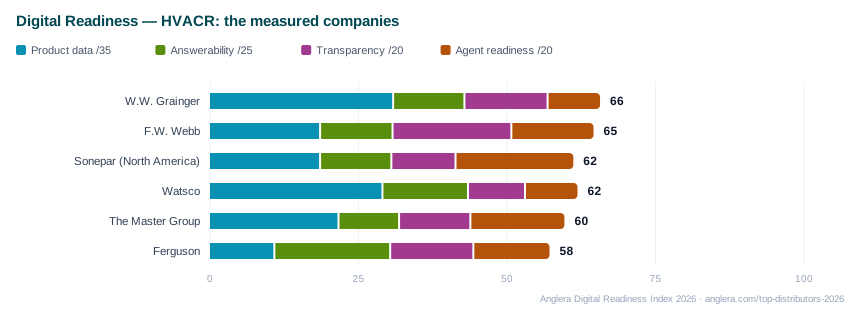
Stacked bars: the four pillars of the Digital Readiness Index — segment lengths are pillar scores, the number is the company's total out of 100.
Full methodology for how these scores are built is at /top-distributors-2026/methodology; the complete cross-vertical index is at /top-distributors-2026.
Generalists at the top, specialists doing the actual work
This vertical is really two businesses wearing one label. Ferguson, Sonepar, and Grainger are scale-aggregators — national buying power and centralized purchasing, with Ferguson layering on a fiscal-year change to calendar-year 2026 plus nine tuck-in acquisitions in FY2025 worth roughly $300M in annualized revenue, including HPS Specialties and Ritchie Environmental Solutions. HVAC/R is a category inside a much larger plumbing, electrical, or MRO catalog for all three. The other seven — Watsco, Winsupply, F.W. Webb, R.E. Michel, The Master Group, Johnstone Supply, and Mingledorff's — are branch-density businesses for whom HVAC/R, or HVAC/R plus plumbing, is the entire business, built branch by branch.
Watsco is the clearest specialist in the group: the archetype rationale calls it the product of "more than 70 acquisitions" since 1989 that made it the largest distributor in a fragmented North American HVAC market, pairing OEM joint ventures like Carrier Enterprise with a deliberate policy of leaving each acquired banner's local identity intact. That roll-up is still running — Watsco closed the acquisition of Jackson Supply Company in Q2 2026, a Sunbelt HVAC distributor with roughly $230 million in annualized sales across 25 locations. The Master Group is doing the same thing from the other side of the border: its June 2026 acquisition of Distributor Corporation of New England, an 8-branch Carrier distributor across Massachusetts, Maine, New Hampshire, and Rhode Island, is its first major push into the US and takes its North American branch count toward 100. Winsupply and R.E. Michel are pursuing the opposite motion — pure organic branch-building, with Winsupply targeting 20 new "Local Company" openings in 2025-2026 and R.E. Michel expanding its Southeast distribution footprint under a strategy it describes as "building, not buying."
Two of the ten are unscored for genuinely different reasons that shouldn't be read as the same finding — a separate two, Johnstone Supply and Mingledorff's, are simply new to this cut and weren't sampled this edition. Winsupply has no single catalog to measure: it operates through 680-plus independently branded local operating companies, each with its own brochureware site, run by branch presidents who hold real local equity — a finding about the business model, not a failing grade. R.E. Michel is the opposite case: remichel.com carries a full 19-category public catalog spanning boilers, HVAC equipment, refrigeration, and valves with no login wall, but the product grid is injected client-side after the page loads, so no individual product page was observable to the measurement. One company has nothing to score; the other has something to score that the measurement couldn't reach.
What the index actually found
Among the six measured companies, the vertical's median Digital Readiness Index is 62, four points above the 58 median across Anglera's full index — a modest but real sign that HVAC/R's core operators treat their digital shelf at least as seriously as the average distributor. The pillar breakdowns are where the real differences show up.
Grainger's 66 rests on a near-maxed product data pillar: 31 of 35 points, with a median of 47 structured attributes per sampled page — the richest catalog in this cut, tied with Watsco. But Grainger's identifier signal is a flat 0% GTIN rate, meaning that attribute depth isn't backed by a universal product code an outside system could match against. Watsco tells the opposite story on the same metric: also a median of 47 attributes, but a 100% GTIN rate on its sampled Carrier Enterprise pages — the only perfect identifier score in the group. Watsco's weakness is elsewhere: a consistency spread of 29, the widest gap between richest and thinnest sampled page of any measured company, and a transparency pillar of just 9.6 out of 20, dragged down by a price rate of only 20%. As a holding company for regional banners like Carrier Enterprise, Baker Distributing, and Gemaire, Watsco's flagship banner can build an excellent page and a thin one under the same corporate roof, and a buyer has no way to know in advance which one they've landed on.
F.W. Webb, the second-smallest revenue company in the measured set at $2.6B, posts the only perfect transparency score in the cut — 20 out of 20 — with public pricing, stock visibility, and no login wall across every sampled category, disproving any assumption that transparency scales with size. Sonepar's agent-readiness pillar hits a perfect 20 out of 20, the only max pillar score in this vertical, built on public product structured data and a working sitemap even though its e-commerce presence is fragmented across 14 independently run regional banners like Capital Electric, Codale, and Irby, sitting behind a corporate site the data describes as brochureware. Its digital sales, per the company's own 2025 reporting, grew 50% to $13.9 billion through its unified Spark platform.
For a buyer trying to spec a part — a condensing unit that must match on tonnage and refrigerant type, a coil that has to fit a specific cabinet depth, a compressor rated for a specific voltage and phase — a median attribute count in the high teens or twenties is the difference between a page that answers "will this work" and one that just shows a picture and a part number. Ferguson's median of 0 structured attributes stands out here: its sampled PDPs are publicly viewable with specs, images, and reviews, so the information exists for a human reader, it just isn't captured as filterable, machine-usable data. Master Group's median of 19 attributes comes with the tightest consistency spread in this vertical, just 5 points — the most even catalog treatment here, ahead of even Sonepar's 8.
Where this is heading
The M&A cadence in this vertical isn't slowing — Watsco's Jackson Supply close, Master Group's cross-border DCNE deal, and Ferguson's nine tuck-ins all landed within the same twelve months — but none of it is matched by comparable investment in how the resulting catalogs present themselves to a machine. Agent readiness is soft across the board: outside Sonepar's 20, no other measured company clears 16, and three explicitly block AI crawlers outright (Grainger, Watsco, and F.W. Webb). None of that silence is a violation; an unaddressed policy scores full marks precisely because nothing is blocked. But an explicit block is a choice, and as branch networks consolidate into fewer, larger banners, the gap between rich human-facing pages and genuinely structured, agent-readable ones looks like where this vertical differentiates next.